
ArianeGroup’s exploration of ballistic‑missile manufacturing in Germany marks a consequential shift in European defense industrial cooperation: it signals a deliberate move to marry Franco‑German industrial know‑how in launcher and propulsion technology with nascent political appetite for a conventional long‑range strike capability, raising strategic, legal and alliance management questions that Brussels, Berlin, and Paris must navigate in the coming decade.
Current developments and strategic rationale
ArianeGroup, the Franco‑German joint venture owned by Airbus and Safran that builds the Ariane 6 launcher and France’s M51 submarine‑launched ballistic missile, is studying options to manufacture ballistic missiles in Germany. The company’s new CEO, Christophe Bruneau, framed the initiative as an extension of Franco‑German cooperation in areas of shared interest, and said ArianeGroup has begun discussions with political and military authorities in both countries. Paris has already allocated roughly €1 billion to start development of a land‑based conventional ballistic missile with a published range target of around 2,500 km and an aspirational deployment window between 2030 and 2035. ArianeGroup’s dual civil‑military portfolio—space launch capability set to ramp up with Ariane 6 availability in 2028 and proven ballistic propulsion expertise from the M51 program—offers technical synergies that could accelerate a European deep‑strike option while distributing industrial work across partner states.
Franco‑German cooperation and the historical evolution of European strike capabilities
Post‑war European defense cooperation has oscillated between integration and national autonomy; France has preserved sovereign strategic capabilities (including nuclear deterrence and submarine‑launched missiles), while Germany has historically been restrained about host‑nation production of long‑range offensive strike systems. Nevertheless, the Franco‑German axis has driven many of Europe’s major defense programs, even as recent collaborations—such as projects for a next‑generation fighter and main battle tank—have experienced setbacks. ArianeGroup itself embodies this industrial convergence, merging launch and propulsion expertise that emerged from separate national programs into a binational corporate structure. The present proposal follows a broader post‑2014 and post‑2022 pattern in which European states reassess force posture and industrial resilience, seeking deeper integration to field capabilities that were traditionally the preserve of larger powers.
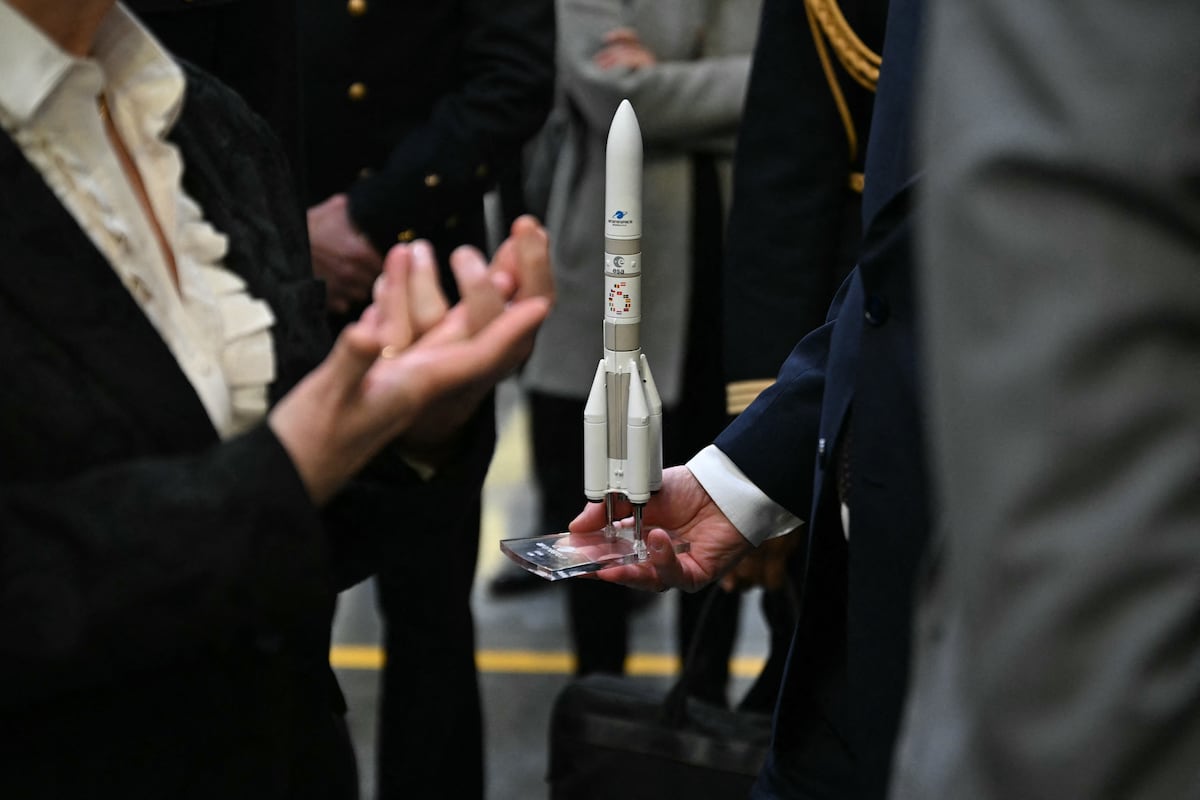
Caption: ArianeGroup executive displays a rocket model during a visit to the Ariane 6 assembly area, underscoring the company’s civil‑military portfolio | Credits: Martin Lelievre / AFP via Getty Images
Implications for European security, industry, and arms control
The proposal carries multilayered geopolitical implications. Strategically, an industrial partnership that produces conventional ballistic missiles in Germany would enhance Europe’s ability to conduct deep‑strike operations independently of non‑European systems, improving deterrence and operational options against high‑value targets at range. Industrially, the move could strengthen the Franco‑German defense core, secure supply chains, and economize development by leveraging ArianeGroup’s propulsion and systems engineering competencies alongside German manufacturing capacity.
Politically and legally, the initiative will test domestic sensibilities in Germany, where public opinion, parliamentary prerogatives, and restrictive export norms have historically limited offensive strike capabilities and weapon exports. Berlin will face pressure to reconcile alliance commitments, constitutional constraints, and domestic politics before consenting to host production of large‑range conventional missiles. Paris, while already moving to fund a national program, must navigate how bilateral production fits with French sovereignty over certain strategic technologies and with broader NATO burden‑sharing.
On arms control and regional stability, Europe’s deployment of long‑range conventional ballistic strike assets risks negative reactions from Russia and could complicate arms‑control dialogues; it also raises proliferation concerns about the diffusion of long‑range missile technology within and beyond Europe. Transparency measures, strict export controls, and clear operational doctrines distinguishing conventional roles from nuclear missions will be essential to mitigate escalation dynamics.
Operationally and programmatically, success depends on overcoming technical integration challenges, securing political mandates in partner states, and aligning development timelines—France’s 2030–2035 ambition sets a challenging cadence. For NATO cohesion, early and candid engagement with allies will be necessary to ensure interoperability, avoid redundant capability development, and maintain a unified deterrence posture.
Recommendations for policymakers include: formalizing a binational industrial and governance framework that preserves necessary national safeguards; launching a public communications strategy in Germany to explain mission, safeguards, and export rules; coordinating capability concepts with NATO and major EU partners to prevent fragmentation; and embedding arms‑control‑compatible transparency and verification measures into any production or deployment pathway. If handled with deliberate political and technical safeguards, ArianeGroup’s proposal could become a catalyst for deeper European strategic autonomy; mishandled, it risks domestic backlash, alliance friction, and regional escalation.