
Boeing's successful demonstration of an autonomously landed CH-47 Chinook marks a pivotal step in the U.S. Army's shift toward pilot-optional rotorcraft and represents a practical inflection point for how heavy-lift aviation will operate in high-demand, contested theaters; the test validates Approach-to-X (A2X) guidance in a large transport helicopter and raises immediate operational, industrial and strategic questions about resilience, command and control, and international competition.
Autonomous Landing Demonstration: Key Facts and Immediate Assessment
The test involved a CH-47F Chinook using Boeing’s Approach-to-X (A2X) software to conduct final approach and landing without a pilot actively manipulating the controls. A2X accepts mission parameters set by aircrew—landing zone coordinates, final altitude, approach angle and start speed—and then executes the approach while allowing pilots to intervene or modify inputs in flight. Boeing reports the software has completed more than 150 approaches ranging from a 100-foot hover down to touchdown, with an average final-position error under five feet. The stated objective is to reduce pilot workload during high-demand phases and increase situational awareness by shifting some sensor and flight-management tasks to automated control laws and interfaces tuned to "how pilots naturally fly."
Operationally, this demonstration is part of a bundled modernization trajectory that includes the H-60Mx pilot-optional Black Hawk and the Army’s future MV-75 "Cheyenne II" tilt-rotor program. Boeing intends to refine A2X before Army release; no firm fielding timeline was provided. From an analyst perspective, the test validates a mature automation capability for heavy rotorcraft, but it remains an incremental step—supervised autonomy with human setpoints and override authority—rather than fully independent unmanned operations.
Technological and Operational Lineage: From Autopilots to Pilot-Optional Rotorcraft
Autonomous landing of a heavy-lift helicopter is the logical extension of decades-long trends: mechanical and electronic autopilots evolved into tightly integrated flight-management systems, then into remotely piloted and increasingly autonomous unmanned aerial systems. Large utility and transport helicopters like the Chinook have been continually upgraded since their introduction in the 1960s; their longevity stems from modular airframes, high payload capacity and adaptability to a wide range of missions from logistics to special operations. Recent policy and procurement moves—such as delivery of pilot-optional H-60Mx Black Hawks and experimental unmanned teaming—reflect an Army decision to embed autonomy at multiple echelons.
Historically, the Chinook has been used for both conventional and special missions, including high-profile raids and cross-border operations, illustrating its relevance to modern expeditionary tactics. The current demonstration fits into this lineage by attempting to preserve that utility while reducing pilot cognitive load, increasing sortie rates and enabling new operating concepts (e.g., distributed logistics nodes, ship-to-shore heavy lift in contested littorals, or long-range resupply in the Indo-Pacific).
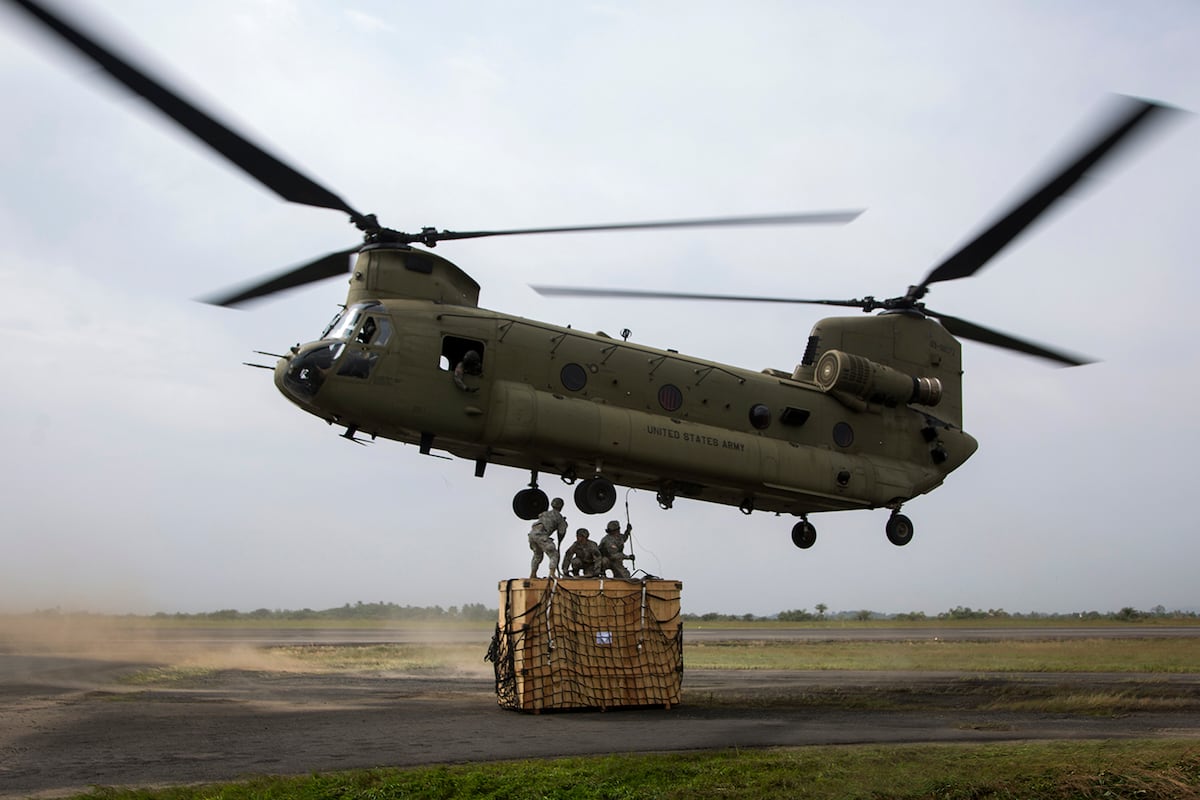
Caption: Boeing’s A2X-guided CH-47 Chinook demonstrating an autonomous approach and landing | Credits: Sgt. 1st Class Brien Vorhees/U.S. Army
Strategic Consequences: Risks, Advantages and Global Responses
Strategically, autonomy in heavy-lift aviation produces a suite of operational advantages and accompanying risks. On the advantages side, pilot-optional systems can expand endurance and sortie-generation capacity, reduce crew exposure, and permit reallocation of human attention to mission tasks like ISR management, threat assessment, and coordination with unmanned assets. In logistics-starved campaigns or dispersed basing schemes—particularly in the Indo-Pacific where distances are vast and bases are widely distributed—autonomously assisted approaches can improve sustainment through faster turnaround and reduced crew fatigue.
However, the shift increases vulnerability vectors. Autonomous flight control depends on sensors, software integrity and robust communications for planning and oversight; that dependency creates new attack surfaces for cyber intrusions, data spoofing, jamming and electronic attack. In contested environments where adversaries employ sophisticated electronic warfare, the effectiveness of A2X-like systems will hinge on resilient navigation (e.g., inertial/GNSS fusion), degraded-mode behavior, and hardening against compromise. Tactical doctrine must therefore balance automation benefits with conservative human-in-the-loop safeguards and verified fail-safe behaviors.
Geopolitically, the demonstration will accelerate interest and investment in autonomy across state and non-state actors. Major powers such as China and Russia already prioritize unmanned and autonomous systems; a visible U.S. Army milestone will spur parallel programs, indigenous adaptation, and potential export pressures. This dynamic risks an arms-race effect for autonomy, sensor fusion and electronic-resilience capabilities. Allies and partners will face interoperability and policy choices: whether to adopt compatible systems, harmonize doctrine, and coordinate export controls and norms to manage escalation and unintended incidents.
There are implications for force posture and escalation calculus as well. Reduced crew requirements could make expeditionary lift more politically and logistically palatable, enabling more persistent presence and faster surge. At the same time, more autonomous platforms may lower the threshold for risk-tolerant operations, complicating signaling and crisis stability. To mitigate destabilizing trends, defense planners should pair technological adoption with: rigorous cybersecurity accreditation, clear rules-of-engagement and human-override policies, robust training on degraded-mode operations, and international dialogue on standards and responsible use.
Finally, industrial and sustainment considerations will shape long-term impact. Boeing and the defense industrial base stand to gain from retrofit markets and new production lines, but procurement must fund not only software development but sensor suites, hardened avionics, and logistics for fleet-wide upgrades. Close coordination between services, manufacturers and allied procurement agencies will determine whether autonomous heavy-lift becomes a decisive operational multiplier or an incremental capability constrained by contested-environment vulnerabilities.