
China’s armed forces are methodically integrating artificial intelligence into select platforms and missions rather than pursuing an across-the-board technological leap; the approach prioritizes discrete operational advantages—such as improved shipboard air defence sensors, drone-swarm coordination, and space/cyber automation—while navigating limits in data, advanced semiconductors, and a centralized command culture that complicates rapid, decentralized AI-enabled decision-making.
Current Dynamics: China's Focused AI Push in the PLA
Beijing is allocating AI where it can yield asymmetric, near-term effects. Recent public releases highlight upgrades such as an AI algorithm installed aboard a guided-missile frigate to reduce air-defense blind spots and demonstrations showing a single operator supervising scores or hundreds of autonomous drones. These examples reflect a pragmatic calculus: target systems where AI can multiply existing strengths (swarm coordination, sensor fusion, and autonomy for maritime and undersea platforms) rather than attempt immediate parity with U.S. capabilities across the board.
Constraints are material and institutional. China faces hardware bottlenecks because export controls restrict access to the most advanced semiconductors, and it lacks the density of military operational data the U.S. has accumulated through decades of expeditionary missions. Politically, the leadership’s concern about information flows—both datasets that might politically embarrass the Party and outputs that are hard to control—produces an official posture of caution. At the same time, the PLA is leveraging China’s industrial base and civil-military integration to develop tailored AI tools for space operations, cyber campaigns, and increasingly autonomous naval and underwater platforms.
Evolution of 'Intelligentized' Warfare and Modernization Milestones
China’s pursuit of “intelligentized” warfare has been explicit in defense planning documents since 2019 and is manifest in gradual, demonstrable steps rather than a sudden technological revolution. The PLA’s modernization trajectory over recent decades—shifting from manpower-heavy force structures to technologically sophisticated units—set the institutional groundwork for selective AI adoption. This modernization includes investments in unmanned surface and underwater systems, experimental drone carriers, and shipborne sensor and decision-support upgrades.
However, historical patterns matter. The U.S. military’s long operational tempo and expeditionary engagements have generated rich, labeled datasets and battle-tested doctrines that favor rapid AI maturation, advantages China currently cannot fully replicate. Moreover, the PLA’s historically centralized command culture creates doctrinal friction: effective AI-augmented operations typically require decentralized decision-making at tempo, which conflicts with practices designed to preserve strict political and command control.
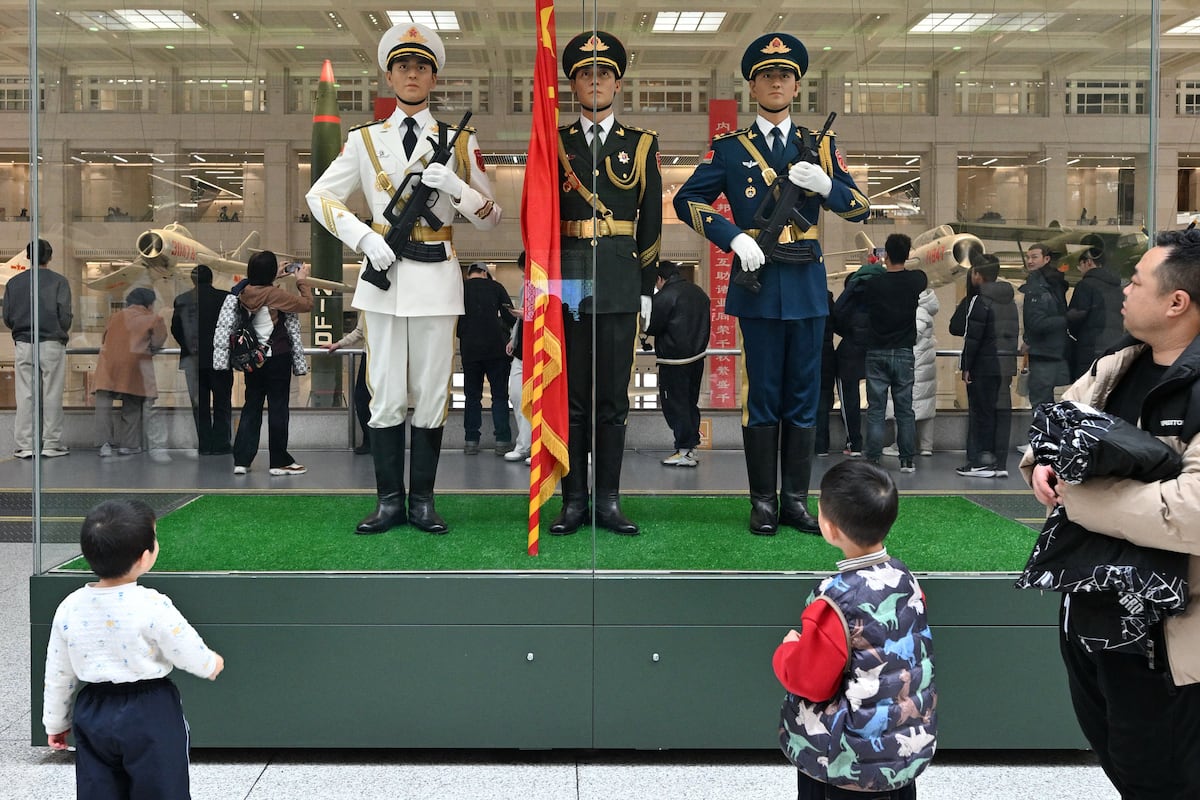
Caption: Chinese naval display underscoring recent PLA steps to integrate AI into shipborne air-defence and broader maritime systems | Credits: Adek Berry/AFP via Getty Images
Geopolitical Consequences and Strategic Risks
At the operational level, selective AI advances can compress decision cycles and increase the tempo of engagements in contested spaces such as the South China Sea and Taiwan Strait. Faster observe-orient-decide-act loops raise the prospect of miscalculation: automated or semi-automated systems acting on incomplete information could accelerate crises before political leaders fully grasp events. In incentive terms, systems that appear to provide local advantage—drone swarms or AI-assisted target planning—will be prioritized for deployment, increasing localized risk even absent overall technological parity with the United States.
Strategically, China’s targeted AI investments will intensify regional competition and accelerate allied responses. U.S. partners and Taiwan will likely bolster counter-AI capabilities, defensive systems for maritime and air domains, and supply-chain resilience for critical semiconductors. At the same time, export controls and allied cooperation on sensitive technologies will become more central to deterrence strategies. Finally, Chinese emphasis on autonomy in space and cyber domains complicates crisis stability: degraded satellites or automated cyber campaigns can produce cascading effects across civilian and military infrastructure.
For policymakers and analysts, the immediate priorities are monitoring indicators of operationalization (large-scale fielding, doctrine changes that decentralize decision authority, and new training regimes), securing and diversifying AI-relevant supply chains, and advancing diplomatic efforts to establish norms and guardrails for the use of autonomous lethal systems. The PLA’s selective, cautious approach reduces the likelihood of an abrupt capability leap, but its targeted deployments—if combined with advances in navigation, sensing, and secure compute—will reshape regional military balances and crisis dynamics over the coming decade.