
Cheap consumer electronics have again exposed a strategic vulnerability: a regional Dutch broadcaster successfully tracked the Royal Netherlands Navy frigate HNLMS Evertsen in real time after sending a low-cost Bluetooth tracker through military mail, revealing weaknesses in mail screening, personnel practices, and the intersection of consumer technology with naval operational security during a multinational carrier strike group deployment.
Incident summary and immediate operational findings
The incident involved a small Bluetooth locator concealed in postal material sent via the military postal system to a sailor aboard HNLMS Evertsen, part of a French-led carrier strike group operating in the eastern Mediterranean. The device transmitted location data that the broadcaster used to map the ship’s movements through port and into open water for roughly 24 hours before the device went offline near Cyprus. The tracker itself was later discovered onboard during routine mail sorting after the ship sailed.
Dutch defence authorities have characterised the episode as a procedural lapse rather than an operational defeat: measures were promptly adjusted (including a ban on greeting cards with batteries), a review of mail guidelines launched, and parliament was informed. The ministry maintains that there was no actionable operational risk in this specific case. Still, the event occurred amid a recent pattern in which consumer devices and app telemetry have divulged sensitive military movements (most notably the Strava-derived geolocation of elements of a French carrier), underscoring how low-cost, widely available technologies can generate disproportionate security exposure.
Historical precedents and the technological trend line
The Evertsen episode is best understood as part of an accelerating historical trend: since the 2010s, commercial satellite imagery, social-media metadata, fitness-app telemetry, and ubiquitous Internet-of-Things (IoT) devices have increasingly enabled open-source intelligence (OSINT) that can reveal military dispositions. Past examples include the Strava heatmap disclosures that highlighted troop bases and movements, social-media geotags that compromised unit locations, and documented cases of Bluetooth/GPS tags being used to track vehicles and assets. Navies historically relied on emission control (EMCON), mail security, and strict restrictions on personal electronics to mitigate exposure; the ubiquity of tiny battery-powered trackers and wearable sensors now challenges those traditional mitigations.
Technological diffusion has outpaced doctrine: consumer-grade beacons, commercial tracking services, and global logistics visibility create multiple, low-cost vectors for geolocation that were not envisaged when many maritime security protocols were designed. The result is a shift in the threat environment from sophisticated, resource-intensive spying to mass-enabled, opportunistic reconnaissance that can be executed by non-state actors, journalists, or adversaries with limited means.
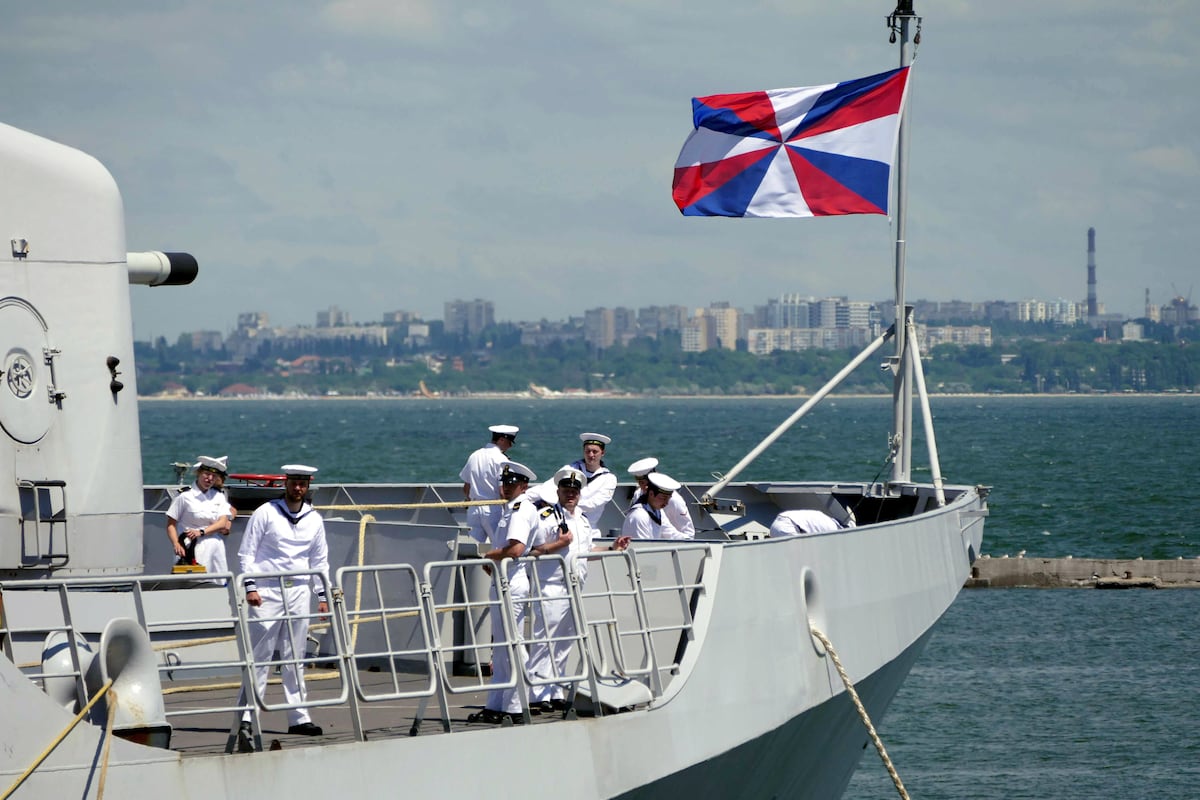
Caption: Crew of the frigate HNLMS Evertsen on deck during a prior port visit, illustrating the type of vessel involved in the tracking incident | Credits: Yulii Zozulia/ Ukrinform/Future Publishing via Getty Images
Geopolitical and practical implications for navies, alliance policy, and public oversight
Strategically, the episode presents three interconnected challenges: operational vulnerability, alliance-wide doctrinal gaps, and a democratic tension between transparency and security. Operationally, inexpensive consumer trackers and pervasive app telemetry lower the threshold for adversaries or malicious actors to collect near-real-time maritime location data. For NATO and European navies this demands rapid updates to mail screening, force protection procedures, and onboard countermeasures (for example, systematic inspection protocols, detection capability for Bluetooth/LE beacons, and stricter controls on battery-equipped items).
At the alliance level, the repeatability of such disclosures—across different national forces and media actors—argues for common standards: unified guidance on personal electronic devices, harmonised procedures for military mail and port visits, and shared best practices for training personnel on OPSEC in the era of wearable and tiny-tracking technologies. There is also a legal and political dimension: open societies must balance press freedoms and public interest reporting against tangible risks to deployed forces; that balance will require transparent oversight mechanisms and clear public communication when vulnerabilities are found and remedied.
Finally, the wider geopolitical risk is not merely embarrassment. In a high-intensity confrontation, adversaries could weaponise these low-cost vectors to degrade force survivability or cue more lethal targeting systems. Preventive measures should therefore combine procedural fixes (mail policy, port-visit protocols, education), technical solutions (BLE-signal detection, hardened communications, emission-control discipline), and policy work (regulating commercial platforms’ handling of location data, establishing norms for media reporting around deployed assets). Coordinated, alliance-level responses will reduce strategic risk while preserving legitimate oversight and journalistic functions.