
Estonia’s decision to pause a €500 million infantry fighting-vehicle purchase and reallocate that funding toward drones, counter‑drone systems and layered air defenses marks a deliberate tactical shift: preserve and modernize existing CV90 hulls while prioritizing capabilities seen as decisive in Ukraine — unmanned systems and integrated air defense — to strengthen deterrence along the eastern flank.
Estonia’s Budget Rebalancing: Immediate Situation
Tallinn announced a suspension of a planned acquisition of new infantry fighting vehicles and will instead extend the service life of its current CV90 fleet by at least ten years through upgrades to electronics, weapon and targeting suites. The move, presented by Defense Minister Hanno Pevkur as a lesson from Russia’s invasion of Ukraine, redirects capital toward combat and counter‑UAS drones and additional air‑defense capabilities. Estonia obtained 44 used CV90s from the Netherlands in 2019 and later rebuilt another set of hulls sourced for support roles; the current plan emphasizes modernization of those platforms rather than procurement of entirely new IFVs.
Politically and fiscally, the decision is enabled by Estonia’s unusually high defense burden — spending above 5% of GDP — which provides room to rebalance. Domestic procurement authorities (ECDI) and lawmakers framed the change as a rational reallocation that preserves armored capability while responding to contemporary battlefield dynamics. At the same time, Latvia and Lithuania continue with new IFV buys, creating a regional mix of approaches rather than uniform procurement.
Historical Drivers: Strategic Memory and Technological Lessons
Estonia’s force posture has been shaped by longer historical imperatives: the legacy of Soviet occupation, post‑Cold War vulnerability, and renewed urgency after Russia’s 2014 and 2022 campaigns. Those events accelerated Baltic investments in deterrence and drove NATO’s focus on forward presence and rapid reinforcement. The recent operational picture from Ukraine — widespread use of loitering munitions, swarms of tactical drones, and the decisive role of air‑defense networks — has recalibrated threat assessments in Tallinn, prompting emphasis on systems that blunt aerial and unmanned threats and protect mobilization and logistics nodes.
Concurrently, Estonia has cultivated a nascent defense‑industrial base centered on unmanned technologies and is pursuing domestic ammunition production (155mm) to reduce supply vulnerabilities. The choice to modernize existing armored platforms rather than buy new ones reflects both a cost‑effective short‑term logic and the influence of battlefield lessons that prioritize survivability through sensors, active protection and integrated air defenses as much as platform mobility and armor weight.
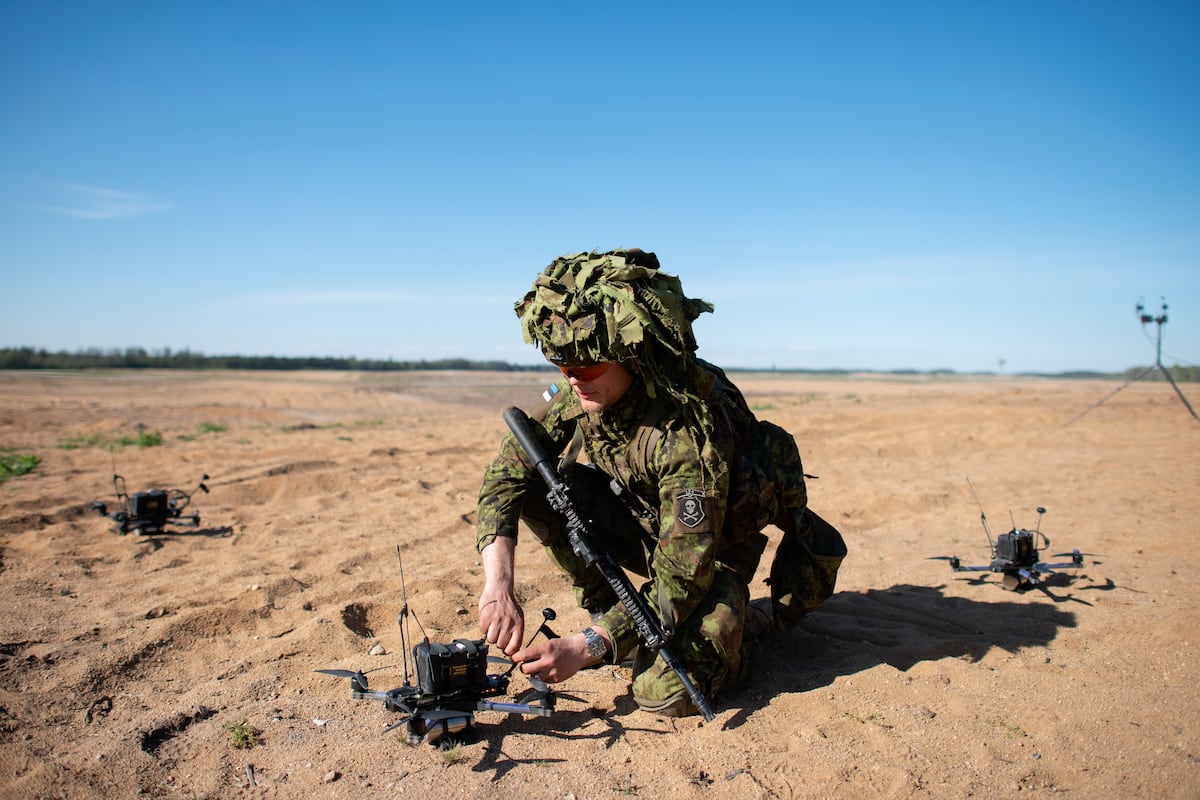
Caption: Estonian soldier prepares a tactical drone during Exercise Hedgehog 25, underscoring Tallinn’s increasing focus on unmanned and air-defense capabilities | Credits: Peter Kollanyi/Bloomberg via Getty Images
Regional and NATO Implications
The shift has several geopolitical and operational implications. Strategically, investing in drones, counter‑drone measures and air defenses strengthens Estonia’s ability to contest the early phase of any aggression, protect rear areas and critical infrastructure, and complicate adversary air operations — all attributes that enhance collective NATO deterrence in the Baltic theater. Modernizing CV90s preserves a mechanized backbone for territorial defense without the long lead times and industrial commitments of new platform buys.
However, the decision creates a differentiated capability landscape across the Baltics: Latvia and Lithuania are procuring new IFVs while Estonia focuses on upgrades and soft‑kill/active defenses. That divergence can be complementary if coordinated — for example, pooling heavy platforms, standardizing key subsystems, and aligning logistics and training — but it also risks interoperability frictions unless NATO and Baltic defense ministries synchronize doctrine and procurement timelines.
There are risks and trade‑offs. Extending older platforms delays full transition to next‑generation armor and may increase long‑term sustainment costs; modernization must include active protection systems, sensor and networking upgrades, and integration into NATO C2 and air‑defense architectures to be operationally meaningful. The reallocation also signals a pragmatic, threat‑driven approach to defense spending that prioritizes survivability and force‑multiplying technologies over platform replacement — a posture likely to be read in Moscow as adaptation rather than escalation.
Recommendations for Tallinn and allies include accelerating joint Baltic procurement and interoperability initiatives, ensuring upgraded IFVs are tightly integrated with new air‑defense and counter‑UAS layers, expanding domestic and regional munitions production to underpin protracted defense, and maintaining transparency with NATO partners to align capability mixes and avoid capability gaps along the eastern flank. Done well, Estonia’s move can increase regional resilience and provide a model for small‑state adaptation in high‑intensity, networked warfare environments.