
France’s defense leadership is preparing a pragmatic course correction: with the French‑German Main Ground Combat System (MGCS) project slipping into the early 2040s and the Leclerc fleet approaching the end of its service life, Paris is exploring an interim main battle tank that preserves national sovereignty over lethality while embedding the connectivity and modularity envisaged for MGCS—part of a wider defense reorientation backed by a €36 billion top‑up to the 2026–2030 budget.
Immediate Situation: Bridging the Leclerc–MGCS Gap
Faced with a likely capability shortfall between the Leclerc’s projected retirement horizon (around 2038) and a delayed MGCS entry into service, France is engaging manufacturers on a stopgap tank that would not merely extend an older generation but serve as a first building block toward MGCS. Paris emphasizes that the interim design should prioritize digital networking, system‑of‑systems integration and French control of the turret and its lethality. Operationally, that means exploring a cross‑border platform arrangement—reportedly a chassis from KNDS Germany matched with a French turret—while national authorities (the Directorate General for Armament) negotiate industrial terms, sovereign control and technical specifications. The move is embedded in a broader defence update that adds roughly €36 billion to the 2026–2030 envelope and includes accelerated air‑defence purchases, a maintained commitment to 225 Rafales by 2035 (with a focus on the future F5 standard), and a stepped‑up investment in combat drones and long‑range strike effects.
Historical Context: Franco‑German Industrial Cooperation and Programmatic Strains
Franco‑German cooperation in land systems and aviation has deep roots—built on interdependence of European defence industries and shared aims for strategic autonomy—but it has also repeatedly encountered friction over national industrial champions, program leadership and workshare. The MGCS initiative itself grew out of decades of efforts to reconcile divergent national tank philosophies: German emphasis on standardised, exportable chassis families and French priorities for autonomy in lethal systems and turret‑level sovereignty. KNDS, the Franco‑German vehicle group formed from Nexter and KMW, embodies both the promise and tensions of such partnerships. Contemporary parallels are evident in the Future Combat Air System (FCAS), where disagreements between Dassault and Airbus over leadership, workshare and intellectual property have disrupted development timelines. Those recurrent tensions—between national industrial policy and cross‑border project logic—help explain why France insists on a French turret and why interim solutions that can be integrated into a later pan‑European architecture are politically and technically attractive.
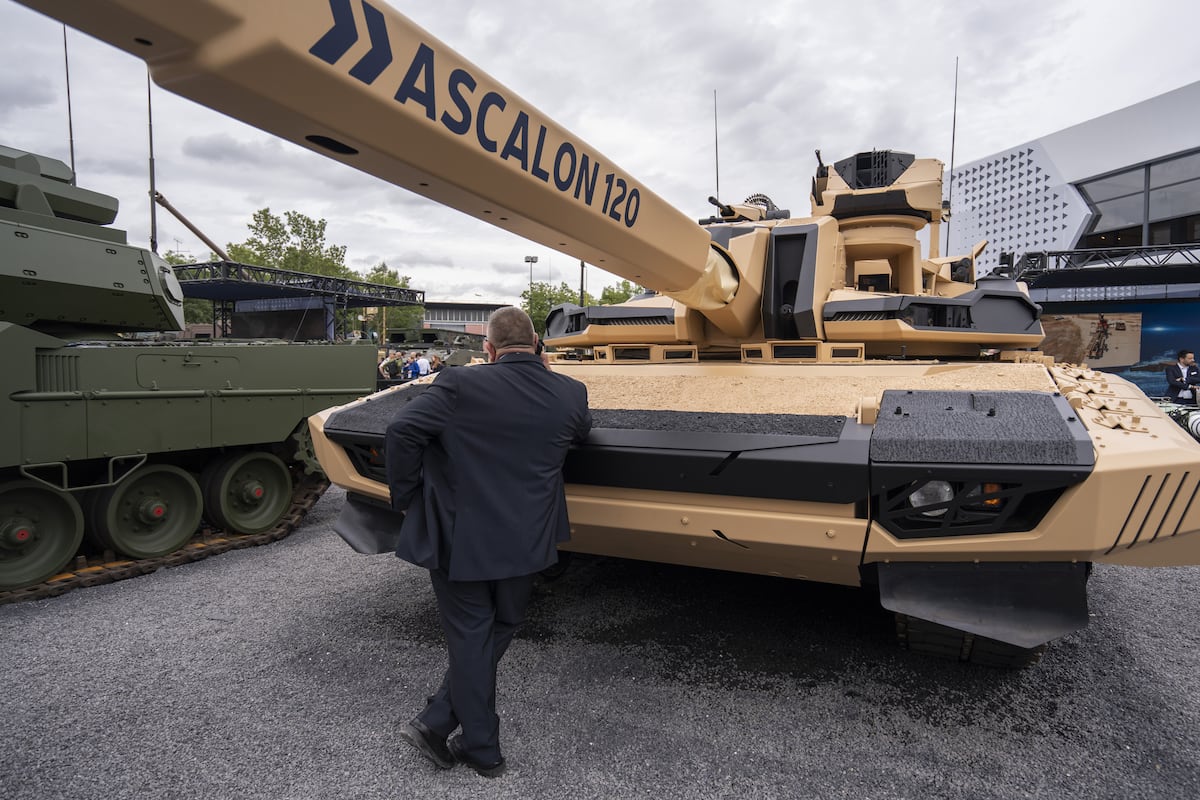
Caption: An Ascalon 120 cannon on display highlights turret and lethality innovations at European defence exhibitions | Credits: Nathan Laine/Bloomberg via Getty Images
Geopolitical Impact: Autonomy, Alliance Dynamics and Industrial Signalling
The French decision to pursue an interim tank with an explicitly French turret is geopolitically consequential on several levels. First, it signals Paris’s determination to protect national control over key lethal technologies even while engaging in European industrial cooperation—an important reassurance to domestic political constituencies and to export customers seeking French sovereign guarantees. Second, the development underscores an emerging policy divergence with Germany: Berlin’s separate Leopard 3 initiative and France’s interim approach could produce platform heterogeneity on NATO’s eastern flank at a time when collective deterrence requirements are rising. That heterogeneity raises short‑term operational challenges (logistics, training, common doctrine) but also creates strategic redundancy, which can be advantageous if supply chains or production become constrained.
Third, the French budget uplift and procurement reprioritisations—more SAMP/T NG systems, greater investment in long‑range strike and a large purchase of combat drones—reflect a broader rebalancing toward layered air defence, stand‑off capabilities and unmanned effects. Taken together, these moves strengthen France’s role as a European security provider and as an independent capability hub, but they also amplify industrial competition within Europe (e.g., Airbus v. Dassault in FCAS, domestic rocket‑artillery efforts) that Brussels and Paris will need to manage to avoid duplicative spending and fragmented supply chains.
Finally, the interim‑tank approach embodies a pragmatic risk management posture: by prioritising a modular, networked platform that can evolve into MGCS, France seeks to close an operational gap without conceding future design leadership. For allied planners, the choice will require transparent arrangements on interoperability, export policy and joint sustainment to ensure that short‑term fixes reinforce, rather than undermine, long‑term European defense integration and NATO readiness.