
France’s Orion 26 exercise has put a newly configured, highly mobile corps-level command to the test, demonstrating an operational pivot from static headquarters toward dispersed, armored command nodes designed to operate close to high-intensity combat. The experiment combines rapid physical mobility, layered communications, electronic warfare and deception measures, and a nascent AI-enabled data layer to shorten the decision cycle and project France as a capable framework nation within NATO—even as it highlights enduring shortfalls in long-range fires and logistics for independent European deterrence.
Orion 26: Fielding a Mobile Corps Command in Practice
Over a concentrated drill near Poitiers, the French 1st Army Corps deployed a three-node command architecture: a forward, armored “CP1” that can move within roughly 80–100 km of the fight; an intermediate rear node for host‑nation and sustainment support; and a main, data-centric headquarters in Lille. CP1 is lean—roughly 50 personnel operating from six APCs packed with communications and computing equipment—and is designed to be established under camouflage quickly (20 minutes for basic setup, up to two hours with defensive measures).
The exercise simulated corps command over multinational divisional headquarters from France, Poland, the U.K., Italy and Spain, putting emphasis on real‑time C2 (command and control) with satellite, radio and mobile networking to maintain connectivity between nodes. Survivability measures—armored mobility, anti‑drone systems, electronic‑warfare assets and decoy emissions—were integrated deliberately to blunt adversary targeting of command nodes. Organizers also tested deception techniques and digital hygiene to complicate enemy sensor-to-shooter timelines.
Operational lessons surfaced quickly: deployed signals can betray locations to persistent sensors and small drones, necessitating emissions control and decoy deployment; fielding tactical IT suites into armored vehicles requires platform integration and sustainment planning; and while sovereign communications and distributed data processing are improving, national shortfalls in heavy fires (rocket artillery and numbers of howitzers) remain a material constraint on an autonomously deployed corps’ combat power.
From Cold War Corps to Distributed Command: Historical Drivers
The shift embodied by Orion 26 has deep antecedents. Cold War-era corps concepts presupposed massed formations and fixed rear headquarters; by contrast, France’s recent experimentation is an admission that modern high‑intensity conflict, influenced by lessons from World War II maneuver warfare, the Gulf Wars and the Russo‑Ukrainian war, favors mobility, dispersion and rapid decision cycles. Counterinsurgency campaigns of the 2000s promoted static basing and large, city‑like installations—models that proved ill suited to contested, high‑end operations where proximity to the front and survivable C2 are decisive.
The Russian invasion of Ukraine was a formative influence: both the vulnerability of rear C2 to long‑range fires and the operational importance of commanders being close enough to comprehend rapidly changing tactical realities have driven NATO planners to reconsider command posture. France formalized this reorientation quickly—moving from the Rapid Reaction Corps‑France designation back to the 1st Army Corps and reorganizing its command architecture in under 18 months—targeting a combat‑ready division by 2027 and a deployable corps by 2030.
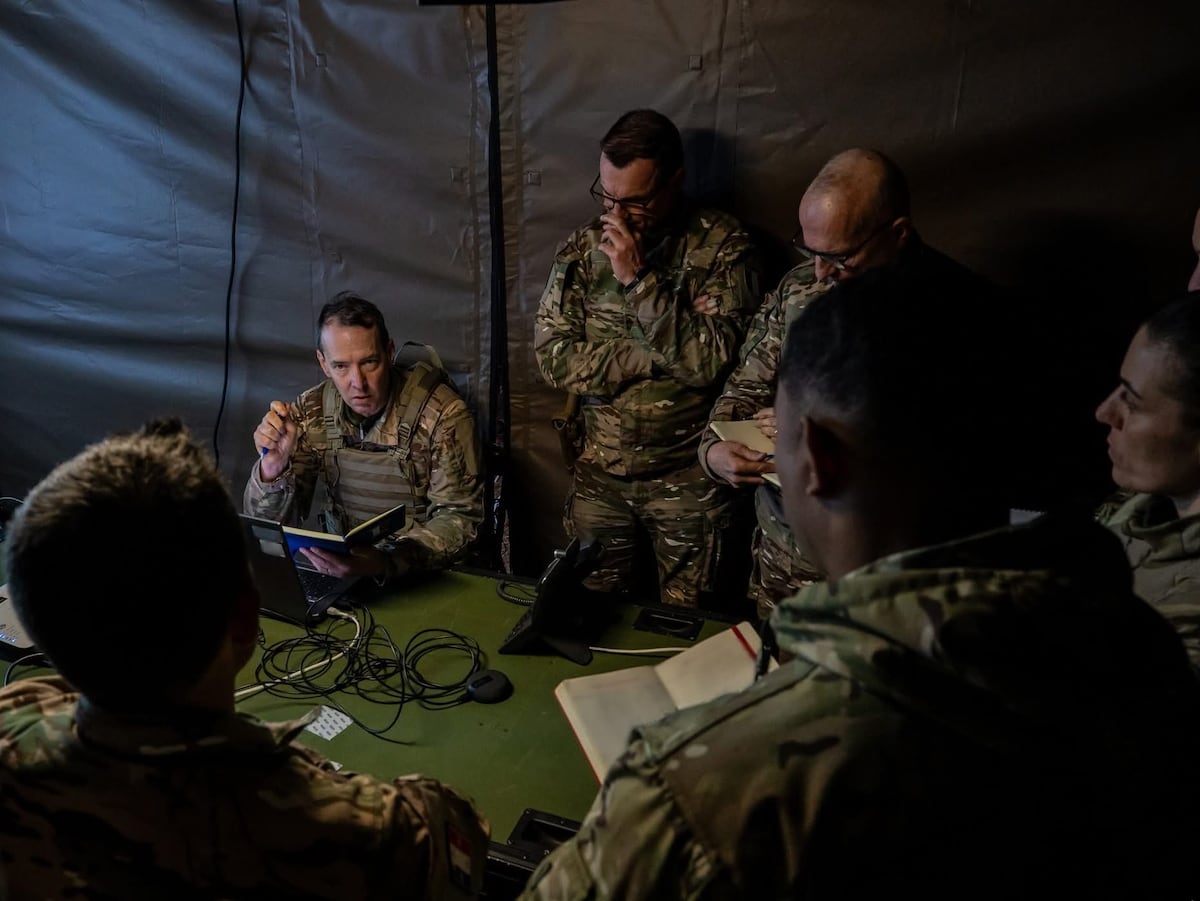
Caption: French 1st Army Corps operates a mobile forward command post during Orion 26, demonstrating armored C2 mobility and survivability | Credits: État-major des armées
Strategic and Geopolitical Consequences for NATO and European Defense
France’s effort has several cascading geopolitical implications. First, it strengthens Paris’s credibility as a framework nation able to lead a multinational corps in high‑intensity conflict—an important political signal to allies and adversaries that Europe is investing in autonomous operational capabilities rather than relying solely on U.S. force projection. That signaling supports NATO’s burden‑sharing narrative and the Alliance’s push for greater European responsibility for collective defense.
Second, the experiment exposes the operational limits of European autonomy. While sovereign communications and mobile C2 reduce dependence on U.S. facilities, the admitted shortfall in long‑range fires and heavy artillery underscores a persistent capability gap. Without significant investment in deep fires, munitions stockpiles and sustainment, a European‑led corps could face disproportionate attrition against near‑peer adversaries even if its C2 is resilient.
Third, the integration challenge demonstrated in Orion 26—running parallel national and NATO command chains—illustrates an underappreciated friction point: political control and national sovereignty frequently complicate real‑time interoperability. Technically feasible links do not instantly translate into unified command in crisis; doctrine, legal authorities and pre‑agreed rules of engagement must adapt alongside equipment and network architecture.
Finally, the exercise foreshadows an operational ecosystem where EM signature management, deception, electronic warfare and AI‑enabled processing are central. Adversaries with advanced ISR and long‑range strike will prioritize targeting C2; thus, the ability to move, mask emissions, present decoys and process data at the edge becomes as important as traditional force size. France’s investment may catalyze similar reforms across NATO, accelerating procurement of hardened, mobile C2 platforms, tactical EW, anti‑UAS systems and AI tools—but it will also intensify the arms and counter‑measures competition in Europe’s security environment.
Policy implications: NATO and European capitals should accelerate synchronized investments in precision fires, munitions production, mobile logistics and resilient communications; institutionalize joint doctrine for distributed C2 and emissions control; and expand multinational exercises to stress interoperability under contested‑electromagnetic and degraded‑satcom conditions. These steps will determine whether mobile corps concepts translate into credible deterrence or remain doctrinal experiments with limited operational effect.