Germany has moved from informal battlefield feedback to a formalized, institutional arrangement that grants its defense industry direct access to combat performance data from weapons deployed by Ukraine, bundled into a wider €4 billion security package. The agreement — covering key systems such as the PzH 2000, RCH 155 and IRIS‑T, and access to Ukraine’s DELTA battlefield management data — accelerates German weapons development while reshaping political, industrial and security dynamics across Europe and the NATO alliance.
Germany's New Battlefield Data Agreement: A Strategic Summary
The centerpiece of Berlin’s decision is a memorandum that channels front‑line performance metrics and digital system outputs from Ukrainian forces to German defense firms. In practice this grants manufacturers empirical operational feedback on munition wear, firing rates, sensor performance and air‑defense kill chains — insights that previously arrived only sporadically through informal routes. The package also ties direct procurement and co‑production commitments to Ukraine’s long‑term battlefield needs, including financing for Patriot interceptors, a further order of IRIS‑T launchers, €300 million for long‑range strike capability and plans to jointly build 5,000 AI‑enabled mid‑range strike drones under a “Build with Ukraine” rubric.
For Germany, the arrangement is transactional but framed as mutually reinforcing: Kyiv gains continued and expanded material support and production partnerships; German industry receives real‑world validation and a rapid feedback loop to refine next‑generation systems; the German state gains a leading role in shaping European battlefield systems architecture. For Ukraine, access to upgraded systems and munitions — plus integration into development programs — strengthens near‑term combat power and longer‑term domestic industrial capacity.
From Field Lessons to Formal Policy: Historical Context
Iterative weapons improvement based on combat experience has long been a military constant: artillery, armor and air‑defense concepts historically evolved from front‑line exigencies from World War I through recent conflicts. What is new in the German‑Ukrainian arrangement is the industrialized, cross‑border and digitally enabled scale of that learning loop. Where previously battlefield feedback was channeled through militaries and ad hoc operator reports, Germany’s memorandum institutionalizes streaming access to battlefield management systems and datasets explicitly for industrial R&D and AI model development.
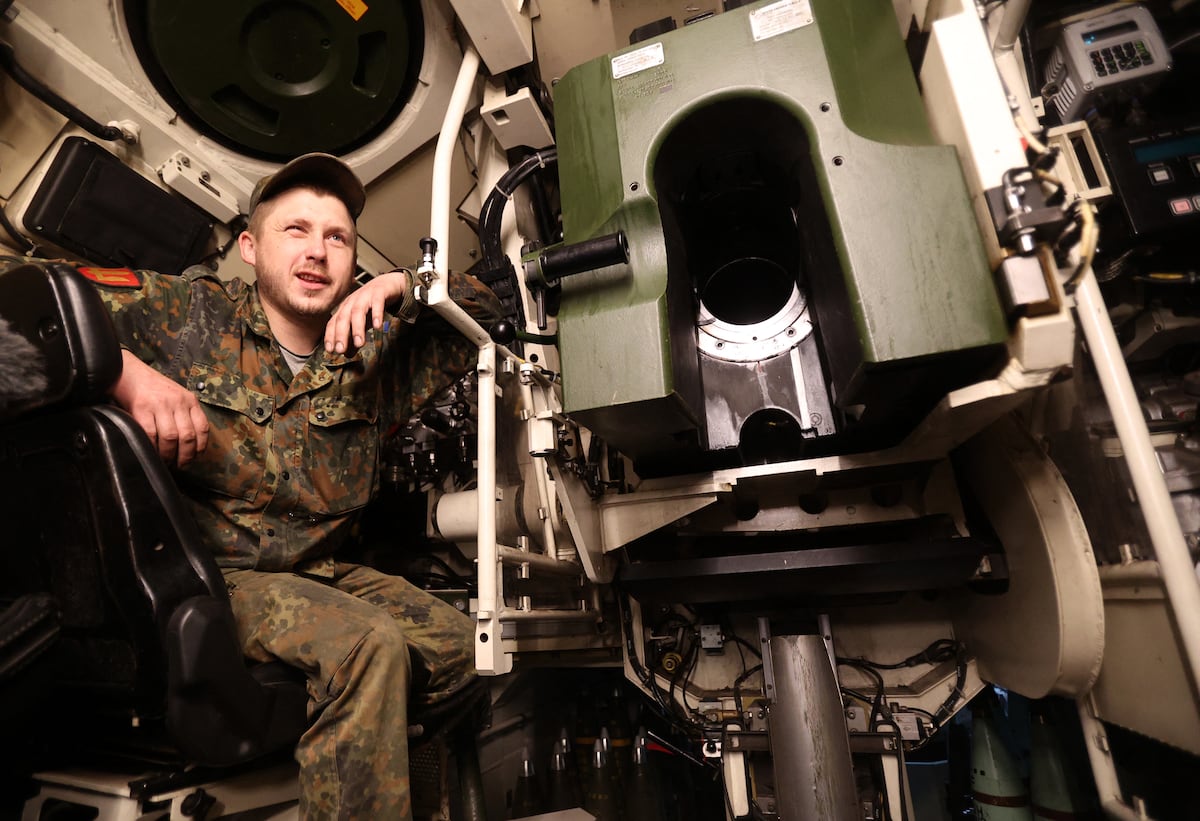
Caption: Ukrainian crew operating a German-made 155mm PzH 2000 near a frontline position, demonstrating live combat testing of fielded systems | Credits: Anatolii Stepanov/AFP via Getty Images
Strategic and Geopolitical Consequences
Short term, Germany’s formal data access accelerates capability improvements across air‑defense, artillery and counter‑armor technologies. Operational insights — such as accelerated barrel wear on the PzH 2000 from high firing rates or the utility of Trophy‑style active protection systems on heavy armor — will inform upgrades and procurement specifications, benefiting NATO interoperability and the competitive position of German prime contractors.
Politically, the arrangement signals a maturing of Western assistance from moral‑political support toward structured, reciprocal industrial partnerships. That shift may make future aid easier to justify at home — framed as dual‑use investment in national industry — but it also risks greater domestic scrutiny over whether taxpayers are subsidizing corporate R&D through wartime testing grounds.
From a diplomatic and adversary‑perception angle, Russia is likely to view the agreement as deeper German entanglement in Ukraine’s warfighting proficiency, raising tensions and complicating de‑escalatory narratives. The formalized flow of battlefield data and co‑production of strike-capable drones also introduces escalation sensitivities: opponents may interpret improvements as enabling more effective long‑range strikes, even as Berlin publicly rules out specific platforms such as the Taurus missile.
There are important legal, security and ethical trade‑offs. Sharing live battlefield management data and sensor feeds for AI development raises classification, oversight and data‑protection questions: how datasets are anonymized, how models are validated, and how control and export rules are enforced. There is also a proliferation risk if lessons learned flow into platforms that are subsequently exported beyond tightly controlled alliances without consistent safeguards.
Finally, the deal reframes transatlantic and intra‑European industrial competition. Germany’s hands‑on access to combat data will strengthen its defense technology base relative to other suppliers, potentially creating political friction with partners who lack equivalent battlefield inputs. To mitigate this, Berlin can pursue cooperative frameworks that share analytical outputs, set common data governance standards, and coordinate force‑design choices within NATO to preserve alliance cohesion while reaping the tactical benefits of wartime learning.