
Germany has unveiled a comprehensive, legally backed blueprint to transform the Bundeswehr over the next decade and a half, shifting from post‑Cold War restraint to an assertive conventional force posture aimed at making Germany the strongest European military by 2039; the package blends personnel expansion, doctrinal reframing, effects‑based capability planning, and organizational modernization to respond to a reassessed threat environment and to assume a larger role inside NATO and beyond.
Current Strategic Reset: What Germany Is Implementing
The newly released suite of documents—Germany’s first standalone military strategy alongside a capability profile, personnel growth plan and a reserve strategy—represents a synchronized policy thrust to enlarge and modernize the Bundeswehr. The military strategy names Russia as the primary threat, adopts a “one theater” conception linking NATO territory with the Middle East and Indo‑Pacific, and sets out classified threat assessments to shape capability choices. The capability profile abandons fixed platform quotas in favor of an effects‑based model: emphasis is placed on deep precision strike, layered air defense including counter‑hypersonic measures, and extensive unmanned systems, while acknowledging that long‑range strike capabilities must be developed largely from the ground up.
Personnel targets are explicit and legally anchored: active forces are to grow from roughly 185,420 today to about 260,000 by the mid‑2030s, while the reserve is to expand from roughly 60,000 assigned reservists to at least 200,000, yielding a combined force posture of some 460,000 combat‑ready personnel. The plan is phased—rapid expansion through 2029, capability consolidation to 2035, and a technology‑driven maturation phase toward 2039—while new law permits re‑introducing conscription as a fallback. Complementing capability and manpower reforms is EMA26, a 153‑measure deregulatory and digitization agenda that ties internal rules to automatic expiry, prioritizes administrative AI and accelerates procurement processes. Officials acknowledge production bottlenecks and global competition for systems such as air‑defense, underscoring procurement and industrial risks to the timetable.
From Postwar Constraints to Strategic Ambition: A Historical Perspective
Germany’s defense evolution has been shaped by historical constraints and shifting threat perceptions. The Bundeswehr emerged in a Cold War context as a territorial defense force under tight political oversight; after reunification and the end of conscription as routine service, Berlin adopted a more restrained, integration‑oriented posture. That trajectory began to change after Russia’s 2014 aggression in Ukraine and accelerated sharply following the 2022 invasion, when Germany announced a policy turning point that increased defense spending and ambition. The 2026 package therefore represents both continuity with a longer reorientation toward burden‑sharing and a pronounced break: it combines expanded scale, legally enshrined milestones, and doctrinal reach into expeditionary and global deterrence roles.
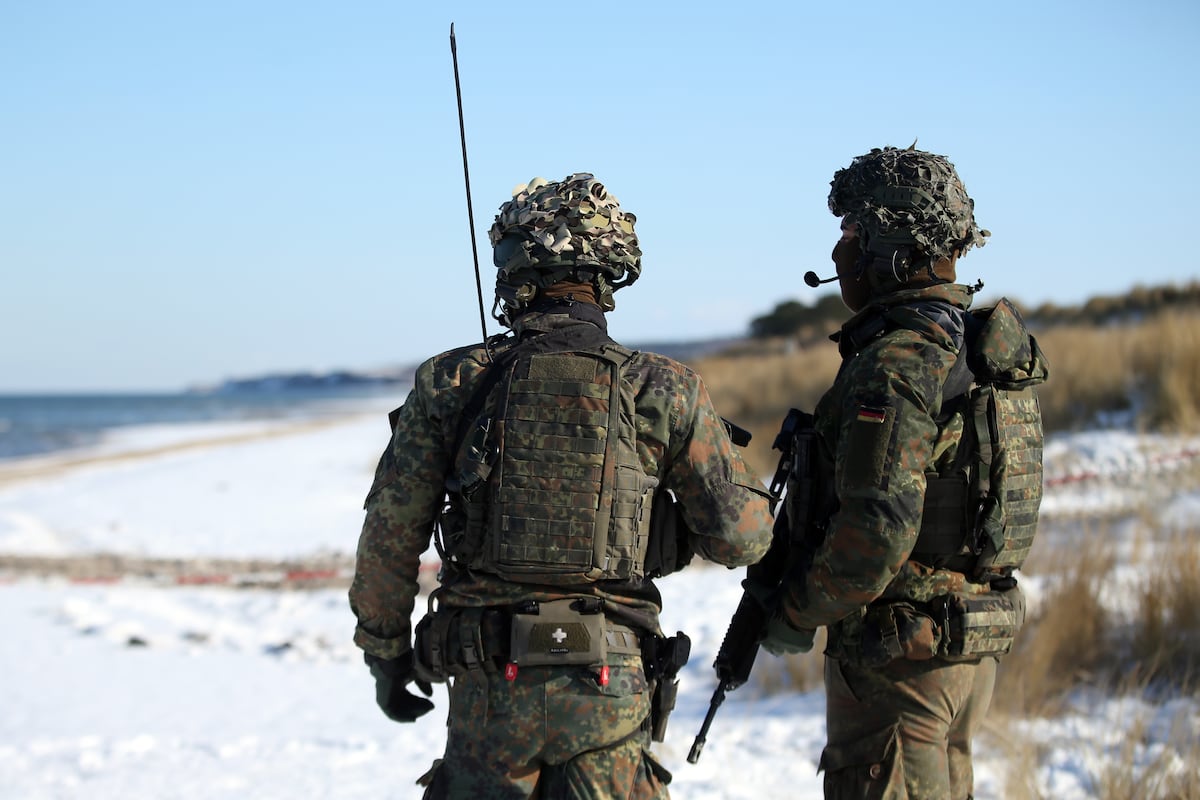
Caption: German soldiers securing NATO exercise terrain during Steadfast Dart 2026 | Credits: Baris Seckin/Anadolu via Getty Images
Strategic and Geopolitical Consequences for Europe and Beyond
Germany’s ambition will produce layered geopolitical effects. Within NATO, a larger, more capable Bundeswehr strengthens forward deterrence and eases alliance burden‑sharing, particularly for ground forces and homeland logistics; Germany’s explicit aim to act as a logistics hub for eastward reinforcement could materially improve NATO’s sustainment posture in the Baltics and Poland. Politically, assuming leadership by capacity enhances Berlin’s influence over alliance priorities but also raises expectations from partners—especially France, the UK and the United States—about German commitments to forward deployments, financing and rapid response.
Regionally, a German buildup will alter European force balances. If realized, greater German conventional strength may spur deeper defense cooperation across the EU while encouraging rival states to recalibrate their own postures. Russia will likely view the shift as escalatory, increasing the risk of heightened military signaling and reciprocal enhancements along NATO’s eastern flank. The strategy’s global reach—treating the Indo‑Pacific and Middle East as connected security spaces—signals Berlin’s intent to contribute to non‑European contingencies, which may extend German strategic engagements into maritime security and deterrence architectures far from the continent.
However, realizing the vision faces three main constraints: industrial capacity and procurement bottlenecks (compounded by competing global demand for air‑defense and precision systems), sociopolitical limits at home (public opinion and the political acceptability of conscription as a contingency), and technological uncertainty for next‑generation capabilities such as hypersonic defenses and AI‑enabled command systems. Forecast scenarios range from a successful, steady build‑out that redefines European conventional balance by the late 2030s, to a constrained outcome where capability shortfalls and production delays force prioritization and dependence on allied assets. The strategic package nevertheless marks a decisive German choice: to invest in scale, integrate reserves as an operational hinge with society, and recast procurement and governance to sustain a credible deterrent role in an increasingly contested European security environment.