
Introduction: Germany is recalibrating its stance on nuclear deterrence amid growing doubts about the durability of the U.S. security commitment to Europe. Berlin’s National Security Council has initiated a series of diplomatic and policy dialogues — bilaterally with the U.K. and France and multilaterally with other European states — to explore a European deterrent architecture that complements, and could partially substitute for, the American nuclear umbrella if necessary.
Current Situation: Germany's Strategic Reassessment
Berlin’s effort is pragmatic rather than doctrinal: it seeks credible options to reassure NATO allies and deter major-state aggression while avoiding hasty moves toward independent nuclear armament. The process currently comprises layered dialogues. The U.K.–France “Northwood Declaration” has opened the door to operational coordination between Europe’s two nuclear powers. The 2024 German–British “Trinity House Agreement” established a framework for defense cooperation that could be expanded to nuclear topics. A Franco‑German steering group chaired at high level is exploring concrete mechanisms for cooperation, and a Merz‑Macron proposal anticipates a broader European format that could include Poland, Denmark, Sweden, the Netherlands, Belgium and Greece — and potentially the U.K. if it opts in — to mirror, in part, NATO’s Nuclear Planning Group dynamics.
Germany’s immediate priorities are political and institutional: building trust between nuclear and non‑nuclear states; defining consultation procedures for crises (akin to NATO’s long‑standing Athens Guidelines); and exploring legal and financial instruments that would permit non‑nuclear allies to underwrite aspects of collective deterrence. At the same time, Berlin stresses that any European nuclear arrangement must be underpinned by robust conventional capabilities, placing a renewed premium on allied burden‑sharing and industrial planning.
Historical Roots: European Nuclear Posture and Alliance Dynamics
Europe’s post‑war security architecture was built on asymmetry: the United States provided a strategic nuclear guarantee while Britain and France maintained independent deterrents for prestige, autonomy and national survival. France’s tradition of an independent “force de frappe” resisted formal extended‑deterrence arrangements; Britain historically integrated more closely with NATO structures. Germany, following World War II, remained a non‑nuclear state embedded in NATO’s U.S.-led deterrence system. The Athens Guidelines and NATO’s consultative mechanisms codified how non‑nuclear allies would be consulted in crisis decision‑making.
Two developments have reanimated debate. First, political volatility in Washington and rhetorical scepticism about NATO commitments have heightened anxiety in European capitals about the continuity of the U.S. guarantee. Second, gradual convergence among European leaders on the need for greater strategic autonomy — recently evidenced by high‑level Franco‑German and transnational initiatives — has shifted the conversation from theoretical autonomy to practical architectures for collective deterrence that remain compatible with transatlantic ties.
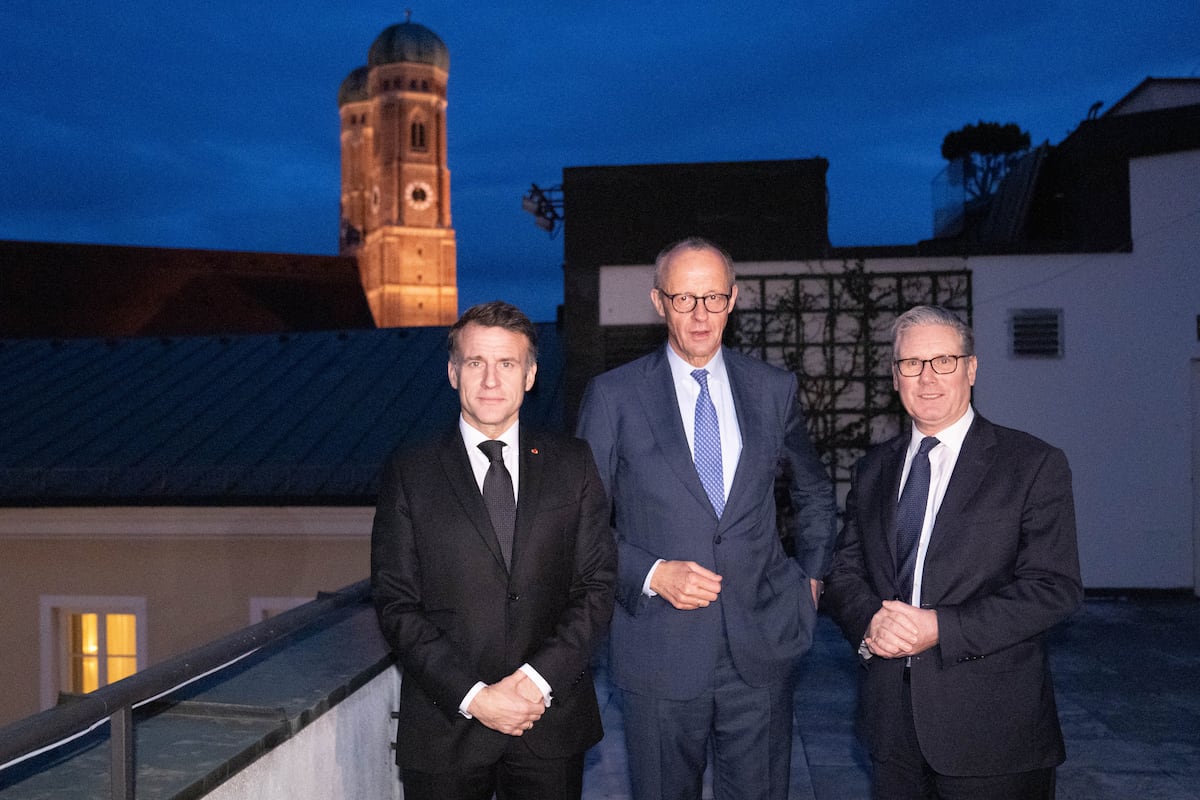
Caption: European leaders meet at the Munich Security Conference as nuclear cooperation talks gain momentum | Credits: Stefan Rousseau - Pool / Getty Images
Geopolitical Consequences: Allies, Deterrence, and Risks
Short term, Berlin’s initiative is likely to produce enhanced information‑sharing, crisis consultation protocols and symbolic commitments that shore up allied confidence. In practical terms, a Europe‑centred deterrent built around U.K. and French capabilities could improve regional crisis signaling and reduce European vulnerability to coercion when U.S. political unpredictability spikes.
However, the strategic and political ramifications are complex. A more autonomous European deterrent could strain transatlantic cohesion if Washington interprets it as dilution of U.S. leadership rather than reinforcement of collective burden‑sharing. For Moscow, incremental European integration on nuclear matters will be perceived as hostile, potentially provoking doctrinal adjustments or escalatory postures. Beijing will watch for signs of European strategic consolidation, which could complicate its calculations about transatlantic cooperation on global issues.
Institutionally, progress hinges on reconciling French reluctance about extended deterrence with the demands of Germany and other non‑nuclear allies for reassurances. Macron’s concept of “advanced deterrence” signals French flexibility, but translating political language into legally binding consultation procedures, targeting rules, and command‑and‑control safeguards will be technically and politically demanding. Financial arrangements — including possible co‑financing by beneficiaries of nuclear protection — require clear legal bases and domestic political buy‑in, particularly in Germany where nuclear policy remains sensitive.
Risks include proliferation pressures within Europe (if weaker states seek their own hedges), erosions of NATO unity if formats compete, and an arms‑management problem if coordination increases complexity without commensurate command safeguards. To mitigate these risks, a prudent path would prioritize transparency with the United States and Canada, institutionalize consultation protocols, commit to parallel investments in conventional forces, and sequence integration to build confidence before operational coordination. Such an approach can enhance deterrence credibility in the near term while minimizing strategic surprises and alliance fragmentation over the longer term.