
Italy’s government has chosen to forgo a one‑time boost of roughly €12 billion in defense spending enabled by an EU mechanism, prioritizing short‑term fiscal credibility and energy relief over an accelerated military buildup — a decision that tightens the trade‑off between domestic politics, European defense commitments, and long‑term industrial capacity.
Situation Overview: Decision to Decline the NEC and Its Immediate Consequences
Prime Minister Giorgia Meloni publicly dismissed the option to invoke the European Union’s National Escape Clause (NEC), which would have permitted Italy to exclude additional defense outlays from deficit calculations and thereby unlock approximately €12 billion over three years. The choice follows fresh fiscal data showing Italy’s deficit at about 3.1% of GDP and a stated government priority to shield households from higher energy costs ahead of national elections. Internally, the move reflects a split between a security‑focused executive and economic ministers who fear damage to fiscal credibility; externally it represents a deliberate shift away from an aggressive, front‑loaded rearmament trajectory.
Operationally, Rome still retains access to EU defense financing tools such as SAFE loans — its application for about €14.9 billion in SAFE lending remains on record — but officials acknowledge those resources would only lift defense spending modestly, to roughly 2.5% of GDP, falling short of the government’s public aspiration to reach a 5% share.
Historical Context: Italy’s Defense Spending Path and the EU Rulebook
Italian defense policy has oscillated between periods of fiscal restraint and bursts of modernization driven by external shocks and alliance expectations. In 2024 Italy’s defense outlays were recorded at about €29.18 billion (≈1.54% of GDP), and by 2025 Rome reported defense spending near 2% after accounting changes. The NEC is a recent EU innovation allowing participating states to add an annual defense uplift — up to 1.5% of GDP for four years from 2025 — to their budgets without triggering macroeconomic sanctions. Seventeen member states have used or signaled participation in the scheme, illustrating a broader European trend of stepped‑up military investment after recent regional crises.
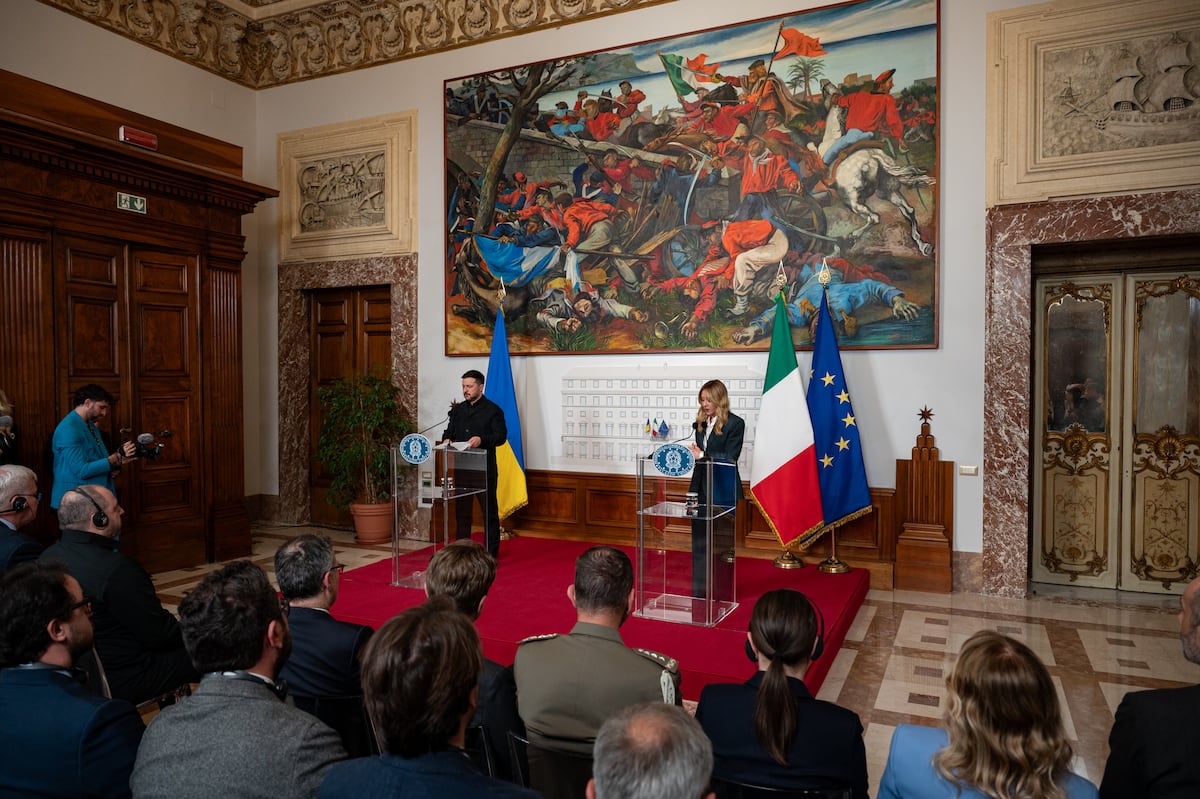
Caption: Ukrainian President Volodymyr Zelensky and Prime Minister Giorgia Meloni hold a joint press point at Palazzo Chigi, signaling Italy’s diplomatic engagement even as it hesitates on accelerated defense financing. | Credits: Massimo Valicchia/NurPhoto via Getty Images
Geopolitical Impact: Short‑Term Signals and Long‑Term Strategic Costs
In the short term, Italy’s restraint reduces immediate pressure on public finances and addresses voter concerns about inflation and energy prices — politically salient issues ahead of the 2027 electoral cycle. Strategically, however, the decision dampens momentum toward ambitious NATO burden‑sharing objectives and delays the procurement pipelines essential for force modernization. Programs requiring large, upfront capital — shipbuilding, advanced munitions, and platform recapitalization — are particularly vulnerable to postponement or scaled‑back orders, risking industrial layoffs, supplier fragility, and higher per‑unit costs if production runs are interrupted.
Diplomatically, Rome’s choice creates a mixed signal: continued rhetorical support for enhanced deterrence, but a reluctance to deploy extraordinary fiscal tools to meet it. Allies may interpret this as a pragmatic recalibration rather than a permanent retrenchment, but the gap between Italy’s stated ambition (a 5% defense target) and its fiscal posture could force partner governments to compensate, complicating European coordination on capabilities and shared procurement.
Looking ahead, several scenarios are plausible. If energy prices stabilize and the economy strengthens, the government could revive NEC use or finance catch‑up spending in future budgets, particularly if electoral incentives shift. Conversely, a prolonged economic wobble or renewed public resistance to higher military outlays would institutionalize a lower‑investment path, increasing strategic risk over the medium term by degrading readiness, slowing replenishment of critical stockpiles, and constraining Italy’s ability to sustain expeditionary commitments.
To mitigate these outcomes, Italy will need to balance near‑term social relief with multiyear procurement commitments that protect the defense industrial base, make transparent choices about capability prioritization, and coordinate with NATO and EU partners to pool procurement and leverage shared financing mechanisms. Absent such measures, Rome’s decision to forgo NEC‑backed spending will be remembered as a fiscally prudent but strategically costly pivot in a period when Europe is recalibrating its defense posture.