
Japan’s imminent loosening of arms export controls marks a watershed in postwar security policy: enabled by a politically emboldened government and driven by allied uncertainty, Tokyo is preparing to move from restrained supplier to active partner in regional and transatlantic defense supply chains, with implications for alliance resilience, industrial competition, and strategic balance in Asia and Europe.
Situation Overview: Japan’s Policy Shift and Global Interest
Tokyo’s planned revision of long-standing export rules — expected to be formalized within weeks — is designed to unlock sales of advanced systems and used platforms, including the likely transfer of frigates to the Philippines and potential missile-defense and electronic-warfare exports to partners such as Poland. This policy pivot follows a concerted political push by Prime Minister Sanae Takaichi and reflects both domestic imperatives (a $60 billion defense budget and the need to expand industrial capacity) and external demand from countries seeking to diversify sources of military equipment as U.S. production and commitments are perceived to be strained.
Japanese defense contractors, notably Toshiba and Mitsubishi Electric, have already signaled operational shifts: hiring, new export-focused organizational units, and investment in testing and manufacturing capacity. Interest spans Asia — driven by maritime and air-domain tensions — and reaches into Europe, where countries like Poland are exploring cooperation in anti-drone, EW, and component supply to reduce reliance on U.S. inventories.
Historical Context: From Postwar Restraint to Strategic Reawakening
Japan’s reluctance to participate in the global arms market long stems from post-World War II legal, political, and societal constraints that prioritized pacifism and limited the international sale of lethal systems. Incremental changes began under former leaders seeking closer security ties and joint development with allies, but many prohibitions persisted. The current acceleration builds on that gradual liberalization: it is the most significant opening since the postwar era and represents an explicit strategy to translate Tokyo’s growing defense spending and indigenous technological capability into a more outward-facing defense industrial posture.
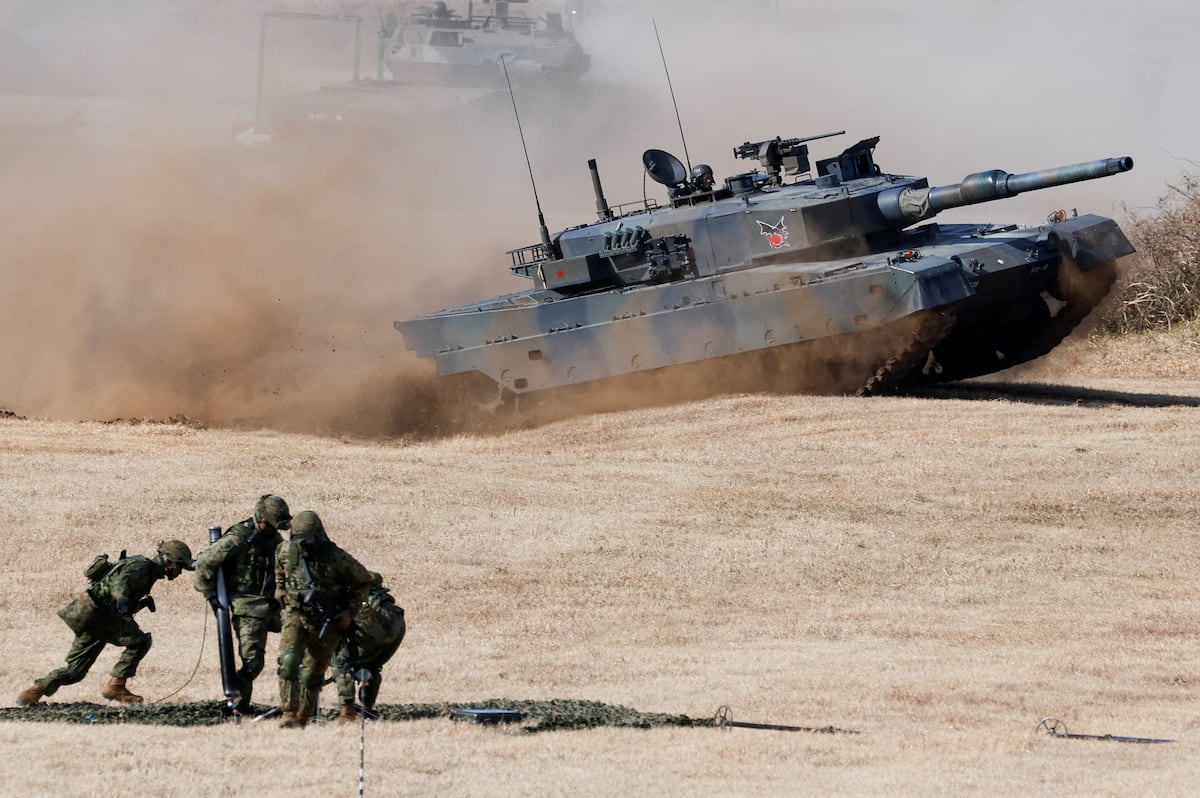
Caption: Type 10 tanks operate during a Ground Self-Defense Force drill east of Tokyo, Jan. 11, 2026. | Credits: Kim Kyung-Hoon/Reuters
Geopolitical Impact: Alliance Dynamics, Supply Chains, and Regional Security
Strategically, Japan’s export liberalization reshapes several intersecting dynamics. First, it offers allied governments immediate alternatives to U.S. suppliers at a time when American policy volatility and operational strain have prompted buyers to diversify. Evidence of this shift includes diplomatic outreach from European and Southeast Asian governments and tentative procurement talks with Japanese firms. Second, by enabling co-development and component exports, Tokyo may foster regionalized defense supply chains that reduce single-point dependencies and improve resilience against production bottlenecks exposed by concurrent conflicts.
Third, Japan’s move will alter competitive landscapes. South Korea’s rise as a defense exporter shows the political and industrial benefits of an outward-facing military-industrial strategy; Japan carries greater scale and technological depth in platforms such as submarines and fighter components, which could enable rapid market penetration if policy and corporate appetite align. Japanese entry into markets currently dominated by U.S., European, and Israeli suppliers will incentivize partnerships but also catalyze friction, especially where products intersect with contested maritime domains.
Fourth, regional security implications are twofold. On the deterrence side, transferring frigates, air-defense components, and EW systems to frontline states like the Philippines strengthens their ability to contest gray-zone coercion and sea-control threats. Conversely, Beijing is likely to view expanded Japanese arms exports with suspicion, potentially amplifying military competition in the East and South China Seas and complicating crisis stability. Tokyo’s stated intent to maintain strict controls on transfers to active conflict zones will be a crucial signal to manage escalation risks.
Finally, the domestic-commercial calculus cannot be ignored. Some Japanese conglomerates with consumer brands remain wary of reputational effects and market backlash; the pace at which they embrace defense exports will shape how quickly capability and capacity scale. Policymakers should therefore balance export ambitions with clear licensing frameworks, transparency measures, and allied interoperability standards to maximize strategic benefits while limiting diplomatic fallout.
In sum, Japan’s largest postwar arms opening is a strategic inflection point: it offers partners a credible new supplier and strengthens regional deterrence if carefully managed, but it also raises competition with established exporters and risks intensifying strategic anxieties, particularly in relation to China. How Tokyo calibrates export controls, corporate engagement, and allied integration over the coming months will determine whether this policy becomes a stabilizing force for shared security or another vector of great-power friction.