
The U.S. Navy’s public consideration of foreign shipbuilding marks a potential inflection point in maritime force generation: driven by domestic labor shortfalls and an accelerated procurement tempo, senior leaders are openly weighing allied yards and established maintenance partnerships as a pragmatic way to expand capacity — while balancing industrial base preservation, security controls and political trade-offs.
Current Situation: Navy Weighs Overseas Construction and Expanded Allied Maintenance
Senior Navy leadership has signaled a formal review of whether allied shipyards could be used to build or sustain U.S. warships, prompted by a clear labor-capacity constraint in U.S. yards. Secretary John Phelan framed the idea as part of “everything’s on the table,” citing existing maintenance, repair and operations (MRO) work done with Korea and Japan as precedent. South Korean firms HD Hyundai Heavy Industries and Hanwha Ocean recently secured U.S. Navy MRO contracts in 2026, primarily servicing ships tied to the 7th Fleet. Concurrently, the Navy is pursuing contract reforms to accelerate production — including bonus structures for early completion shared with workers — after evidence that multi-ship production runs can shave many months off build schedules. These operational responses are occurring against the backdrop of a proposed fiscal 2027 defense budget that requests $65.8 billion for shipbuilding to buy dozens of new combat and auxiliary vessels as part of a broader plan to grow the fleet toward a long-term target.
Historical Precedent: Allied Repair Links and the U.S. Maritime Industrial Base
Historically, the U.S. has prioritized a domestic shipbuilding base to ensure sovereign access to naval platforms, control over classified integration, and a stable industrial workforce. However, allied support for maintenance and limited construction is not new: in peacetime and expeditionary basing contexts, partner yards have regularly handled depot-level repairs, upgrades and refits for forward-deployed units. Post-Cold War consolidation and commercial pressures reduced U.S. production capacity and labor depth, creating vulnerabilities when procurement rates rise. The Navy’s recent outreach to Korean and Japanese builders and the Chief of Naval Operations’ engagement with foreign shipbuilders reflect a pragmatic turn toward amplifying allied contributions where security and technical constraints permit, while the service explores contracting incentives to recover domestic throughput.
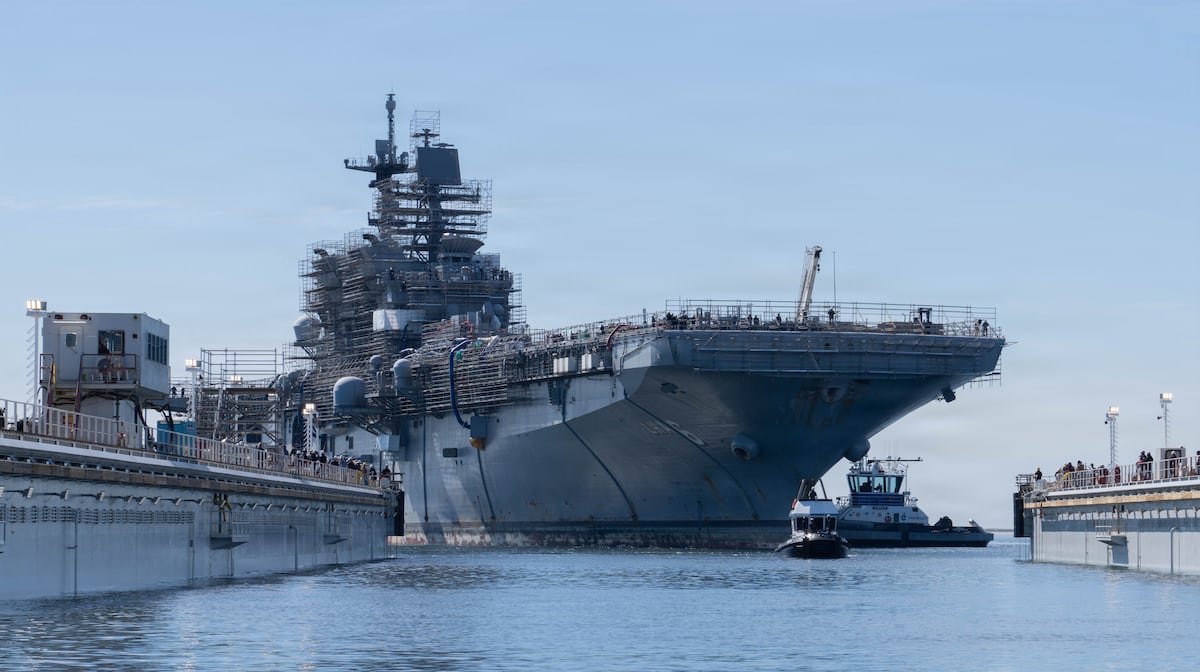
Caption: USS America arrives at a U.S. shipyard, illustrating the scale of maintenance and production demands facing the fleet | Credits: MCS2 Kenneth Melseth/U.S. Navy
Geostrategic Consequences: Opportunities, Risks and Policy Trade‑Offs
Shifting any portion of shipbuilding or deeper maintenance overseas would yield immediate throughput gains and strengthen allied industrial ties, offering a near-term hedge against U.S. workforce limits and helping meet accelerated procurement goals. It could also institutionalize burden-sharing with key partners in the Indo‑Pacific and reinforce interoperability by aligning maintenance standards and supply chains.
At the same time, the move carries meaningful risks. Outsourcing construction complicates protection of sensitive technologies and classified systems, raises export-control and supply‑chain vetting burdens, and may erode long-term domestic workforce skills if not tightly managed. Politically, using foreign yards for platforms typically built in the U.S. will draw scrutiny over jobs and domestic economic impact, and could prompt legal and procurement hurdles under Buy American and defense-industrial policy. Strategically, reliance on external yards introduces vulnerability if geopolitical competition — notably from adversaries seeking leverage over allied economies — intensifies.
To balance these trade-offs, a phased, risk‑managed approach is advisable: prioritize allied yards for non-sensitive auxiliary hulls and depot-level MRO work in theater; retain critical combat system integration, final assembly and classified work stateside; implement rigorous cybersecurity, supply‑chain traceability and export‑control regimes; and pair any foreign work with robust domestic incentives (contracting reforms, shared completion bonuses, workforce development) to regenerate U.S. shipbuilding capacity. Such a hybrid model would buy time to expand the American industrial base while harnessing allied capacity to meet urgent fleet expansion and sustainment needs.