
The sudden, immediate removal of John Phelan as U.S. Secretary of the Navy marks a sharp leadership pivot inside the Pentagon at a moment of elevated maritime tension — a decision that signals both internal policy impatience from civilian leadership and potential turbulence for naval operations and procurement programs already under strain from a high-tempo posture in the Middle East.
Rapid leadership change and immediate situation
On April 22, 2026, the Pentagon announced John Phelan’s departure as secretary of the Navy, effective immediately, with Undersecretary Hung Cao named acting secretary. The administration offered no operational explanation in the initial announcement; a senior official indicated that President Trump and Defense Secretary Pete Hegseth agreed new leadership was needed. Phelan had been confirmed in March 2025 and was notable as one of a small number of recent service secretaries without prior military service. His exit follows a pattern of abrupt senior leadership changes within the Department of Defense since the current civilian leadership took office, including the recent accelerated retirements and removals at the top echelons of the Army and Joint Chiefs.
Practically, the Navy faces a near-term leadership transition while engaged in a high-risk maritime environment including ongoing operations to interdict traffic related to Iran and enforce blockades in and around the Strait of Hormuz. With shipbuilding capacity and force generation already prioritized by the Navy and referenced by Phelan in public remarks days earlier, this change raises immediate questions about continuity of strategy, program advocacy, and day-to-day operations in a theater where rapid, disciplined civilian-military coordination matters.
Historical precedents and institutional background
Removals and accelerated leadership turnovers in wartime or crisis environments are not unprecedented in U.S. defense history, but they tend to be exceptional and carefully framed to preserve institutional credibility. Over the past 70 years, the office of Secretary of the Navy has rarely been held by non-veterans: Phelan was the seventh non-veteran in that span, reflecting a longstanding institutional preference for appointees with military or deep service experience. The concentrated pattern of removals under the current Secretary of Defense — including service chiefs and other senior officers — contrasts with prior administrations that typically sought smoother succession to maintain coalition confidence and operational stability.
Historically, abrupt changes at the top can produce short-term disruption but are often managed through acting officials drawn from senior civilian or uniformed ranks. Hung Cao’s naval academy background and 25-year special operations career provide an immediate operationally credible bridge. Nonetheless, the cumulative effect of multiple rapid leadership changes — particularly when combined with a perception of political motive — can erode long-standing norms of civil-military relations and complicate relationships with Congress and defense industry partners responsible for long-lead shipbuilding programs.
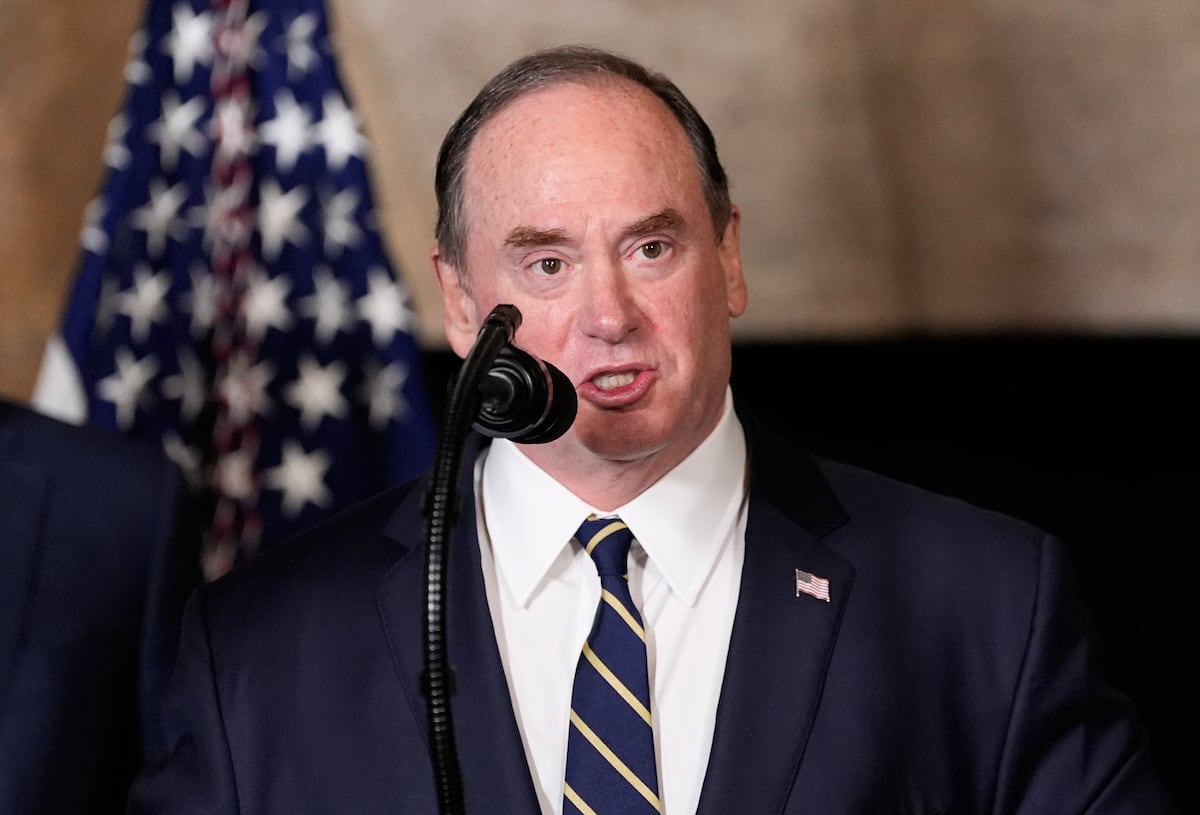
Caption: John Phelan delivering remarks at a Mar‑a‑Lago event in December 2025 | Credits: Alex Brandon/AP
Regional and global implications
Geopolitically, the removal has several immediate and medium-term implications. First, adversaries and regional actors will monitor Washington’s internal coherence; sudden turnover can be exploited opportunistically in grey-zone maritime environments such as the Persian Gulf, where signaling and timely decision-making matter. Second, allies and partners — particularly those reliant on U.S. naval presence for deterrence and freedom of navigation — will seek reassurance about continuity of commitments and procurement plans. Any perceived instability in U.S. naval leadership could complicate burden-sharing discussions and coalition command arrangements.
Third, force posture and procurement are at stake. The Navy’s push to expand shipbuilding capacity and request a significant increase in vessel procurements requires sustained advocacy and stable stewardship to navigate Congress and industry timelines. Leadership discontinuity risks slowing acquisition decisions, altering priorities, or creating openings for policy pivots that may not align with operational needs. Finally, repeated senior-level turnovers contribute to a broader politicalization of defense appointments, which can undermine morale among uniformed leaders, reduce retention of senior talent, and invite more aggressive Congressional oversight — all of which feed back into U.S. readiness and the credibility of forward deterrence.
Looking ahead, three scenarios are plausible: (1) a managed transition with Cao providing steady, operationally credible stewardship that preserves procurement momentum and allied confidence; (2) further senior leadership changes that produce short-term operational friction and procurement delays; or (3) a strategic reorientation in naval priorities if civilian leaders install a new permanent secretary with markedly different emphases on industry, basing, or rules of engagement. Policymakers, industry, and allied navies will each recalibrate based on which of these scenarios unfolds, and immediate attention should be paid to Congressional engagements, industrial base signals, and operational communications in the Persian Gulf to limit misperception risks.