
Poland’s fast-moving push to build a domestic ammunition industrial base — led by a private company partnering with Northrop Grumman and ST Engineering — crystallizes a broader European response to sustained artillery-intensive conflict: sovereignty of supply, rapid capacity expansion, and the commercialization of defense production to meet both national and allied demand.
Immediate situation: industrial partnerships respond to an ammunition surge
Poland’s Niewiadów Polish Military Group has announced collaborations with Northrop Grumman and Singapore’s ST Engineering to establish production lines for 155mm and 40mm ammunition inside Poland, targeting annual outputs of roughly 180,000 and 480,000 rounds respectively. The effort is aligned with Warsaw’s plan to use EU SAFE-backed loans — approximately PLN 23.8 billion (about $6.5 billion) — to accelerate ammunition and rocket procurement and domestic manufacture. Niewiadów’s market debut on the Warsaw Stock Exchange and its strategy to import technology while localizing production underscore a hybrid public-private approach: rapid capability acquisition through foreign partners combined with an explicit aim of sovereign, NATO-aligned supply. Parallel moves by state actors and firms in the region — including PGZ’s selection of BAE Systems and Rheinmetall’s joint ventures across eastern Europe — demonstrate that this is not an isolated business decision but part of a coordinated regional industrial surge.
Historical drivers and industrial precedent
The current wave of ammunition industrialization in Central and Eastern Europe must be read as a continuity of policy responses dating to Russia’s 2014 annexation of Crimea and accelerated dramatically after the 2022 invasion of Ukraine. Those conflicts exposed critical vulnerabilities in allied munitions stockpiles and supply chains, prompting both immediate transfers to frontline partners and a strategic pivot toward replenishment and resilience. Poland’s long-term artillery plans — including ambitions to operate roughly 1,000 self-propelled howitzers — reflect doctrinal lessons from artillery-centric combat and create predictable demand for large-caliber rounds. The region’s private-sector actors, exemplified by Czechoslovak Group’s expansion and public listings, have become important complements to state-owned suppliers, leveraging capital markets to scale production. Historically, munitions industrialization has followed waves of conflict: rapid investment, foreign technology transfer, localization efforts, and eventual export orientation. The current environment repeats that pattern but on a larger, EU-backed scale and with greater emphasis on automation and standardization to NATO specifications.
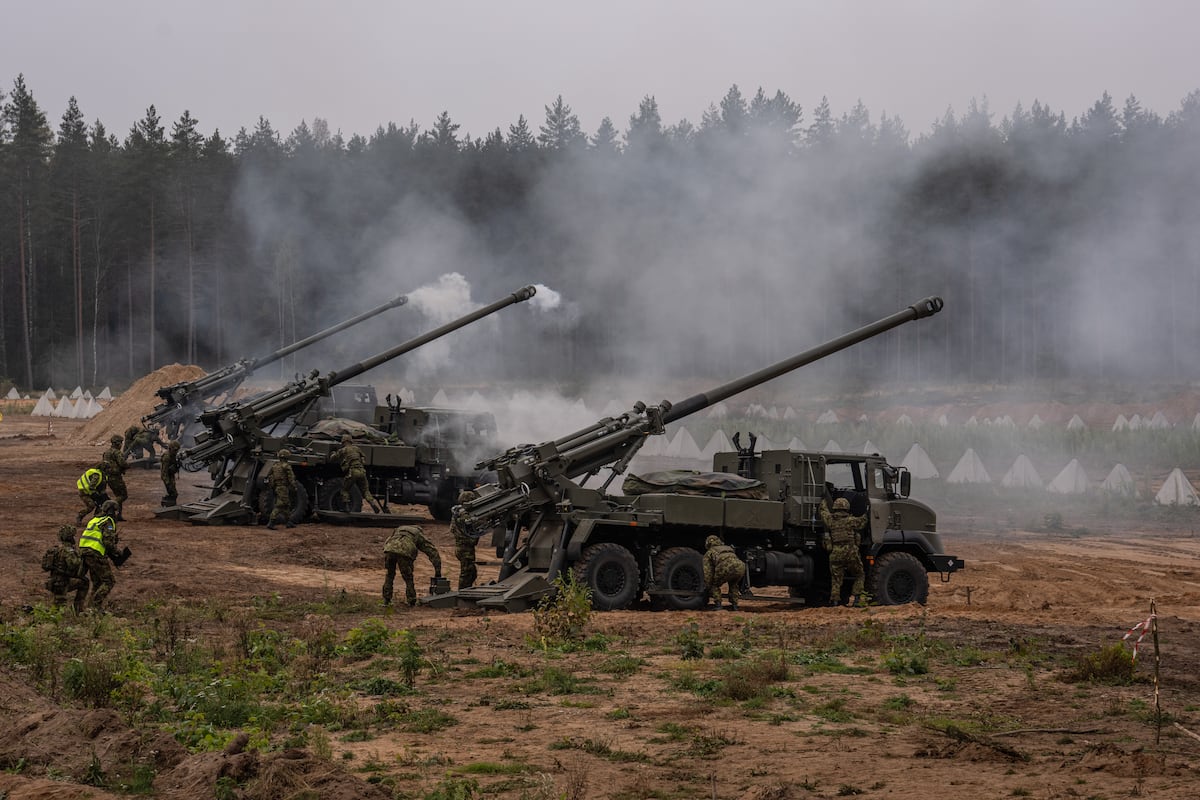
Caption: Estonian reservists train with 155mm self-propelled howitzers, illustrating the region’s focus on artillery readiness | Credits: Carl Court/Getty Images
Geopolitical implications: deterrence, industrial autonomy, and market geopolitics
The emergence of new ammunition factories in Poland and neighboring states has multiple geopolitical consequences. First, it strengthens deterrence and operational sustainability along NATO’s eastern flank by shrinking logistical gaps and reducing reliance on single-source overseas suppliers. Greater domestic output improves surge capacity for allied support to partners and reduces the political friction of recurrent external requests for transfers. Second, the pattern of foreign partnerships plus local manufacturing advances European defense industrial autonomy. Technology transfers from U.S., U.K., and Singaporean firms — coupled with automation and high-volume production targets — accelerate capability maturity while embedding Western standards across the region. Third, commercialization and stock-market listings of defense firms create a competitive export-oriented industry that could reshape regional defense trade flows: producers will seek third-country sales to amortize investments, raising questions of export controls, political vetting, and alliance coordination. Fourth, interdependence risks persist. Dependence on foreign know-how, critical components, energetic and chemical supply chains (propellants, explosives) and skilled labor means that political shifts, sanctions, or supply disruptions could still constrain output. Finally, the rapid capacity build-up creates potential for overcapacity or market volatility once immediate wartime demand recedes, so states will need to coordinate purchases and retention strategies to avoid wasted investment or destabilizing export competition. Overall, Poland’s initiative is emblematic of a strategic industrialization trend: hardening supply lines for present conflict dynamics while turning defense manufacturing into a longer-term geopolitical asset for both national policy and allied burden-sharing.