
Saildrone’s unveiling of the Spectre unmanned surface vessel signals a disruptive inflection point in naval operations: a relatively affordable, high‑speed, low‑signature platform purpose‑built for anti‑submarine warfare that accelerates the shift from platform‑centric ASW to distributed, persistent maritime sensing and engagement networks.
Situation Summary: Introduction of the Spectre USV into ASW Operations
The Spectre, a 54‑meter, ~250‑metric‑ton unmanned surface vessel capable of roughly 30 knots and optimized for quiet propulsion and long on‑station performance, is positioned as Saildrone’s entry into purpose‑built ASW. Available in two configurations — one retaining the company’s endurance wing and one without — the design reflects tradeoffs between sustained endurance and higher speed/stealth. Saildrone reports design certification in principle under High Speed Naval Craft rules and a manufacturing pathway at Fincantieri’s Wisconsin yard at an estimated unit cost near $40 million, with initial sea trials scheduled for early 2027.
Lockheed Martin is named as mission integrator, signaling a systems‑of‑systems approach: the USV is being promoted as a sensor and platform node that can host integrated sonar suites, autonomy software, and communications links to allied command networks. Production cadence presently described supports small series output (roughly five hulls per year at the stated facility), but the underlying business model emphasizes lower per‑unit cost to enable wider deployment across maritime theaters.
Historical Context: ASW Evolution and the Rise of Unmanned Maritime Systems
Anti‑submarine warfare has historically been a technology‑and‑logistics‑intensive mission set. From passive hydrophone belts and wartime convoy escorts to Cold War towed arrays, carrier‑borne sonars, and fixed undersea sensor networks, ASW required high‑end ships, aircraft, and large investments in acoustic processing and intelligence. After a post‑Cold War lull in investment, renewed great‑power competition in the 2020s prompted a doctrinal and procurement pivot back toward undersea dominance.
Concurrently, unmanned maritime systems matured from experimental concepts into operationally relevant assets. Early unmanned surface vessels focused on endurance and low cost for patrol and ISR. The Spectre represents a next step: a USV explicitly engineered for the acoustic and platform characteristics that matter to ASW — quiet signatures, persistent presence, host‑integration potential for towed arrays or deployable sonars, and autonomy to operate in contested environments without continuous human piloting.
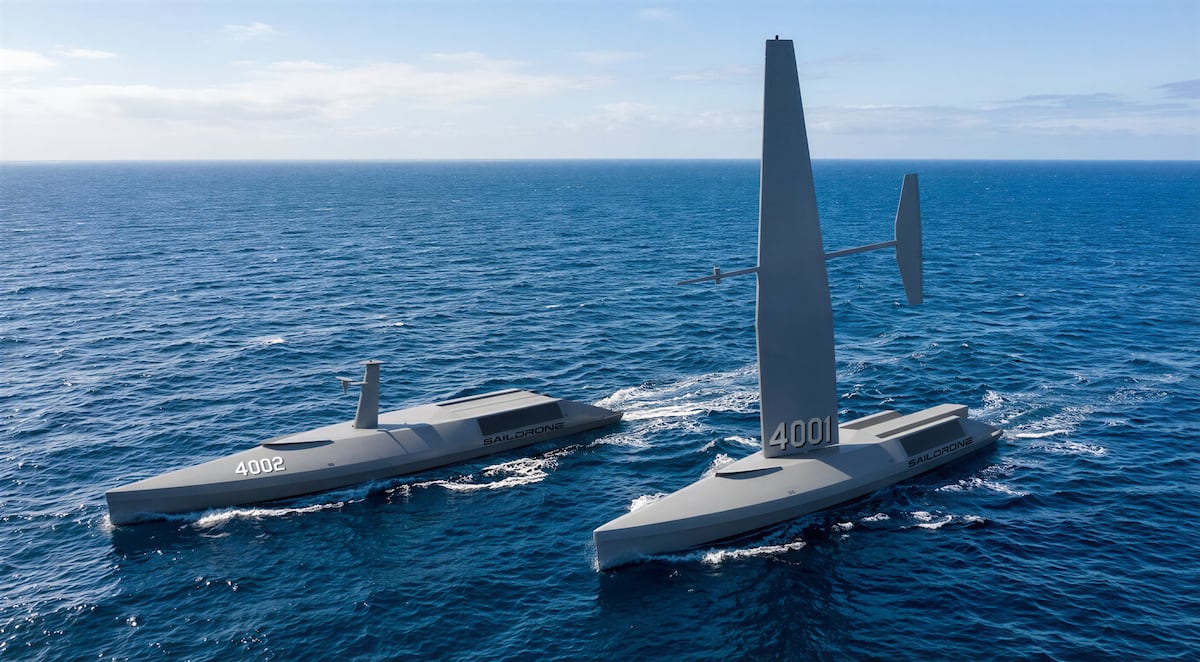
Caption: Saildrone’s Spectre concept — a large, quiet USV tailored for anti‑submarine missions — shown in concept imagery | Credits: Saildrone
Geopolitical Impact: Strategic Consequences, Risks, and Regional Implications
Operationally, cheaper, quieter, and widely fieldable ASW USVs change the calculus for both defenders and submarine operators. For navies and navies’ partners, these platforms offer the potential to proliferate ASW sensing across choke points, maritime approaches, and contested littorals without tying up manned hulls and airframes. That can blunt adversary submarine freedom of maneuver, raise operating costs for stealthy undersea forces, and improve persistent domain awareness when integrated into wider multi‑domain sensor and shooter networks.
Strategically, production and deployment of Spectre‑class vessels will affect alliance dynamics and regional balances. Allied navies with constrained budgets may find value in buying or co‑operating around lower‑cost USVs to share ASW burdens, enabling greater presence at lower individual cost. Conversely, potential adversaries will likely accelerate countermeasures: enhanced acoustic stealth of submarines, new passive/active decoys, electronic and cyber tactics against USV autonomy and datalinks, and doctrine changes that exploit acoustic or signature windows to evade unmanned sensors.
The presence of commercially developed, exportable ASW USVs also raises proliferation and escalation concerns. While unit cost is lower than traditional manned warships, capability diffusion can complicate crisis stability in constrained waters (e.g., the South China Sea, Arctic approaches, North Atlantic chokepoints), where large numbers of persistent sensor nodes could crowd contested zones, increasing incidents and misperception risk. Rules, certification, and export control frameworks will be tested as governments decide how to acquire, license, and integrate these systems into national fleets.
From an industrial and doctrinal perspective, partnerships between innovative maritime firms and established defense primes — exemplified by Saildrone’s work with Lockheed Martin and Fincantieri production plans — accelerate a hybrid supplier model where rapid innovation meets naval systems integration and naval certification pathways. That model lowers barriers to fielding new capabilities yet creates single‑point dependencies in autonomy software, sensor integration, and secure communications that adversaries may target.
In sum, Spectre‑class USVs deepen a broader trend toward distributed maritime lethality and sensing. They will not replace traditional ASW platforms overnight, but by enabling more nodes in the undersea detection network at reduced marginal cost, they can materially change tactics, procurement priorities, and regional force postures — and will prompt counter‑innovations and legal, operational, and strategic debates over the future character of naval competition.