
Europe is rethinking hard borders: restoring wetlands, peat bogs, mangroves and forests as deliberate landscape defenses—low-cost, climate-positive terrain modifications that can slow, channel or deny mechanized invasions while delivering carbon sequestration and biodiversity gains. The proposal, now moving from academic journals into defence conversations, forces strategic planners to weigh ecology as an instrument of deterrence alongside traditional hard infrastructure.
Current proposal and strategic summary
Researchers advocating “defensive rewilding” propose using restored ecosystems—rewetted peatlands, dense forest corridors, mangrove belts and reconfigured riverbanks—to create persistent, self-repairing obstacles to mechanized forces and amphibious landings. The approach is framed as dual-use: it increases the physical cost and complexity of aggression while contributing to national and NATO climate and resilience goals. Cost estimates presented by proponents place wetland restoration at a fraction of concrete anti-tank ditches, and emphasize rapid hydrological reversibility (for example, blocking drainage channels to raise peatland water tables within a year).
Operationally, rewilding seeks to: deny favorable mobility for main battle tanks and logistics; channel adversary movement into predictable corridors where defenders can concentrate effects; complicate sensor performance and guided munition employment through canopy and terrain clutter; and make river crossings and littoral landings materially more difficult. Advocates highlight pilot-ready geographies—northern Ukraine’s drained peatlands, border regions in Finland, Estonia and Poland, and tropical coasts in the Pacific—as priority areas where environmental restoration offers clear tactical promise.
Roots and historical precedents for terrain-based defence
Using terrain as a strategic weapon has long precedents. Marshes, forests and reefs have shaped campaign outcomes from the Eastern Front in 1941—where the Pripet Marshes constrained maneuver—to the Battle of Hürtgen Forest in 1944, where dense woods blunted technological and numerical advantages. More recently, Ukrainian forces used the meanders and wooded banks of the Siverskyi Donets River to disrupt and destroy river-crossing attempts in 2022. In the Pacific theater of World War II, reefs and shallow approaches proved decisive obstacles for amphibious operations.
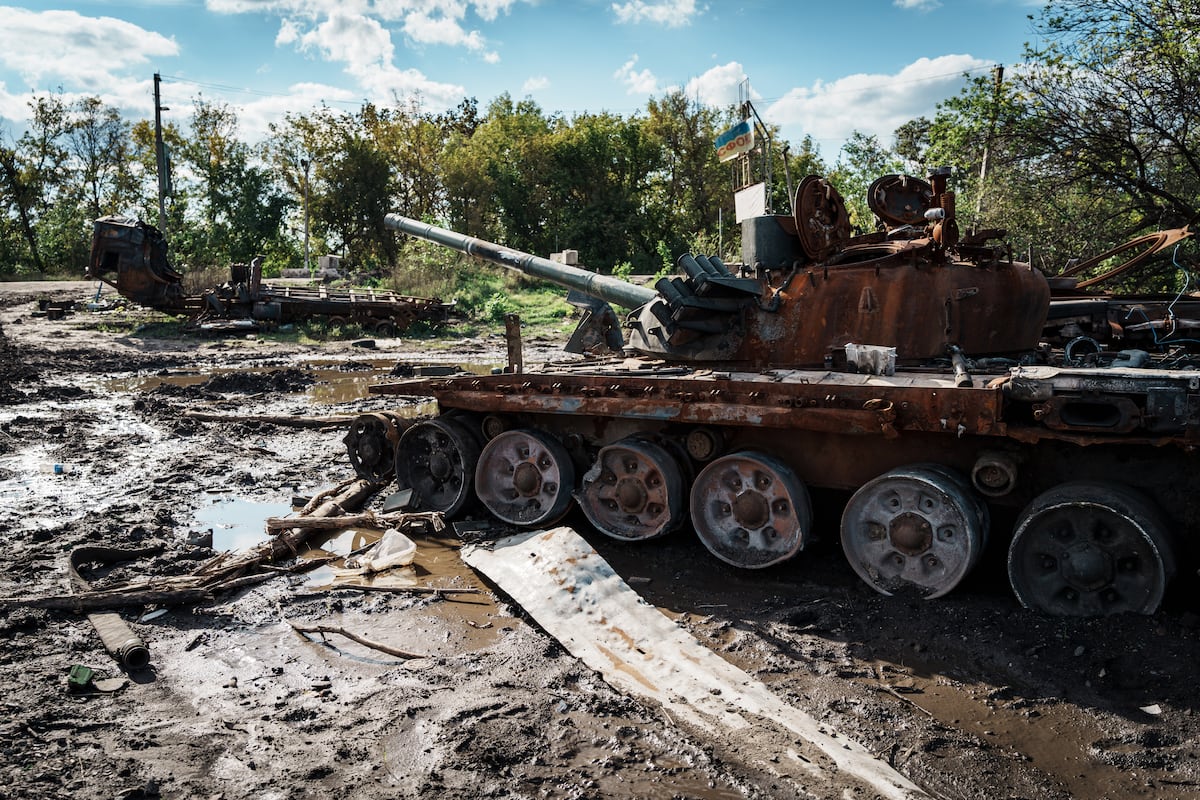
Caption: Wreckage and mud in a forest illustrate how terrain and vegetation affect mechanized movement | Credits: Serhii Mykhalchuk/Global Images Ukraine via Getty Images
Geopolitical implications and policy considerations
Defensive rewilding sits at the intersection of environmental policy, national defence and alliance burden-sharing; its adoption would create a set of strategic consequences that planners must anticipate. Positively, rewilding can be presented as low-escalatory, non-kinetic hardening of borders that supports national net-zero targets, potentially unlocking climate budgets and NATO resilience funding for security ends. It is cost-competitive with engineered obstacles and provides co-benefits—flood control, habitat restoration and carbon storage—that bolster domestic political support.
However, the approach raises complex geopolitical and governance issues. First, land use changes on international borderlands require careful diplomacy: cross-border hydrological alterations could be perceived by neighbours or adversaries as covert defensive preparations, risking misinterpretation and escalation. Second, implementation involves legal and property challenges—reversing decades of agricultural drainage and compensating affected communities will demand sustained fiscal and political commitments. Third, there are operational trade-offs: while rewilded terrain slows mechanized thrusts, it can also constrain friendly mobility, logistics and civilian access unless integrated into defence plans with roads, engineered crossings and local pre-positioning of forces and supplies.
From a military doctrine perspective, rewilding should be treated as a complement—not a replacement—to active defence capabilities. It requires new mapping, modelling and war-gaming to quantify effects on movement, sensor performance and engagement zones. Environmental modifications must be subject to rigorous, peer-reviewed evidence demonstrating tactical effectiveness across seasons and under different climatic conditions. Wide-scale adoption also risks the securitization of conservation policy: environmental projects could be instrumentalized for defence in ways that complicate conservation goals or civil liberties if emergency regulations are misapplied.
Policy recommendations for states and alliances include: (1) sponsor multidisciplinary pilot projects in candidate regions to gather empirical data on mobility, bearing capacity and hydrology under operational loads; (2) develop transboundary confidence-building measures and transparency protocols so restoration is not misconstrued as offensive preparation; (3) update military engineering doctrine to incorporate rewilded terrains, including mobility enablers for friendly forces and specialized logistics planning; (4) integrate landowners and local communities through compensation and co-management schemes to reduce domestic resistance; and (5) align financing by mapping rewilding’s contributions to climate targets and resilience spend to unlock blended funding from defence, environment and EU/NATO resilience instruments.
In sum, defensive rewilding is strategically attractive because it leverages natural processes to raise the costs of aggression while advancing climate and ecological objectives. Its promise will only be realized through careful empirical validation, transparent diplomacy, and institutional frameworks that reconcile military utility with environmental stewardship and local social rights.