
The 2027 U.S. defense budget proposal seeks an unprecedented surge in naval procurement—aiming to roughly double ship requests from the prior year and to seed a broadly expanded maritime industrial base—signaling a decisive shift toward hard power projection at sea with significant operational, industrial and geopolitical consequences for allies and competitors alike.
Overview of the 2027 Shipbuilding Proposal
The administration’s proposed $1.5 trillion defense package allocates $65.8 billion for shipbuilding capital, targeting the procurement of 18 battle force vessels and 16 non-battle force ships in fiscal 2027. That pace would roughly double the Navy procurement posture compared with fiscal 2026, when $27.2 billion was dedicated to building 17 ships. The request names an expansive mix of platforms: next-generation frigates, amphibious vessels, Columbia- and Virginia-class submarines, sealift and logistics ships, hospital ships, Consolidated Cargo Replenishment at Sea tankers, submarine tenders, a special mission ship, and capacity expansion for public shipyards. Central to the proposal is the so-called “Golden Fleet” concept and the construction of two large “Trump-class” battleships—an element intended as much for strategic signaling as for capability, given administration claims about their exceptional firepower. The plan stresses industrial-base regeneration by prioritizing vessels that are economically and technically less complex to produce than the most sophisticated combatants, while acknowledging that the package requires congressional authorization and will be subject to budgetary negotiation and program-level scrutiny.
Historical Precedents and Industrial Context
U.S. naval procurement has historically fluctuated with strategic pressure and political will: rapid expansion in wartime, contraction in the post-Cold War era, and episodic rebuilds when strategic competition resurfaces. The current push echoes past mobilization cycles in which policy-makers prioritized numbers and surge capacity to restore forward presence and deterrence. However, decades of variable investment have eroded parts of the maritime industrial base—skilled labor pools, specialized supply chains, and public yard throughput—that are difficult to rebuild quickly. Modern surface combatants and nuclear-powered submarines demand long lead times, complex supply chains and sustained investment in workforce training and yard infrastructure. The 2027 request explicitly addresses these bottlenecks by funding public shipyard expansion and ordering a mix of less-complex hulls alongside high-end submarines, aiming to balance achievable near-term production increases with long-term strategic platforms.
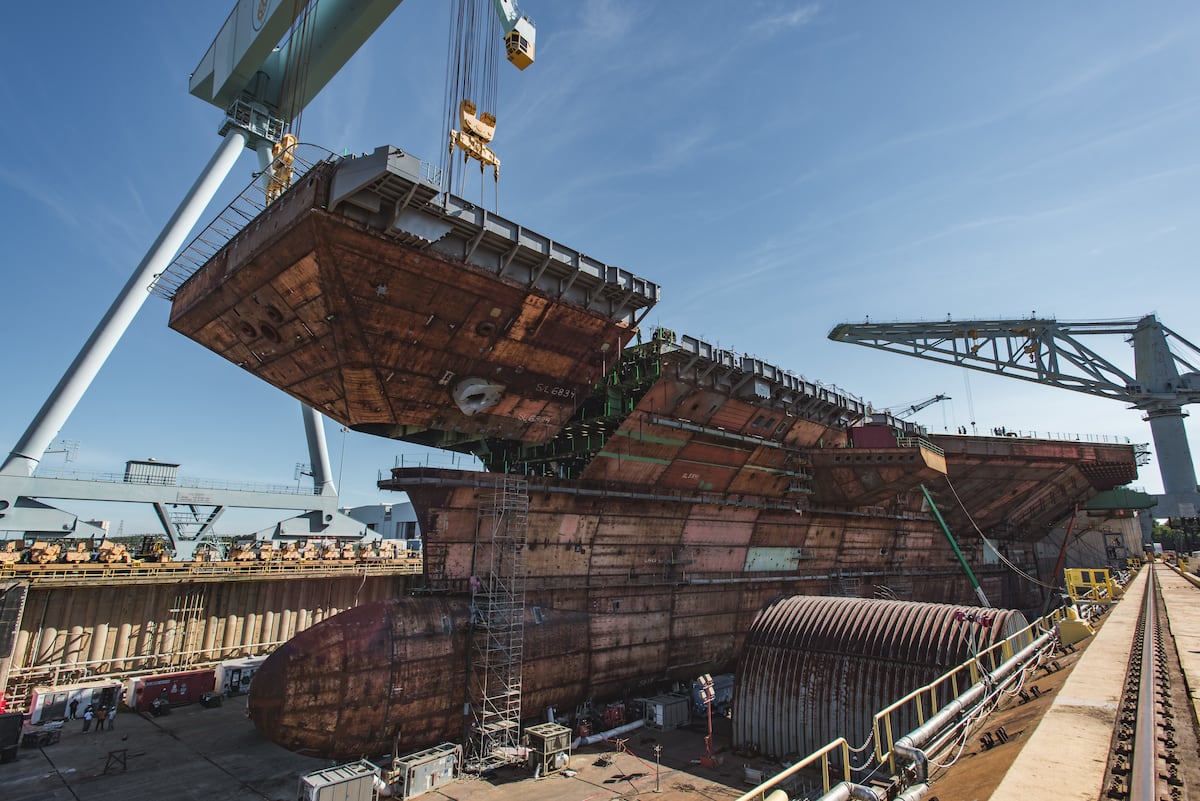
Caption: USS John F. Kennedy under construction, a visual cue for the administration’s renewed shipbuilding push | Credits: Matt Hildreth/U.S. Navy
Strategic and Regional Consequences
The proposed shipbuilding surge carries immediate and medium-term geopolitical implications. Strategically, an expanded fleet seeks to strengthen deterrence and maritime domain awareness in the Indo-Pacific and global commons, directly signaling U.S. resolve to China and other potential adversaries. Allies in the region—NATO partners and Indo-Pacific states—are likely to welcome greater U.S. naval capacity as reassurance, while also recalibrating their own force-planning and burden-sharing calculations.
However, the policy also risks stimulating competitive dynamics. A rapid procurement increase, coupled with publicized claims about novel “battleship” potency, can prompt adversaries to accelerate their own force modernizations or anti-access/area-denial investments. Operationally, scaling hull numbers without parallel investments in crews, maintenance, logistics, forward basing, and munitions creates a mismatch between inventory and sustained combat-ready presence. The industrial-scale challenges are non-trivial: workforce shortages, supply-chain fragility, and the long production timelines for complex platforms—particularly nuclear submarines—mean that numerical goals may outpace deliverability and generate cost overruns.
Domestically and politically, the program is likely to be a contested feature of congressional debate, attracting both support—through jobs, regional economic benefits, and visible deterrent symbolism—and criticism for opportunity costs and programmatic risk. Internationally, the initiative reshapes maritime competition: it deepens U.S. conventional options for power projection and presence, reintroduces debates about capital ships’ utility in modern naval warfare, and forces allies and rivals to reassess maritime strategies across the next decade.