
Ukraine’s Fire Point has announced an audacious timetable to field a low-cost ballistic missile interception system by the end of 2027, positioning a homegrown industrial actor to challenge established Western solutions amid surging demand for air defenses in Europe and the Gulf; this development blends battlefield-derived innovation, private capital interest from the Middle East, and significant geopolitical risk as states seek cheaper, more numerous alternatives to scarce systems like Patriot.
Program snapshot and immediate situation
Fire Point’s public roadmap centers on adapting its existing propulsion and guidance expertise from long-range drones and cruise missiles to an interceptor role that aims to reduce the cost-per-kill for ballistic threats to below $1 million. The firm is combining indigenous missile airframes—planned FP7 and FP9 variants—with external partnerships for radar, seekers and communications to deliver a full kill chain. Commercial motives are clear: a market opening has emerged as Western high-end interceptors are deployed extensively in the Gulf and replenishment is constrained, creating demand for affordable alternatives among mid-sized states and regional powers. At the same time, Fire Point’s progress is conditional on Ukrainian state approvals, export controls and potential foreign investment—factors that will shape timing and customer access.
Operationally, the company’s approach prioritizes cost-efficiency and mass production over replicating the layered, sensor-rich architectures of legacy systems. Fire Point claims high production throughput for strike drones and has scaled engine and fuel supply plans, but transitioning to a reliable, battlefield-grade anti-ballistic capability requires integrated sensors, robust command-and-control, and rigorous testing against realistic ballistic trajectories—elements that are complex, time-consuming and capital intensive.
Evolution of Ukraine’s defense innovation
Ukraine’s recent defense industrial trajectory has been defined by rapid wartime adaptation and a culture of incremental engineering driven by operational necessity. Since 2022, firms that scaled up drone and cruise-missile production have accumulated systems-in-use experience, supply-chain improvisation, and a pragmatic design ethos favoring affordability and modularity. Fire Point emerged within this environment, leveraging battlefield-tested designs such as the Flamingo cruise missile and high-volume strike-drone production techniques to diversify into both offensive ballistic weapons (FP7, FP9) and, now, defensive interceptors.
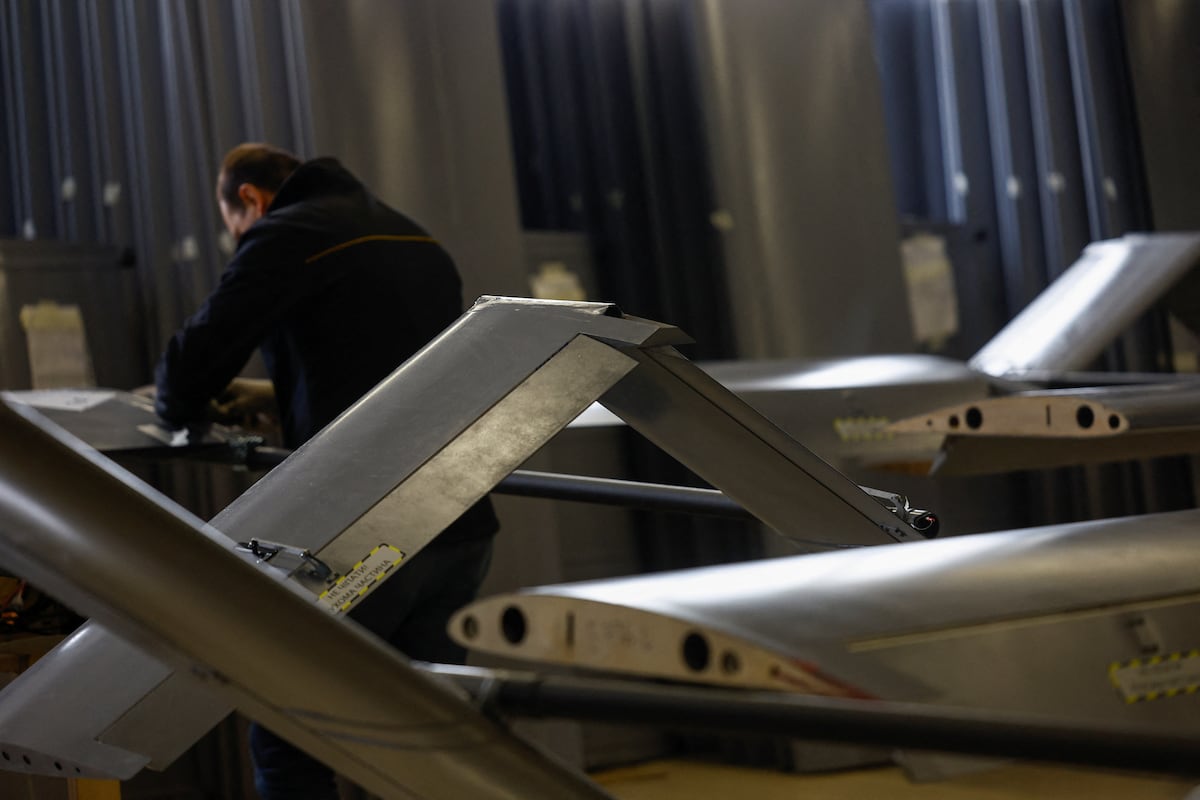
Caption: Fire Point employee at the production line for long‑range drones, illustrating the company’s high-volume manufacturing capability | Credits: Valentyn Ogirenko/Reuters
The pivot from strike systems to an interceptor mirrors historical patterns where combat-proven industrial bases repurpose technologies for new missions—similar to how wartime aviation advances accelerated radar and avionics in prior conflicts. But the interceptor mission introduces new technical demands: high-precision sensors, millisecond-level data links, robust atmospheric flight controls for high closing speeds, and a tested kill mechanism (hit-to-kill or proximity detonation) that will determine effectiveness against modern ballistic targets and countermeasures.
Regional and global strategic consequences
Should Fire Point meet its timeline and performance claims, several strategic consequences would follow. First, a credible, lower-cost interceptor would broaden procurement options for states unable or unwilling to acquire U.S. or European systems, accelerating air-defense proliferation and potentially altering regional deterrence postures in the Middle East, North Africa and parts of Asia. This could ease supply constraints for NATO partners and allied states while also enabling smaller powers to field layered defenses where previously cost was prohibitive.
Second, the involvement of Gulf capital and potential UAE basing or launch arrangements signals deeper Ukraine–Gulf defense-industrial ties, translating into political influence and strategic partnerships beyond arms sales. A space-launch or satellite component would further entwine civilian and military cooperation, raising export-control and dual-use proliferation concerns for Western policymakers assessing technology transfer risks.
Third, Fire Point’s concurrent development of longer-range strike missiles (FP7/FP9) complicates the arms diffusion picture: the same firms enabling defensive affordability may also expand offensive reach for their customers, introducing escalation dynamics especially vis‑à‑vis Russia. Moscow’s ability to counter increased ballistic use or interception density will shape its threat calculus and may incentivize countermeasures, increasing the pace of an offense–defense arms race.
Finally, the program highlights structural shifts in the defense market: cost-per-effect metrics are becoming central to procurement decisions, pressuring legacy manufacturers to justify premium performance amid tighter inventories. Western governments will face trade-offs between preserving high-end capabilities and supporting diversified suppliers to meet urgent demand, all while managing proliferation, export controls and alliance cohesion.