
The U.S. Air Force’s April 2026 decision to push the A-10 Thunderbolt II’s service life into 2030 represents a tactical and political recalibration: keeping a narrowly specialized close-air-support platform in the inventory to meet immediate operational demand while buying time for broader aircraft production and force-structure adjustments.
Current Decision and Force Posture
Secretary of the Air Force Troy E. Meink announced an extension of A-10 operations to 2030, a move that reverses a near-term retirement plan and trims previously planned drawdowns. The Air Force will keep three squadrons active through the transition: two at Moody Air Force Base (one extended to 2030, one to 2029) and one reserve squadron at Whiteman Air Force Base extended to 2030. Each squadron is slated to retain roughly 18 aircraft, producing an interim fleet of approximately 54 A-10s through 2029 before a planned reduction to 36 aircraft in 2030, split between one active and one reserve squadron.
This decision responds to operational pressures—most notably A-10 employment in Operation Epic Fury in the Iran theater, where the type provided close air support in the Strait of Hormuz and participated in a contested search-and-rescue mission that included a single-aircraft loss and successful recovery of the pilot. The Air Force cites a fleet-management approach that prioritizes keeping the most serviceable airframes online, acknowledging that sustainment choices will shape readiness and risk for the remaining years of service.
A-10 Heritage and Its Operational Evolution
The A-10 emerged from a Cold War requirement for survivable, low-altitude close-air-support aircraft optimized to protect armored formations and ground troops. Its titanium "bathtub," redundant systems, and the 30mm GAU-8 cannon made it uniquely suited to penetrate dense air defenses at low speeds and altitudes. Over decades the Warthog has been repeatedly adapted—structural life-extension programs, avionics upgrades, and weapons integration—to remain relevant in asymmetric and high-intensity environments.
Political and budgetary cycles have repeatedly put the A-10’s future in flux; past retirement plans were deferred when combatant commanders demanded its survivable CAS profile. The fiscal 2026 National Defense Authorization Act previously mandated retention of 103 A-10s through September 2026 with a path to full retirement by 2029. The current extension to 2030 thus reflects both the operational lessons from recent Middle East engagements and the difficulty of phasing out a platform with distinctive battlefield utility when replacements and industrial capacity lag.
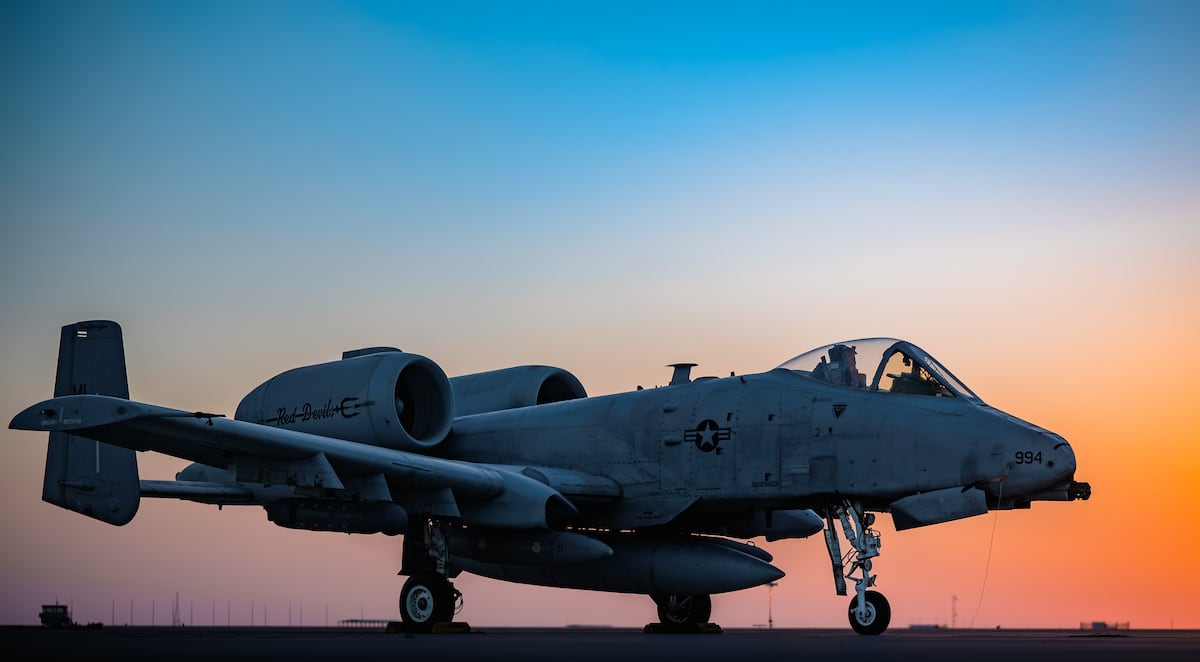
Caption: An A-10 deployed in maritime close-air-support and search-and-rescue operations near the Strait of Hormuz. | Credits: Air Force
Regional Signaling and Strategic Consequences
Keeping a reduced but modernized A-10 presence through 2030 carries several immediate geopolitical effects. Regionally, it signals to Iran and Gulf actors that the U.S. retains a specialized, readily deployable CAS capability tailored for contested littoral and expeditionary scenarios. That signaling is amplified by the A-10’s recent visible roles in maritime security and a high-profile SAR operation; such use projects resolve and an ability to operate in the lower-altitude envelopes where faster, stealthier platforms are less effective or riskier to employ.
Strategically, the extension buys time for the Defense Industrial Base to ramp up broader combat aircraft production—an explicit justification cited by senior leaders—while limiting short-term capability gaps. However, it also complicates longer-term modernization trade-offs. Funding and maintenance resources allocated to sustain aging airframes could otherwise accelerate procurement or sortie generation of next-generation fighters, affecting readiness against near-peer competitors. Moreover, the smaller retained fleet will concentrate operational risk: attrition, maintenance issues, or unexpected mission spikes could quickly strain the remaining squadrons.
Politically, the extension is a domestic signal of responsiveness to operational commanders and constituencies that favor legacy platforms with proven combat records. Public endorsements by Defense Department leaders and explicit crediting of the White House leadership frame the move as decisive governance. For allies and partners, the retention underscores continued U.S. commitment to regional security lines of effort but underscores persistent shortfalls in future-capability production and a reliance on legacy systems to fill urgent operational gaps.
Finally, this decision underscores a broader strategic tension: balancing specialized capabilities needed for current theaters of conflict against the imperative to field technologically advanced, scalable forces for high-end competition. How the Air Force manages sustainment, munitions stocks, training pipelines, and industrial partnerships in the next four years will determine whether the A-10 extension is a prudent bridge or a protracted dependency that constrains future force posture.