
The U.S. Army’s move to procure a heavier, hybrid-powered Infantry Squad Vehicle variant (ISV-H) signals a purposeful shift from pure light mobility toward a distributed, energy-enabled tactical node designed to support sensors, drones, medical evacuation and command functions at the squad and platoon level; the program blends commercial automotive platforms, electrification and exportable power to extend mission persistence and transform small-unit logistics and doctrine.
Program overview and current status
The Army has issued a solicitation seeking roughly 606 ISV-Heavy vehicles to augment an existing fleet of about 1,105 Infantry Squad Vehicles, spreading procurement across three contracts. The ISV-H is not simply an up-armored ISV: it is a heavier, hybrid-electric evolution built on a Chevrolet Silverado 3500 HD chassis with a focus on onboard power generation, mission-system support and multi-mission modularity. Projected configurations reduce passenger capacity relative to the baseline ISV (early mockups indicate two-to-six seats versus the original nine), trading troop transport numbers for payload, power and systems integration.
Key technical requirements disclosed in the solicitation include the ability to export 60 kW of continuous high-voltage DC power, 15 kW of 28V DC and 4.8 kW of 120V AC — effectively converting the vehicle into a mobile energy hub. The hybrid-electric architecture also supports “silent drive” and “silent watch” modes to reduce acoustic and thermal signatures while powering sensors, communications and counter-uncrewed aerial systems (UAS). The ISV-H is described as “add-on armor capable,” preserving flexibility between mobility and protection depending on mission needs.
Procurement has moved through an initial white-paper phase completed on April 13; subsequent stages for technical presentations and final proposals will refine designs and contractor selections. Industry entrants, including GM Defense prototypes, emphasize multi-role concepts: command-and-control, counter-UAS, loitering-munition operations, drone launch-and-recovery and medical evacuation.
Evolution of the squad vehicle and energy-enabled mobility
The ISV-H sits within a decade-long trajectory in U.S. ground vehicle development that emphasizes three converging trends: lighter, more maneuverable platforms for distributed operations; increasing electrification to support sensors and directed-energy weapons; and the adaptation of commercial automotive architectures to speed acquisition and control costs. The original ISV was designed primarily as a light, expeditionary mover for nine-person squads; the ISV-H reframes the vehicle as a mobile node that trades seating for power generation and mission systems.
Historically, the Army has oscillated between heavy armor-centric and light, mobile concepts based on threat environments and operational lessons. The ISV-H reflects a post-2010 doctrinal emphasis on mobility, connectivity and persistent sensing — an approach reinforced by recent doctrinal experiments that prioritize brigade-level agility and distributed lethality. Integrating hybrid-electric propulsion and exportable power follows a global pattern where militaries seek organic energy at the tactical edge to reduce logistic tails, enable electronic warfare and support unmanned systems.
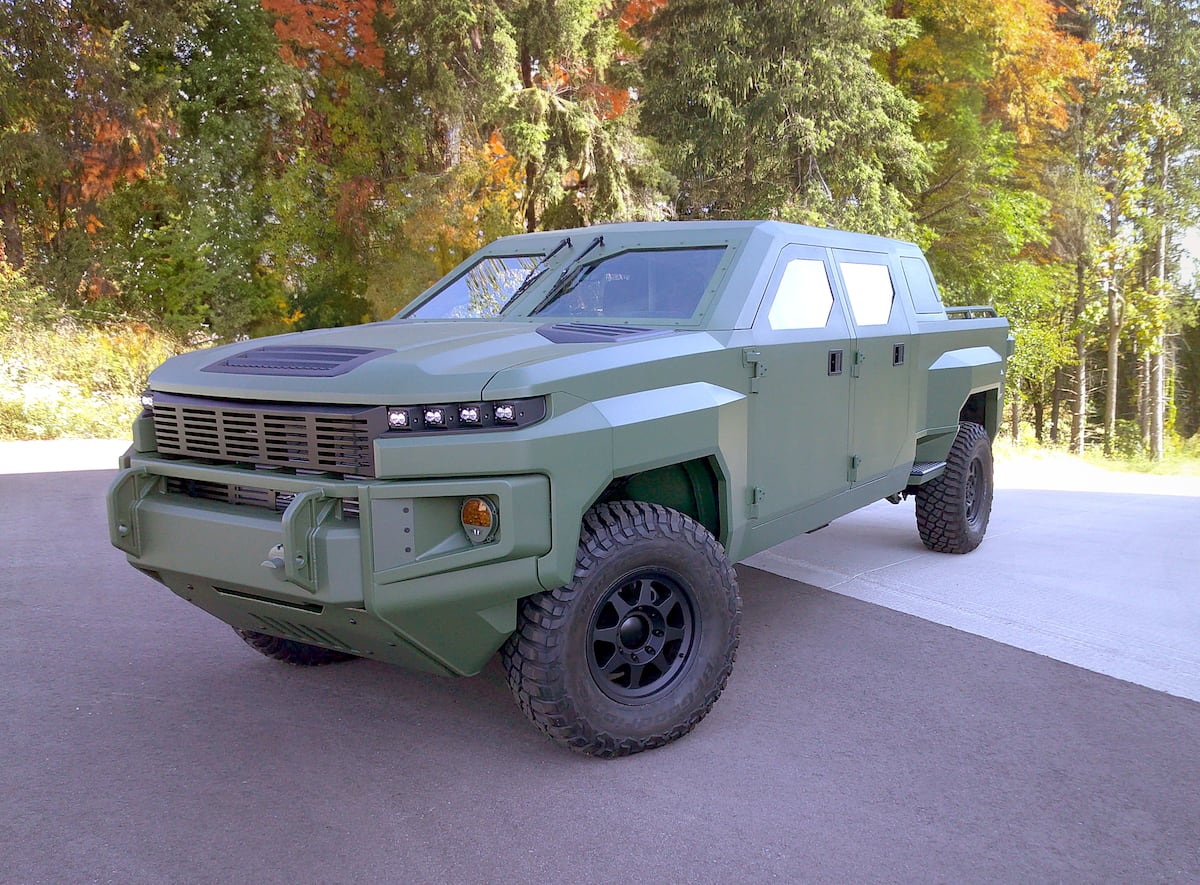
Caption: GM Defense ISV-H prototype demonstrating hybrid-powered architecture and modular mission bay | Credits: Army Times
Strategic and regional implications
Operationally, the ISV-H will influence how small units operate in contested environments. By providing substantial, exportable power at the squad and platoon level, the vehicle enables persistent sensors, directed-energy prototypes, electronic-warfare suites and unmanned air and ground systems without immediate dependence on larger support networks. This enhances distributed operations in anti-access/area-denial (A2/AD) contexts, allowing forward elements to sustain high-power systems during silent watch or rapid stand-off missions.
From a logistics and vulnerability perspective, increased on-platform power shifts complexity ashore: fuel consumption patterns change, maintenance demands increase (hybrid systems and high-voltage equipment require new technical skills) and the vehicle becomes a higher-value target because of its energy-generating capability. The heavier chassis and fewer seats change unit tactics, favoring task-organized mixes of light transport and specialized power nodes rather than homogenous squad carriers.
Geopolitically, the ISV-H embodies trends that allies and partners will watch closely. Countries facing contested littorals or peer competitors will value organic tactical power to operate distributed sensor grids and counter-drone measures. Exportability and defense-industrial partnerships (including commercial platforms adapted by firms like GM Defense) will shape alliance interoperability and technology transfer debates, particularly regarding high-voltage military power systems and counter-UAS capabilities. In theater, adversaries will likely prioritize electronic and kinetic means to deny or exploit these mobile power nodes, making survivability measures, signature reduction and operational dispersion critical.
Finally, procurement of the ISV-H highlights a broader modernization logic: electrification and power projection at the tactical edge are now force multipliers. How the Army balances protection, mobility, sustainment and cost during the next acquisition phases will determine whether the ISV-H becomes a resilience-enhancing utility for expeditionary units or a high-value, maintenance-intensive platform that complicates small-unit logistics in high-tempo conflicts.