
The U.S. Navy is transitioning from limited experimentation to an accelerated operational posture for unmanned surface vessels (USVs) in the Indo‑Pacific, planning to scale medium USV numbers from roughly four today to more than 30 by 2030 while simultaneously fielding thousands of smaller unmanned craft and expanded unmanned aviation — a shift that reorients presence, logistics and command relationships across the theater.
Situation Summary — USV Scale-Up in the Indo‑Pacific
Between 2024 and 2030 the Navy expects to move from a handful of medium unmanned surface vessels to a force measured in dozens of platforms in the Indo‑Pacific alone. That trajectory—articulated by the commodore of Surface Development Group 1—reflects a theater-specific projection tied to the Navy’s long-range force vision and a programmatic choice to prioritize faster expansion for unmanned classes than traditional manned ships.
Operationally, this expansion divides into tiers: medium USVs intended for distributed missions, large numbers of small USVs for tactical roles, and numerous unmanned air systems operating from both manned and unmanned ships. Recent experiential milestones include multi‑month Pacific deployments by four medium USVs (Sea Hunter, Sea Hawk, Mariner and Ranger) used to mature tactics, techniques and procedures. Organizational change is already underway with new USV divisions and theater‑centric maintenance concepts combining forward operating detachments and contractor‑led higher‑level upkeep.
Historical Context — Evolution of Naval Unmanned Systems
The current push builds on a period of iterative experimentation in which the Navy moved medium USVs from test beds to extended operational deployments. Initial fielded vessels served as technology demonstrators and concept‑development platforms; their sustained 2024 deployments provided the empirical basis for accelerating procurement and force design decisions reflected in the Navy’s 2045 vision.
Institutionally, the move from ad‑hoc projects to formalized divisions and doctrine marks a transition from novelty to integration. The service’s decision to treat Indo‑Pacific numbers as a distinct planning metric signals learning from early deployments: that unmanned systems require different basing, maintenance, command arrangements and sustainment models than conventional surface ships. These changes are being synchronized with a broader Robotic and Autonomous Systems strategy that envisions manned–unmanned teams as a core part of future maritime operations.
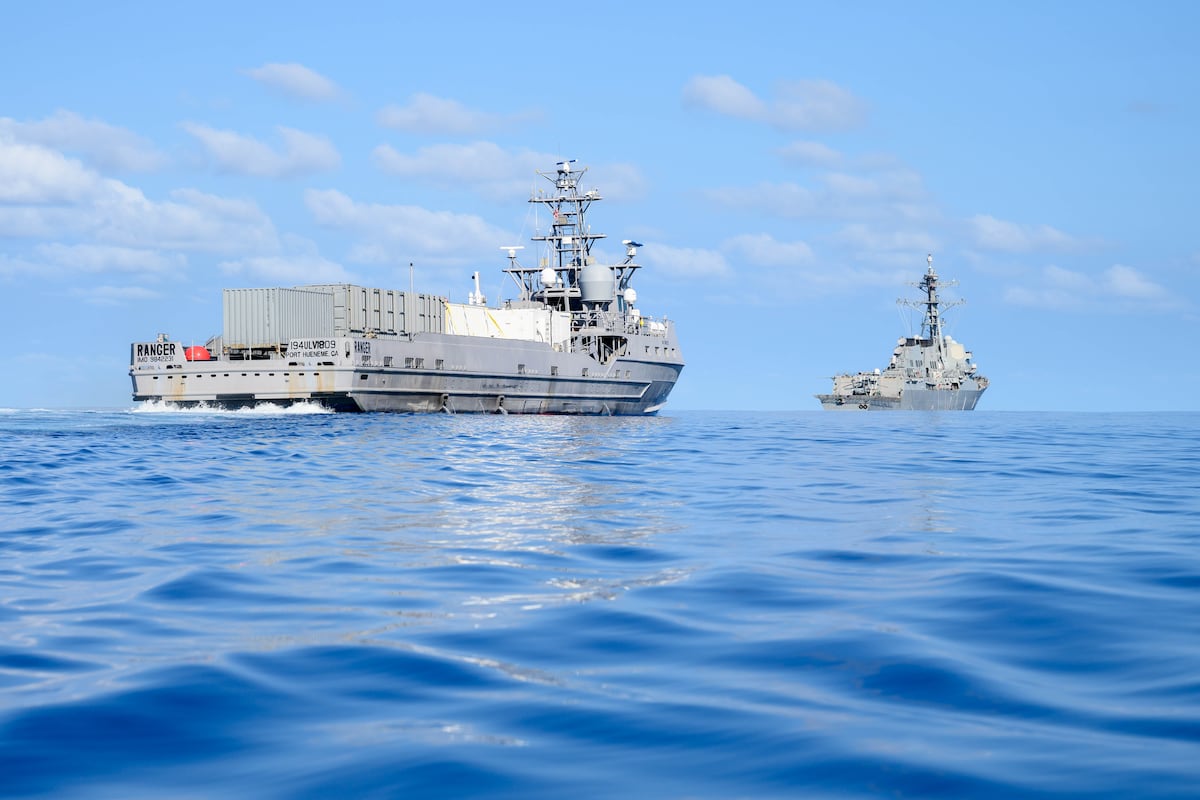
Caption: USV Ranger trailing the missile destroyer USS Shoup during a Pacific transit, illustrating medium USV operations alongside manned warships | Credits: Jesse Monford/U.S. Navy
Geopolitical Impact — Strategic, Operational and Regional Consequences
Strategically, a rapid increase of medium USVs in the Indo‑Pacific enhances U.S. capacity for persistent presence and distributed sensing without proportionate increases in crewed hulls, complicating adversary targeting and expanding options for escalation management. By dispersing sensors and effects across unmanned platforms, the Navy can increase surveillance density, harden command resilience and create a more graduated set of coercive and non‑coercive tools for day‑to‑day competition.
Operationally, the scale‑up shifts key logistical and command questions ashore and afloat. Forward basing, regional maintenance hubs, contractor support chains and theater‑level unmanned squadrons will determine sustainability. Those arrangements create new dependency vectors—on host‑nation access, commercial maintenance networks and secure logistics flows—that will become focal points for both collaboration with allies and potential pressure from competitors.
Regionally, massed unmanned deployments will alter threat perceptions among Indo‑Pacific states and could provoke adjustments in force posture, surveillance investments and doctrine. The presence of large unmanned cohorts raises sensitive legal, attribution and escalation issues: rules of engagement, identity validation for autonomous vessels, and cyber/electromagnetic hardening will be politically salient. Adversaries or competitors may respond by accelerating their own unmanned programs, investing in counter‑USV systems, or seeking diplomatic constraints on unmanned operations in contested waterways.
Risk management priorities should include robust, resilient command‑and‑control architectures; hardened communications and cyber defenses; transparent allied interoperability frameworks; and deliberate basing agreements that distribute maintenance burden while minimizing single points of failure. Done well, the USV expansion offers a cost‑effective means to sustain presence and complicate adversary planning. Done poorly, it creates logistic and legal vulnerabilities that could blunt operational advantage and raise friction across the Indo‑Pacific security environment.