
The United States' announced pause in active combat operations with Iran will not mark an immediate withdrawal: senior U.S. officials signal a sustained, visible military presence across the region to consolidate battlefield gains, deter rapid re-escalation and protect strategic interests while diplomacy is given room to advance.
Current operational snapshot and immediate implications
U.S. leaders portray the recent 38-day campaign—branded Operation Epic Fury—as delivering heavy blows to Iran's conventional military capacity, citing a high tempo of strikes and widespread degradation of air defenses, missile and drone infrastructure, and maritime assets. Pentagon statements recount more than 800 strikes and assert major attrition of Iranian combat systems; official casualty figures for U.S. forces during the campaign stand in the low double digits killed and several hundred wounded. The administration’s decision to declare a two-week ceasefire reflects a short-term shift toward negotiation, yet senior officials emphasize that U.S. forces will remain in the theater, prepared to resume operations if the pause collapses. Operational messaging from the chairman of the Joint Chiefs framed the ceasefire explicitly as a “pause,” underscoring continued readiness and deterrence posture.
Historical patterns and strategic precedent in regional campaigns
Maintaining forces after the cessation of major hostilities follows a recurrent U.S. pattern of post-conflict forward presence intended to stabilize outcomes and preserve leverage for diplomatic follow-up. Commanders’ accounts that Iran employed a decentralized command approach and sustained a high daily rate of drone and missile attacks throughout the campaign illustrate why U.S. planners are reluctant to withdraw precipitously: asymmetric, dispersed capabilities survive kinetic degradation of centralized hardware. Control of key maritime chokepoints—most notably the Strait of Hormuz—has repeatedly proven to be a strategic pressure point in past confrontations, and Tehran’s ability to exert influence there during the fighting sent energy-security signals throughout international markets. The current pause therefore resembles earlier episodes in which battlefield pauses transitioned into protracted security commitments aimed at preventing rapid reconstruction of adversary capabilities.
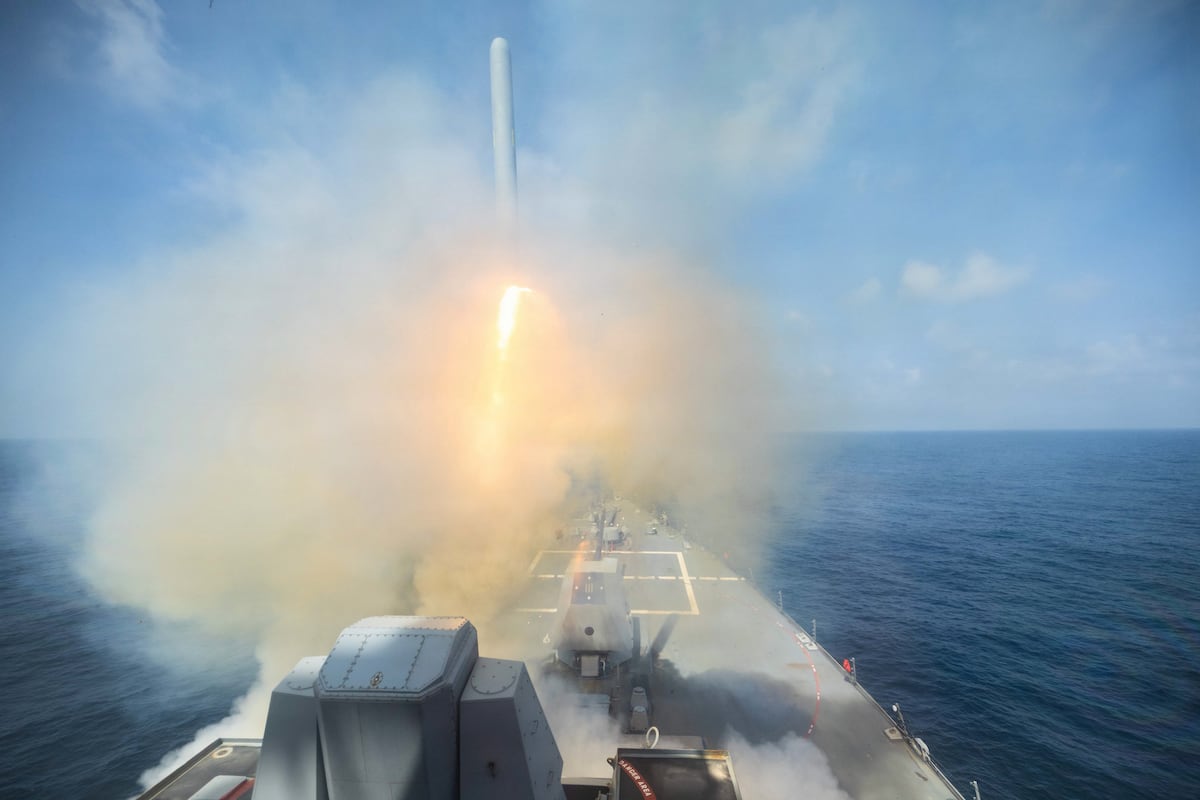
Caption: U.S. Arleigh Burke-class destroyer firing a Tomahawk in support of Operation Epic Fury | Credits: U.S. Navy
Geopolitical consequences and strategic trajectories
Short-term: Retaining U.S. forces in the region during the armistice preserves coercive options and reassures partners, but it also sustains friction points that could trigger incidents. Tehran’s capacity to continue dispersed attacks even after heavy material losses raises the risk that low-level strikes will persist, compelling a durable American presence to protect shipping, bases and regional allies.
Medium-term: A continued U.S. footprint will shape diplomatic dynamics. It expands Washington’s leverage in negotiations over sensitive issues—most notably enriched uranium stockpiles—but also complicates local politics by reinforcing narratives of occupation among Tehran’s regional interlocutors. Public U.S. statements that seizure of nuclear material remains an option introduce a further layer of escalation risk and legal ambiguity that could harden Iranian domestic resolve and complicate third-party mediation.
Long-term: If forward-deployed forces remain for an extended period, the United States will once again confront the familiar trade-offs of presence: deterrence and rapid response capability versus financial, political and human costs, and the potential for mission creep. Allies and partners will judge Washington by its ability to convert military presence into a stable political settlement; failure to do so risks regional realignment as states hedge their security and economic ties. Finally, energy-market volatility tied to threats in the Strait of Hormuz underscores the broader international stakes: prolonged instability could sustain higher energy prices and incentivize other powers to deepen their regional roles, altering the strategic balance beyond the immediate U.S.–Iran confrontation.