
Poland’s public alarm after Washington abruptly halted a planned nine‑month rotation of more than 4,000 U.S. soldiers to the eastern NATO flank exposes a widening gap between rhetorical alliance commitments and the practical guarantees that Warsaw—and other frontline states—need to deter Moscow.
Current situation: Abrupt cancellation and Warsaw’s concerns
The U.S. decision to cancel a large Army rotation has prompted senior Polish leaders to publicly question the stability of the American security umbrella in Central and Eastern Europe. Warsaw frames the issue not only in military terms but also through the prism of deep economic interdependence with U.S. defense industry suppliers: Polish officials emphasize multibillion‑dollar purchases of American platforms—Abrams tanks, advanced fighters, attack helicopters, air defense systems and long‑range rocket artillery—as evidence of reciprocal strategic commitment. Poland’s defense minister and prime minister have sought reassurance that any U.S. force‑posture adjustments will not reduce the footprint of troops already present in Poland, where roughly 10,000 U.S. personnel operate largely on a rotational basis.
Polish messaging mixes pragmatic expectation with political pressure: Warsaw highlights the financial and logistical burdens it assumes to host U.S. rotations and warns that reorganization of the U.S. presence should not be conducted at Poland’s expense. The cancellation therefore functions as both a security alarm and a negotiating lever in Warsaw’s bilateral interactions with Washington.
Historical context: Evolution of U.S.–Poland military ties since Russia’s interventions
Poland’s modern security posture has been heavily shaped by the post‑1991 enlargement of NATO and, more decisively, by Russian aggression in 2014 and the full‑scale invasion of Ukraine beginning in 2022. Those events prompted NATO to reinforce its eastern flank through increased rotational deployments, multinational battlegroups, and enhanced exercises. Poland, situated on NATO’s frontline, has simultaneously deepened defense procurement ties with the United States, seeking interoperability through purchases of U.S. tanks, fighters, helicopters, air‑defense batteries and rocket artillery. Over recent procurement cycles Warsaw has committed tens of billions of dollars to U.S. defense equipment, reflecting a strategy of coupling host‑nation basing with high‑end capability acquisition to harden its deterrence posture.
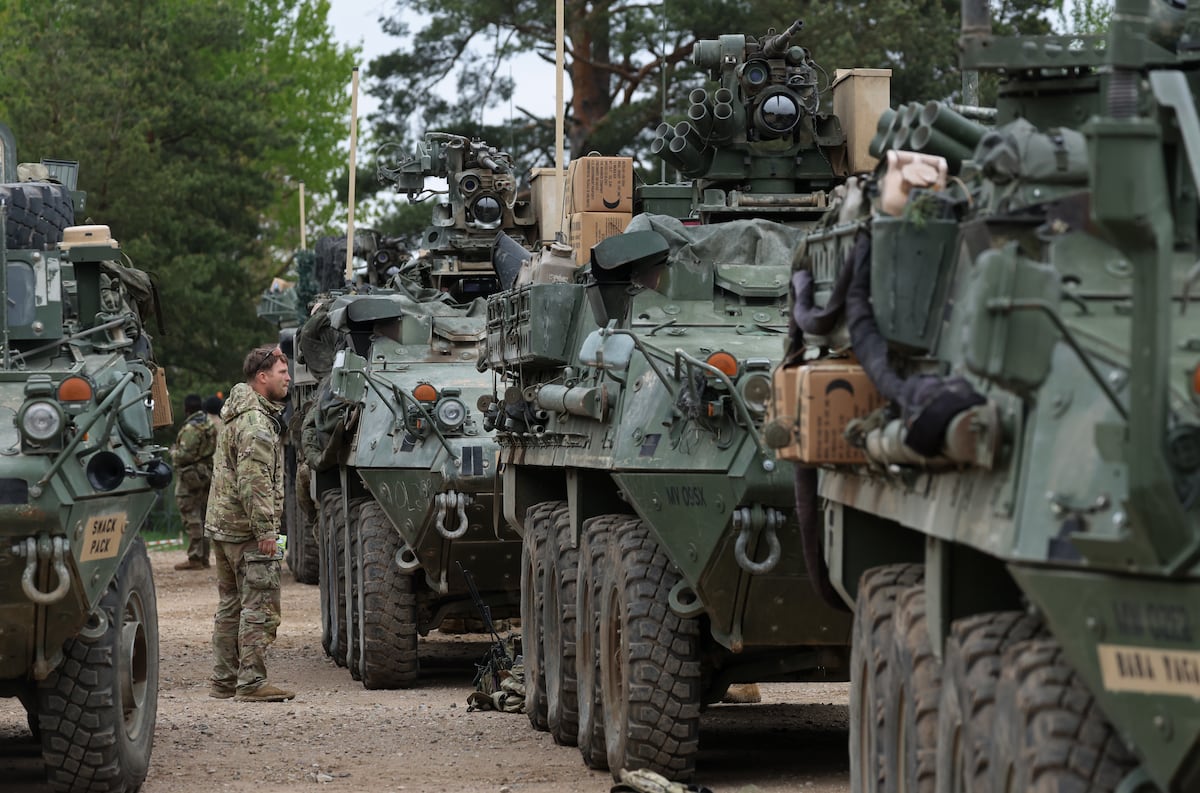
Caption: U.S. Army 2nd Cavalry Regiment Stryker Brigade during Amber Shock 26 NATO exercises near Bemowo Piskie, Poland | Credits: Sean Gallup/Getty Images
Geopolitical impact: Alliance credibility, regional deterrence, and strategic ripple effects
The immediate strategic consequence is reputational: an unexpected drawdown—or the perception of one—erodes reassurance and complicates NATO cohesion at a moment when unified signaling matters most. For Poland, the episode sharpens incentives to diversify deterrence measures: accelerate domestic force development, deepen stockpiling and prepositioning of materiel, expand bilateral arrangements with other NATO allies, and leverage procurement ties to secure additional political guarantees from Washington. Such responses, however, are costly and may exacerbate security dilemmas in the region.
At the alliance level, Washington’s recalibration could fuel debates over burden‑sharing and force posture priorities, pressuring NATO to articulate alternatives to forward rotational forces—such as enhanced rapid‑reinforcement mechanisms, persistent prepositioned equipment, or multilateral permanent presences—to maintain deterrence credibility. For Russia, any sign of wavering allied presence may be read as diminished Western resolve, increasing the risk of coercive actions below the threshold of open conflict. Conversely, NATO’s political and military leadership can counter those perceptions through visible, high‑profile exercises, strengthened command-and-control, and clearer guarantees to frontline states.
Politically, Warsaw’s public reaction also serves domestic purposes: signaling to Polish audiences that government leaders are actively defending national security interests and extracting diplomatic concessions from the United States. Longer term, persistent uncertainty about U.S. force posture may push Poland and other eastern members to institutionalize additional security measures within the EU and NATO frameworks, thereby reshaping the regional balance of deterrence and alliance politics.