
The latest exchanges between U.S. naval forces and Iranian military units in the Strait of Hormuz — including Iranian missile, drone and small-boat salvos against Arleigh Burke-class destroyers and subsequent U.S. strikes on Iranian launch and command sites — mark a dangerous spike in a long-running confrontation; the incident combines maritime coercion, shore-based counterstrikes, and high-level political signaling at a moment when negotiators are reportedly discussing a memorandum to end the broader conflict and constrain Iran’s nuclear activities.
Immediate Situation Overview
U.S. Central Command reports that Iranian forces launched coordinated attacks involving missiles, unmanned aerial systems and fast small craft against three U.S. destroyers — USS Truxtun, USS Rafael Peralta and USS Mason — while they transited the Strait of Hormuz toward the Gulf of Oman. U.S. warships were not hit, and U.S. forces responded with precision strikes against Iranian missile and drone launch sites, command-and-control nodes and intelligence, surveillance and reconnaissance facilities. CENTCOM framed the retaliatory strikes as limited and defensive while stressing it does not seek broader escalation. Separately, U.S. forces earlier neutralized several Iranian small boats and intercepted cruise missiles and drones during escort operations under Project Freedom, which is now paused. Political messaging from Washington has emphasized the strikes’ limited nature even as senior leadership signals confidence that any wider conflict could be resolved quickly; concurrently, reports indicate ongoing deliberations over a peace memorandum that would aim to end hostilities and restrict Iran’s nuclear program.
Historical Background and Patterns
The engagement fits a recurring pattern of maritime contestation and calibrated strikes that has characterized U.S.–Iran relations for decades: asymmetric Iranian tactics at sea, including fast-boat harassment and unmanned systems, have often been met by U.S. naval defensive actions and selective counterstrikes aimed at degrading launch capabilities and C2 infrastructure. These cycles of provocation and limited retaliation reflect strategic restraint on both sides designed to avoid full-scale war while attempting to preserve deterrence and operational freedom in a vital chokepoint for global energy and commerce. The present incident should therefore be read as the latest iteration of a long-standing security dynamic in the Persian Gulf rather than an isolated departure from past behavior.
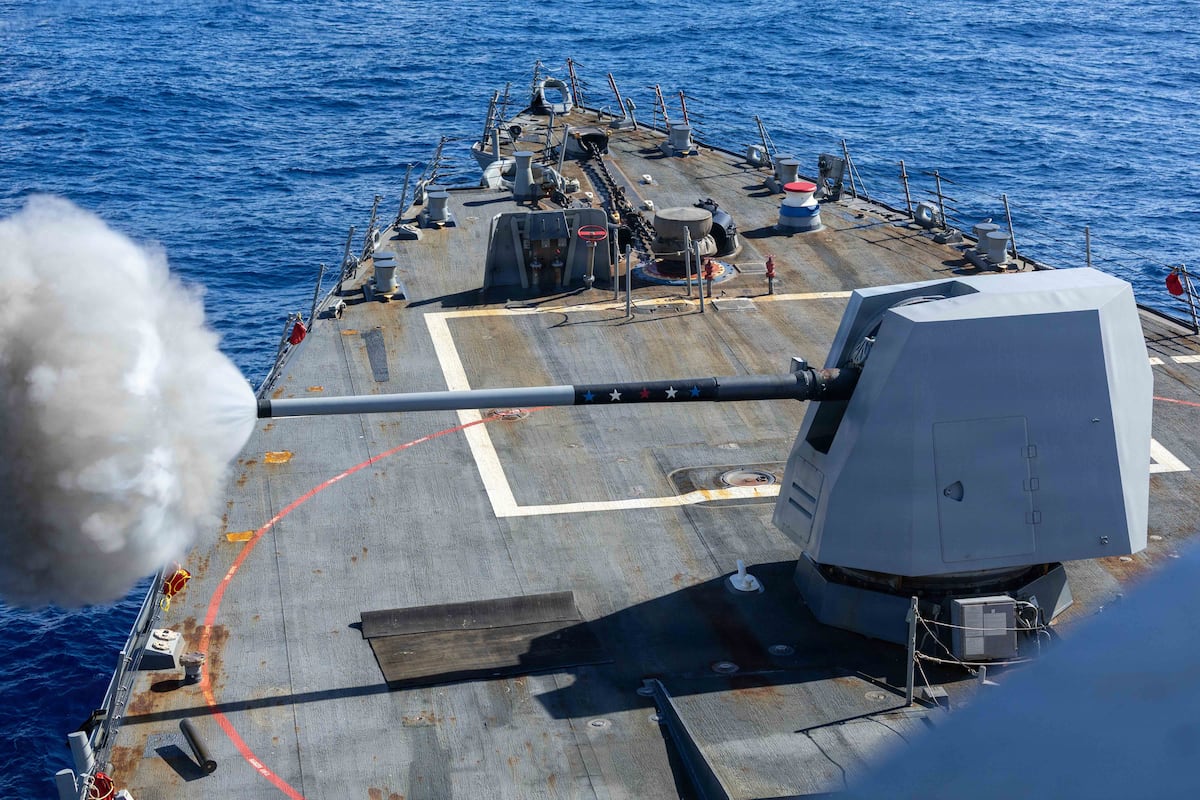
Caption: USS Truxtun conducting a live-fire exercise, April 17, 2026 | Credits: MCS2 Maxwell Higgins/U.S. Navy
Regional and Global Geopolitical Consequences
The incident amplifies several strategic risks and short-term consequences. Militarily, it underscores Iran’s ability to combine shore-based fires, drones and fast-boat tactics to threaten transits in the Strait of Hormuz and to impose costs on naval escorts; the U.S. response demonstrates persistent conventional superiority in strike and ISR capabilities but also highlights the peril of miscalculation during close-range maritime encounters. Diplomatically, the clash complicates negotiations over any settlement: a draft memorandum to end the war and constrain Iran’s nuclear program could be accelerated if both sides judge de-escalation politically useful, but renewed kinetic exchanges increase bargaining friction and harden domestic audiences on each side. Regionally, Gulf states and commercial shipping operators face heightened insecurity that could trigger insurance and rerouting costs, pushing up energy market volatility. For allies and partners, repeated U.S.–Iran skirmishes raise questions about burden-sharing for maritime security operations and the sustainability of escort missions like Project Freedom. Strategically, the episode invites third-party actors to recalibrate their posture — states such as China and Russia may exploit diplomatic openings or offer mediation, while regional rivalries could intensify via proxy actors.
Policy implications: immediate priorities should be to preserve deconfliction channels, reinforce multinational maritime security cooperation, limit retaliatory measures to specific military objectives to avoid escalation, and sustain parallel diplomatic tracks that can convert the nascent memorandum talks into a durable cessation framework. Absent effective risk management, the pattern of episodic strikes risks widening into broader regional confrontation with significant economic and security costs.