
The U.S. Army’s proposed $2.1 billion increase in research and development funding within a $253 billion budget request signals a deliberate shift toward faster, higher-risk technological investment aimed at narrowing the gap with peer adversaries — but it also renews tensions between operational agility and congressional oversight at a time when acquisition failures and fiscal accountability remain politically sensitive.
Funding Shift and Immediate Allocations
The 12.9% year-over-year rise in Army R&D funding — from $16.6 billion in FY2026 to $18.7 billion in FY2027 — reallocates resources toward next-generation capabilities and platforms rather than incremental sustainment. Notable line items include a $2.9 billion general science and technology pool intended for systems the Army expects to field toward 2040, $904 million for Next Generation Command and Control (NGC2) to scale prototypes into service-wide networking and decision-support fabrics, $2.1 billion directed to the MV-75 Cheyenne II tiltrotor as a future long-range assault aircraft, $474 million for the M1E3 Abrams modernization, and $1.1 billion to transition THAAD to Army control. These choices prioritize speed, connectivity, and platform leap-ahead performance — especially in mobility, networked C2, armored survivability and theater missile defense.
However, the same submission reduces budget lines tied to audit and financial management oversight — reportedly consolidating auditing lines from 41 to 4 — prompting lawmakers to warn that flexibility can translate into diminished transparency. Army leadership frames the flexibility as necessary to respond to rapid technological change and shorten acquisition timelines, emphasizing new data tools such as the Vantage dashboard to provide visibility into expenditures.
R&D Spending in Army Modernization: A Brief History
The current increase is best understood as the latest phase in a decades-long effort to prevent capability obsolescence as threats evolve. Post–Cold War budgets prioritized readiness and rotating platforms through incremental upgrades; the 1990s and 2000s saw programs like THAAD and successive Abrams upgrades incrementally enter the force. By the 2010s, strategic competition with near-peer adversaries shifted emphasis toward modernization across layered fires, long-range precision, air mobility and resilient command-and-control. The Black Hawk’s half-century service life exemplifies why the Army is now investing in ventures such as the MV-75: to avoid fielding airframes and systems that cannot operate effectively in contested, digitally networked environments.
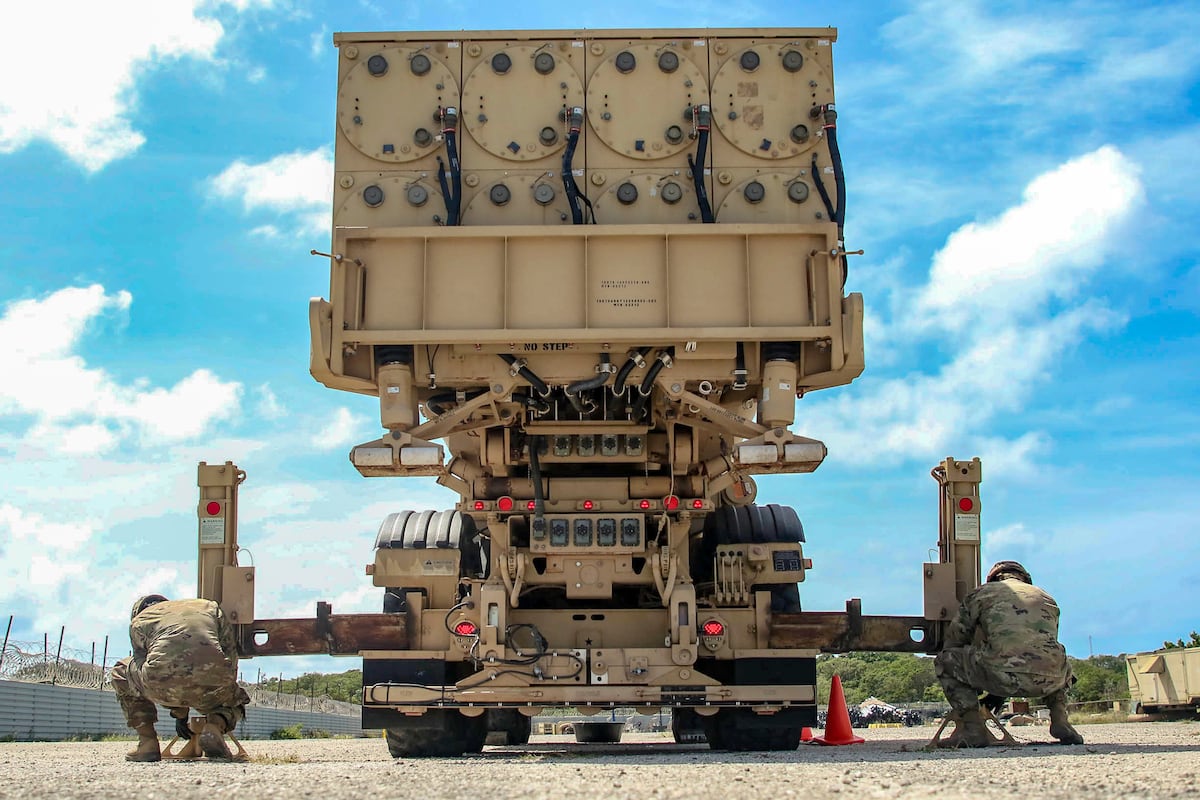
Caption: U.S. soldiers train with integrated missile defense and C2 systems, reflecting the Army’s emphasis on networked, layered defense | Credits: Capt. Adan Cazarez/U.S. Army
Strategic and International Ramifications
Geopolitically, the funding surge serves several overlapping objectives. First, it signals deterrence intent to competitors by investing in advanced mobility, precision engagement and resilient C2 that would complicate adversary campaign plans in both the Indo-Pacific and Europe. NGC2 and Palantir-enabled data tools are explicitly intended to accelerate decision-making cycles — a capability that is central in countering peer-level threats.
Second, concentrated R&D investments reshape the industrial base and alliance dynamics. Large-scale programs like the MV-75 and M1E3 will drive supplier specialization and may favor prime contractors with scale, potentially consolidating portions of U.S. defense industry capacity. Allies will watch procurement choices closely: interoperability with NATO partners and regional forces will determine whether U.S. advances translate into collective advantages or produce capability gaps between partners that complicate coalition operations.
Third, reduced on-budget audit lines and greater reprogramming flexibility raise governance risks. Without robust financial controls and clear congressional engagement, there is heightened exposure to cost growth, schedule slippage and political backlash if promised oversight visibility tools fail to substitute for formal audit readiness. That dynamic could constrain future appropriations or force retroactive remedial measures that slow fielding.
Finally, the strategic payoff depends on execution speed and integration. If the Army shortens acquisition timelines without sacrificing lifecycle sustainment and accountability, these investments can materially improve survivability, reach and tempo. If not, the effort risks repeating historical patterns where money is committed to ambitious platforms that underdeliver or burden logistics and sustainment chains — outcomes that would weaken both deterrence and alliance confidence at a critical juncture in great-power competition.