
U.S. defense leadership has rebuffed congressional requests for timelines and political verdicts on the current conflict with Iran, framing the campaign as a necessary, unfinished strategic effort while the country and its allies absorb the diplomatic, operational and fiscal reverberations of a rapidly escalated confrontation.
Operational posture and congressional standoff
The Pentagon’s senior civilian leader declined to prognosticate about the war’s duration during a contentious House Armed Services Committee hearing, defending the administration’s decision to pursue kinetic action and rejecting critiques that seek to characterize the campaign as directionless. Lawmakers pressed for clarity on objectives and endstates even as service chiefs and deployed forces continue operations in the region. Testimony accompanying a record $1.45 trillion fiscal 2027 defense request emphasized significant near‑term costs — a reported $25 billion so far — and a surge in procurement and personnel funding intended to sustain combat operations and replenish expended ordnance.
Administratively, the exchange comes against a ticking War Powers Act deadline that forces a choice between seeking congressional authorization, justifying continued operations on withdrawal safety grounds, or drawing down forces. That procedural pressure compounds political friction on Capitol Hill, where members of both parties questioned strategic clarity and personnel decisions inside the department, including recent senior officer removals that have fed debates about military culture and civilian oversight.
Historical precedents and recent escalation
The current campaign follows a pattern familiar in post‑Cold War U.S. interventions: rapid initial kinetic effects, contested political narratives at home, and an uncertain pathway from tactical success to strategic closure. Historically, conflicts such as Iraq and Afghanistan demonstrate how early operational gains can be followed by protracted political and security challenges when exit strategies and governance plans are underdefined. The administration’s pronouncements of three explicit goals — degrading missile and naval capacities and preventing a nuclear program — established a high bar for what constitutes strategic success.
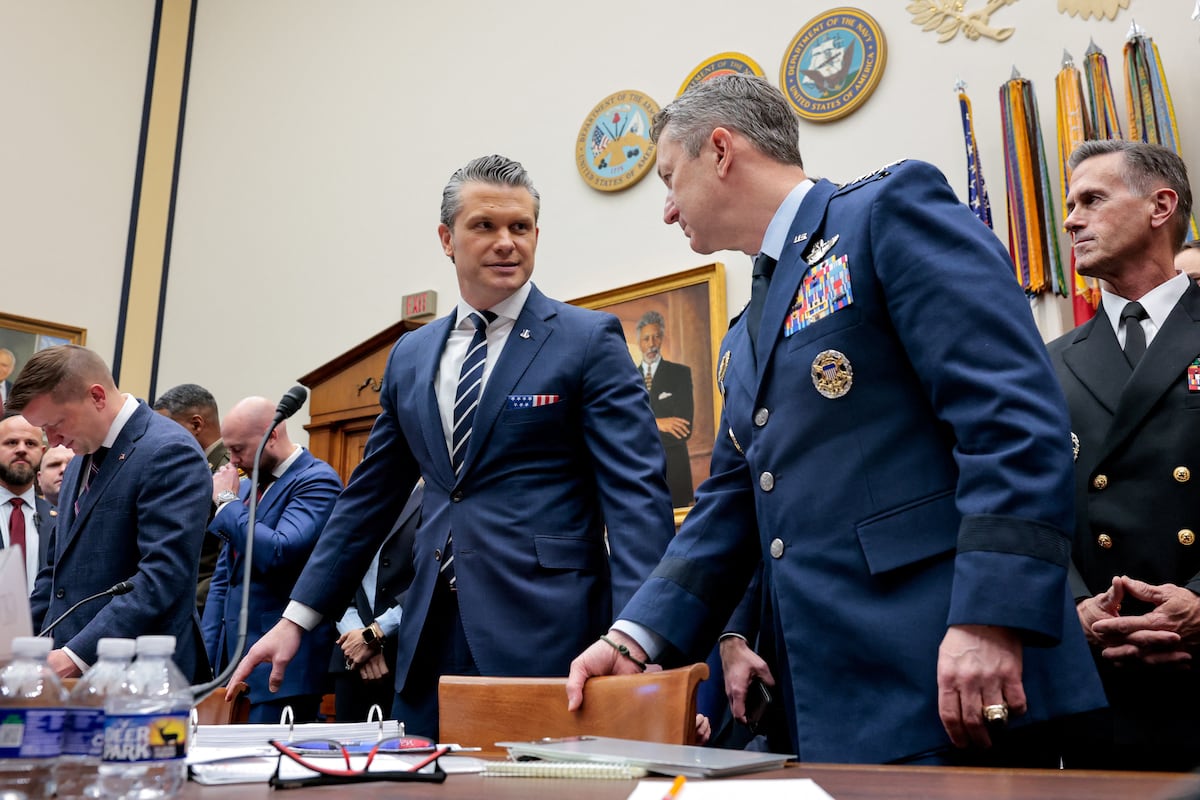
Caption: Defense Secretary testifies before the House Armed Services Committee amid debate over the Iran campaign | Credits: Kylie Cooper/Reuters
Regional ripple effects and strategic implications
The campaign’s near‑term effects have been twofold: demonstrable kinetic damage to Iranian military infrastructure and leadership, and reciprocal strikes that have inflicted casualties and damage across the region. Those dynamics deepen instability in an already volatile theater and raise the probability of asymmetric reprisals by state and non‑state actors. Strategically, the confrontation risks accelerating an arms‑competition logic in the Middle East — particularly around nuclear and missile capabilities — and compels partners and rivals to reassess force posture and alliance commitments.
Domestically, the conflict has crystallized partisan divisions over executive war powers, defense spending and civil‑military relations. A historic budget uplift coupled with rapid force expansion aims to put the defense industrial base “on a war‑time footing,” but it also locks in fiscal and procurement trajectories that will shape U.S. military options for years. Internationally, U.S. reliance on kinetic measures without broad multilateral endorsement may erode legal and diplomatic standing in some forums, complicating efforts to build durable security architectures in the region.
Outlook: Short of a negotiated settlement that produces verifiable constraints on Iran’s nuclear and missile ambitions, the most likely mid‑term scenario is a drawn‑out security competition marked by episodic strikes, contested maritime security, and sustained pressure on regional partners. Policymakers face a narrow set of choices — seek clearer congressional authorization and a political endstate, broaden international coalitions to share risk and legitimacy, or accept an extended period of heightened contingency operations with attendant economic and strategic costs.