
Italy’s decision to acquire six Airbus A330 MRTT tankers for approximately €1.4 billion marks a clear tactical and symbolic shift toward European defense equipment: it replaces a decade-and-a-half reliance on Boeing-derived tankers, embeds a decade of logistical support, and aligns Rome more closely with continental air-refuelling standards at a moment when European states are actively pursuing greater defence industrial cooperation and operational commonality.
Deal Overview and Immediate Implications
The announced contract covers the purchase of six A330 Multi Role Tanker Transport aircraft and a ten-year logistics package, a single-source award revealed through the EU’s TED procurement platform. Operationally, the A330 MRTT is a multi-role platform that enhances aerial refuelling capacity while providing strategic airlift and aeromedical evacuation flexibility beyond Italy’s current Boeing 767-based tankers. For the Italian Air Force, which has operated four B-767 tankers since 2011, the acquisition represents a near-term boost in reach and sortie generation capacity and a medium-term shift in sustainment and training pipelines toward Airbus and European supplier networks.
Practically, the inclusion of ten years of support reduces near-term sustainment uncertainty and indicates a preference for lifecycle certainty over potentially faster or cheaper alternatives. The fact that the A330 was the only bidder—and that Rome previously considered then suspended a KC-46 purchase—underscores procurement friction in cost, delivery timing, and industrial-political calculus that shaped the final choice.
Procurement Backdrop and Historical Trajectory
Italy’s tanker procurement history over the past decade-and-a-half reflects oscillation between U.S. and European solutions. The four Boeing 767-derived tankers entered service from 2011. In 2021 Rome planned upgrades and two additional tankers, and in 2022 moved toward buying six Boeing KC-46 aircraft under a roughly €1.1 billion program. That KC-46 plan was suspended and ultimately halted amid concerns about costs, delivery schedules and “changed and unforeseen needs,” prompting a 2024 review that reopened Airbus as a contender.
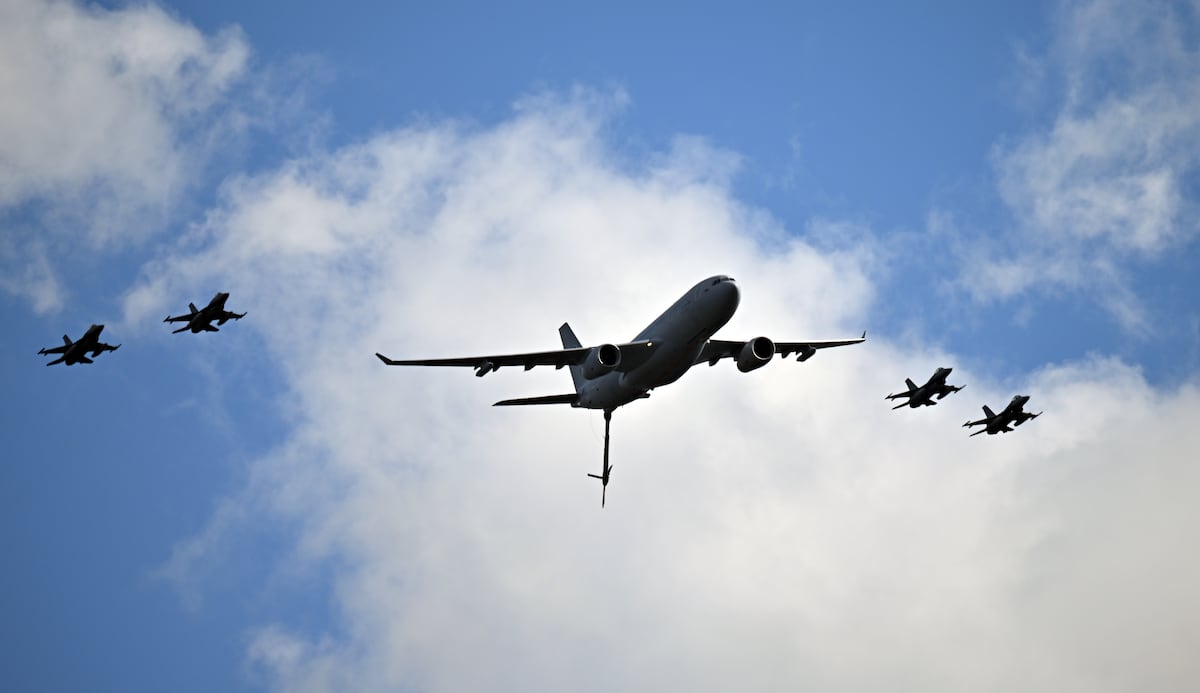
Caption: An A330 MRTT of NATO partners on display during a European airshow, illustrating the platform’s multinational use | Credits: Dursun Aydemir/Anadolu via Getty Images
Strategic and Geopolitical Consequences
This procurement carries layered geopolitical consequences. Strategically, choosing the A330 MRTT harmonises Italy’s tanker fleet with several key European partners—France, Spain and the U.K.—and with NATO pooling arrangements, enhancing interoperability for coalition air refuelling, rapid reinforcement and sustained air operations across Europe, the Mediterranean, and expeditionary theaters. Greater commonality promises efficiencies in joint logistics, training, and deployment planning, particularly for recurring missions such as Baltic air policing, Mediterranean security, and operations supporting stabilization efforts in North Africa and the Sahel.
Politically and industrially, Rome’s pivot signals stronger preference for European defence industrial cooperation and resilience. The move reduces dependency on U.S.-origin tankers and provides potential industrial and maintenance workshare for European suppliers and Italian industry, supporting domestic jobs and sovereign sustainment capacity. At the same time, the decision risks frictions with U.S. suppliers and may be read in Washington as part of a broader European drive for strategic autonomy—an interpretation amplified by recent U.S. political rhetoric that has strained transatlantic defence dialogue. Nevertheless, equipment procurement changes do not equate to alliance rupture: NATO interoperability remains central, and Italy will continue to rely on U.S.-supplied systems across many defence domains.
There are operational and programmatic caveats: a single-bid procurement raises questions about competitive value, and transitioning platform types entails retraining, infrastructure adaptation and interim capability management. Monitoring the delivery schedule, offset and industrial-participation clauses, and how Italy leverages the ten-year logistics contract to build national maintenance capacity will be critical. Longer term, this purchase may accelerate European consolidation in key enablers (tankers, transports, ISR), shaping alliance logistics and industrial balances and nudging future procurement choices toward interoperability with continental partners.