
The unexpected crash of Ukrainian-launched drones inside Latvian territory — striking an empty fuel depot and prompting the resignation of Latvia’s defense minister — has underscored a growing strategic fault line in the Baltic theatre: the lethal intersection of long-range unmanned strike missions, Russian electronic-warfare countermeasures, and fragile NATO territorial defenses. This episode crystallizes immediate operational failures, political fallout at the alliance’s periphery, and longer-term implications for air-defense posture, alliance cohesion, and escalation management between Russia, Ukraine and NATO members.
Incident Overview and Immediate Developments
On May 7, two drones that Ukrainian authorities acknowledge having launched transited from Russian airspace and impacted an oil-storage facility roughly 40 kilometers inside Latvia, damaging four empty storage tanks and causing a localized fire that covered about 30 square meters. No casualties were reported, but the strike triggered school closures, municipal air-raid alerts, and a scramble of French NATO Baltic Air Policing fighters. Latvian officials initially cited civilian-safety concerns for not engaging the drones; the defense minister later publicly reversed course, asserting a duty to shoot down hostile aircraft. That reversal, and the broader perception of inadequate defensive measures along the Latvian eastern frontier, precipitated a political crisis that culminated in the defense minister’s resignation and rapid appointment of a military successor.
Patterns and Precedents: Drone Warfare, Electronic Warfare and the Baltic Frontier
This event is the latest in a string of errant or redirected Ukrainian drones that have crashed into Baltic territory during the wider Russia–Ukraine conflict. Earlier incidents in the same year affected all three Baltic states, feeding a debate over whether Russia is employing sophisticated electronic-warfare (EW) tactics to seize control of inbound munitions and send them back toward neutral third-party airspace. Ukraine’s public attribution that the recent incursions were the result of Russian EW deliberately diverting its drones is the most explicit confirmation to date of that dynamic.
From a historical perspective, the incident reflects two linked trends. First, the progressive export of long-range, relatively low-cost unmanned strike capabilities into contested airspaces has raised the probability of transboundary errors and unintended consequences. Second, modern EW systems — increasingly mobile and networked — are altering the risk calculus for both attackers and defenders, enabling relatively resource-constrained actors to impose operational friction on precision strike campaigns. The Baltic states’ geographic proximity to Russian forward-deployed forces and EW assets has long made their airspace among NATO’s most exposed, a vulnerability accentuated as strike ranges from the Ukraine theatre and the sophistication of countermeasures grow.
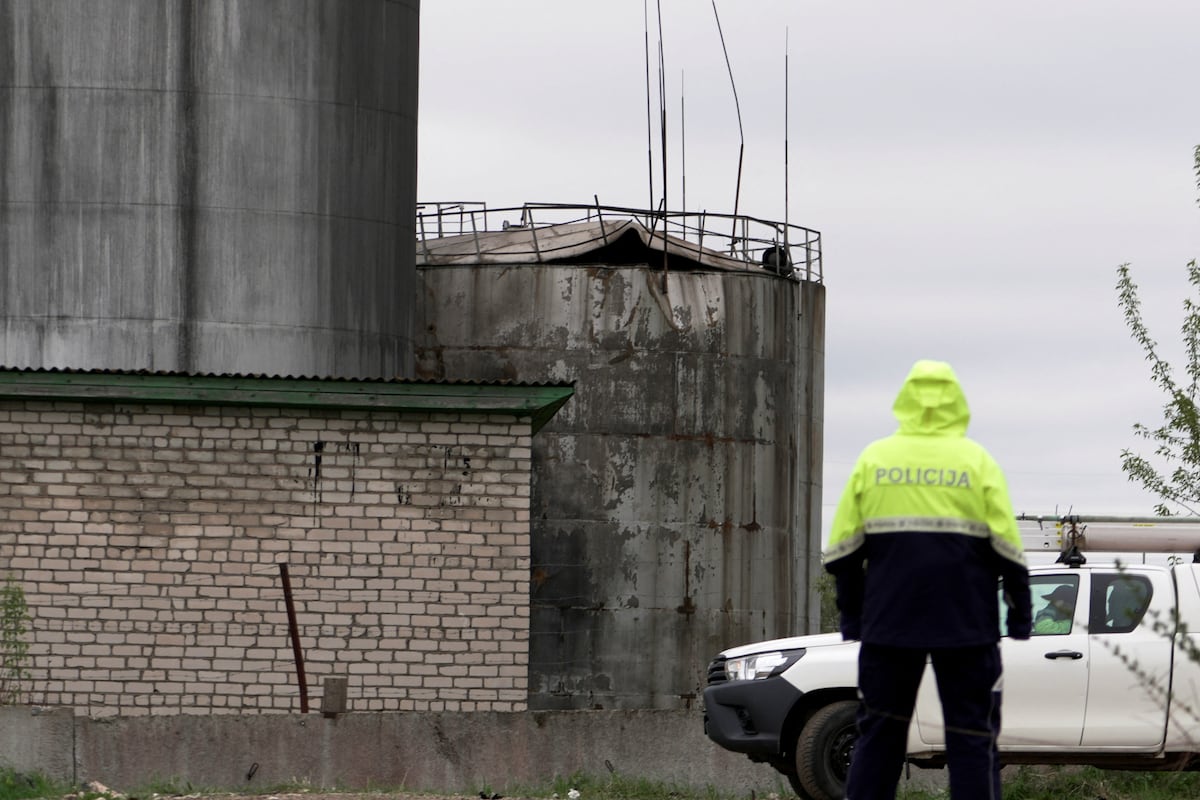
Caption: Damaged oil storage tank at the Rezekne facility following drone impact on May 7, 2026 | Credits: REUTERS/Janis Laizans
Geopolitical Impact and Policy Implications
The strategic consequences are multi-layered. Operationally, the incident exposes critical gaps in regional layered air defenses and counter-unmanned aircraft systems (C-UAS) that allies have long debated but not uniformly prioritized. NATO’s Baltic Air Policing mission provides intercept capacity, yet the recent events highlight that temporary rotations and legacy systems are insufficient against persistent, low-signature threats combined with sophisticated EW. Political fallout is immediate: domestic pressure in Latvia forced ministerial change, while allied capitals now face increased demands to close capability shortfalls quickly.
Diplomatically, the episode creates a potential wedge that adversaries could exploit. Russian use of EW to redirect third-party airspace incidents — if confirmed and persistent — functions as a deniable asymmetric escalation: it imposes political cost and insecurity on NATO members while keeping kinetic attribution and strategic escalation under thresholds that risk direct alliance involvement. For Ukraine, the tactical utility of long-range drone strikes inside Russia must now be weighed against the risk of inadvertent strikes on neighbors, which could erode political support among frontline allies.
Policy responses should follow three concurrent tracks. First, rapid operational bolstering: deploy additional short- and medium-range air-defense batteries, robust C-UAS layers, and improved persistent radar and sensor coverage tailored to low-RCS threats. Second, resilience against EW: invest in hardened communications, interoperable command-and-control, and electronic-protection measures for both sensors and munitions guidance, while increasing intelligence-sharing about EW signatures and adversary tactics. Third, diplomatic and procedural measures: establish explicit coordination protocols between Ukraine and NATO for strikes near international borders, create shared forensic and attribution mechanisms to limit ambiguity after incidents, and develop political communication plans to manage domestic responses in frontline states.
Ultimately, the Latvia episode is a strategic warning: the diffusion of unmanned strike capabilities plus the maturation of electronic warfare is changing the geography of risk in Europe. Without accelerated capability investments and tighter political-military coordination, similar incidents are likely to recur, increasing the chance of miscalculation, alliance friction, and the inadvertent expansion of a localized conflict into the NATO-Russia arena.