
Roberto Cingolani’s abrupt exit as CEO of Leonardo crystallizes a turning point for Italy’s state-controlled defense champion: a company that expanded rapidly under his three-year mandate, pivoted visibly toward cyber and infrastructure security, and introduced interoperable systems such as the Michelangelo Dome—yet now faces political recalibration that will determine whether its industrial plan is executed or reoriented.
Current situation: leadership change amid a strategic inflection
Leonardo’s CEO change—Cingolani stepping down and Lorenzo Mariani slated to take the helm—occurs against a backdrop of strong commercial performance and corporate expansion. Under Cingolani the firm reportedly added roughly 20,000 employees, saw a marked rise in market valuation, and posted a 33% year‑on‑year increase in first‑quarter core earnings. His signature strategy, framed as “bullets and bytes,” sought to broaden Leonardo’s remit beyond traditional materiel to include cyber, energy and infrastructure security, and to accelerate digitalization across the company.
The immediate operational headlines include the roll‑out of the Michelangelo Dome, an open‑architecture air‑defense node designed to link disparate national assets, and a plan to test the system in Ukraine against drone threats later in the year. Cingolani also cultivated multinational industrial ties—most notably with Germany’s Rheinmetall and Turkey’s Baykar—that he argues are now embedded in Leonardo’s industrial plan and thus resilient beyond his personal relationships.
Key risk points: political oversight of a state‑majority firm, short executive mandates that can truncate continuity, and external pressure to prioritize high‑volume munitions production for the Ukraine conflict rather than longer‑term digital and cyber capabilities.
Historical context: Italy’s defense industrial model and recent wartime pressures
Italy has long maintained a close relationship between the state and strategic industrial assets, balancing commercial performance with national security imperatives. Leonardo emerged from this model as a broad‑based security supplier with both civil and military lines. The 2022 war in Ukraine intensified European demand for conventional weapons and munitions, exposing longstanding debates in capitals across NATO about how to balance urgent battlefield replenishment with investments in next‑generation capabilities such as integrated air‑defense networks and cyber resilience.
Within this environment, management choices at prime contractors have become politicized: governments want guaranteed production of rounds and platforms in high volumes, while executives often favor diversification into higher‑margin digital services and cross‑sector security offerings. The choice of three‑year mandates for leadership at state‑influenced firms, a practice criticized by Cingolani as too short, further raises the risk that industrial transformation programs—typically multi‑year endeavors—can be interrupted by political turnover.
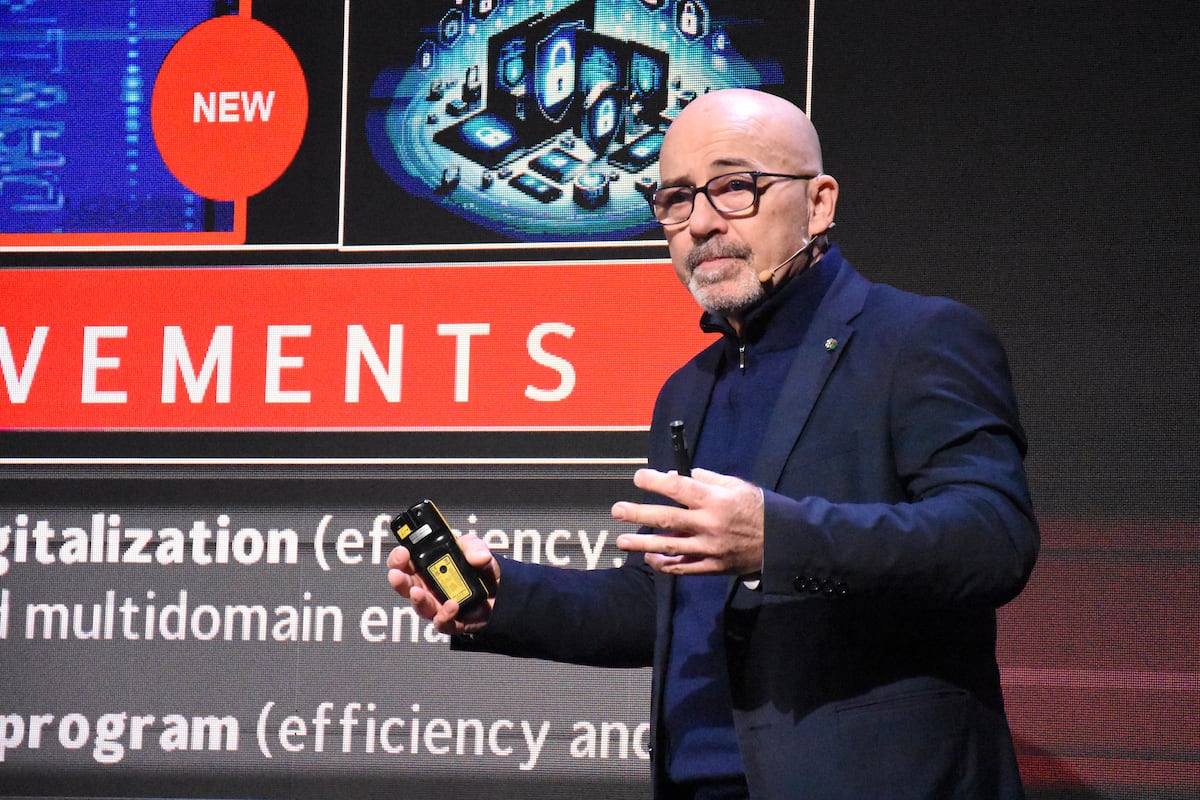
Caption: Roberto Cingolani presents Leonardo’s 2026 industrial plan in Rome as he concludes his three‑year mandate | Credits: Baris Seckin/Anadolu via Getty Images
Geopolitical impact: interoperability, industrial diplomacy and strategic continuity
The Michelangelo Dome’s emphasis on open architecture and asset integration is geopolitically significant. If fielded and validated—especially in an operational environment like Ukraine—it could accelerate allied moves toward modular, networked air‑defense layers that permit national systems and allied contributions to operate jointly. That interoperability is a force multiplier for NATO and EU partners seeking rapid, cost‑efficient increases in defensive coverage.
Testing in Ukraine also institutionalizes Ukraine as a de facto testbed for European defense innovation, with attendant benefits and risks: real‑world validation can speed procurement and doctrinal adoption but also raises legal, reputational and escalation considerations for companies and their home states. Leonardo’s partnerships with Rheinmetall and Baykar reflect a broader European trend toward cross‑border industrial consolidation and pragmatic cooperation—but they are sensitive to political shifts. Relationships enabled by executives’ personal networks can be fragile if governance structures and contractual commitments are not fully institutionalized.
At the strategic level, Rome’s decision not to renew Cingolani underscores the political weight of wartime industrial priorities. A shift away from his digitally focused strategy toward mass production of conventional hardware would affect supply chains and alliance burden‑sharing: Europe’s ability to sustain high‑intensity conflict depends on both munitions throughput and on integrated air‑defense and cyber systems that reduce attrition. Italy’s stewardship of Leonardo therefore has outsized influence on EU defense industrial capacity and on transatlantic interoperability.
Policy implications and recommendations: Italian authorities and Leonardo’s new leadership should (1) codify multinational industrial alliances and program contracts to minimize personal‑relationship risk; (2) balance immediate munitions output with sustained investment in cyber and systems integration to avoid hollowing strategic capabilities; (3) consider longer executive mandates or stronger institutional continuity mechanisms to ensure multi‑year industrial plans are executed; and (4) manage export and political sensitivities around partnerships—especially those involving states with complex relations to NATO members—to preserve alliance cohesion and technology security.