
The U.S. Coast Guard’s finalized $3.5 billion contract to procure five new Arctic Security Cutters marks a decisive escalation in Washington’s capacity-building in the High North, blending allied shipbuilding expertise with an explicit plan to restore domestic industrial capability and sustain a persistent maritime presence in increasingly contested polar waters.
Contract and Fleet Expansion: Immediate Situation Summary
The agreement awards Davie Defense Inc. — the U.S. subsidiary of the Inocea group — responsibility for five Arctic Security Cutters (ASCs), raising the planned ASC inventory to 11 hulls under recent executive direction. Production will be split between Gulf Copper facilities in Texas (three ships) and an affiliated yard in Helsinki, Finland (two ships). The first cutter is slated for delivery in 2028, with construction and deliveries extending through 2035. The procurement sits alongside a broader $25 billion funding stream allocated to the Department of Homeland Security from fiscal 2025 reconciliation, of which roughly $13 billion has already been committed to new fleet assets and associated capabilities.
Historical Trajectory of U.S. Polar Capability and Industrial Policy
U.S. icebreaking capability has been chronically thin since the late 20th century: the heavy polar icebreaker Polar Star remains largely singular in its class, supplemented only recently by two medium polar platforms. Successive administrations have recognized the Arctic’s rising strategic value, but investment lagged until recent policy shifts. The present contract is the culmination of accelerated initiatives dating from renewed emphasis on polar operations in the mid-2020s, a trilateral ICE Pact with Canada and Finland to combine technical know-how, and domestic attempts to revitalize shipyard capacity under legislation aimed at reshoring maritime construction. The use of Finnish yards reflects a pragmatic interim approach — leveraging established Nordic icebreaker design and delivery experience to shorten timelines while channeling subsequent work and sustainment tasks into U.S. yards to rebuild the industrial base.
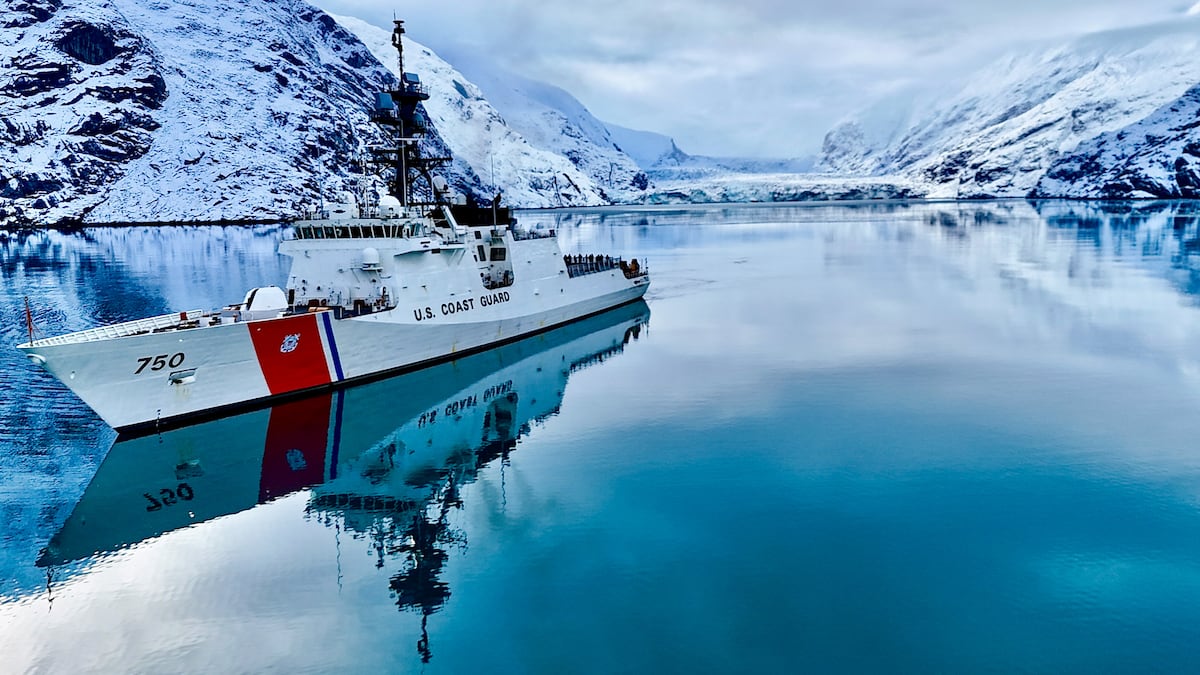
Caption: Coast Guard cutter transiting Alaskan waters, emblematic of increasing polar operations | Credits: Troy Spence/U.S. Coast Guard
Strategic and Geopolitical Implications
The procurement has several clear strategic consequences. Operationally, a modern ASC fleet materially improves U.S. capacity to conduct sovereignty patrols, search and rescue, scientific escort, and law enforcement in ice-covered regions — missions vital to asserting maritime claims and protecting economic corridors and resources. Politically, the contract signals intent to contest growing Russian and Chinese activities in the Arctic by increasing persistent surface presence and by investing in regional infrastructure such as upgraded homeports in Seattle and Juneau.
From an industrial-security lens, splitting construction between Finnish and U.S. yards is a calculated trade-off: it accelerates capability delivery by tapping proven Finnish expertise while aiming to migrate work packages onshore to rebuild U.S. shipbuilding skills and supply chains. That approach, however, invites domestic political scrutiny over jobs and adherence to domestic shipbuilding statutes, and it creates transitional risks — dependence on foreign design and initial construction phases, potential supply-chain bottlenecks, and the need for scaled maintenance and training pipelines.
Diplomatically, the program reinforces trilateral cooperation with Canada and Finland and strengthens transatlantic ties on Arctic governance. It also serves as strategic messaging to Moscow and Beijing that the United States intends to normalize higher-tempo maritime operations in polar theaters. Operational sustainment will require complementary investments: persistent ISR (sensors and surveillance networks), forward logistics and shore infrastructure, cross-domain interoperability with allies, and improved ice-capable aviation and unmanned systems to extend cutter reach.
In sum, the $3.5 billion ASC award is a significant step toward closing a long-standing capability gap, but its ultimate strategic value will hinge on timely deliveries, successful onshoring of sustainment work, and integrated investments in bases, sensors, and allied coordination that convert new hulls into sustained, sovereign presence across the Arctic.