
The U.S. Navy’s decision to advance the MQ-25A Stingray into low‑rate initial production marks the first fielding of an operational carrier‑based unmanned tanker and begins a discreet but consequential transformation of carrier air wing logistics, reach and combat posture.
Operational transition: MQ‑25A moves from development to fleet introduction
Acting Navy leadership has authorized the MQ‑25A program to transition from engineering and manufacturing development into production and deployment following Milestone C approval. That administrative milestone clears the way for a small Lot‑1 low‑rate initial production award this summer, with follow‑on priced options envisaged for subsequent lots. Operationally, the Stingray’s principal mission is organic air‑to‑air refueling from the carrier — a role intended to relieve the F/A‑18E/F Super Hornet of tanker duties so those combat aircraft can prioritize strike, suppression and air superiority tasks. Early flight trials — including a roughly two‑hour sortie controlled from a shore‑based MD‑5 ground station — demonstrate basic flight and remote control integration, but the program will require further testing, deck integration, and carrier qualification before routine fleet employment.
Program evolution: origins, timeline and development milestones
The MQ‑25 effort began with a formal Boeing‑Navy design and development contract signed in 2018 for an initial set of test assets, and has since navigated delays, technical work and iterative test events. Costs projected in public reporting place the full buy at roughly $13 billion for an envisioned fleet on the order of dozens of air vehicles, with an early development contract valued in the low hundreds of millions. The program’s passage to Milestone C reflects completion of major engineering milestones and an assessment that the design is sufficiently mature for controlled production. Yet the path to operational utility has been measured: the first flight came later than originally scheduled, and fielding will proceed incrementally through LRIP as the Navy evaluates carrier integration, maintenance demands, crew procedures and the ability to operate the Stingray alongside manned platforms in the carrier air wing.
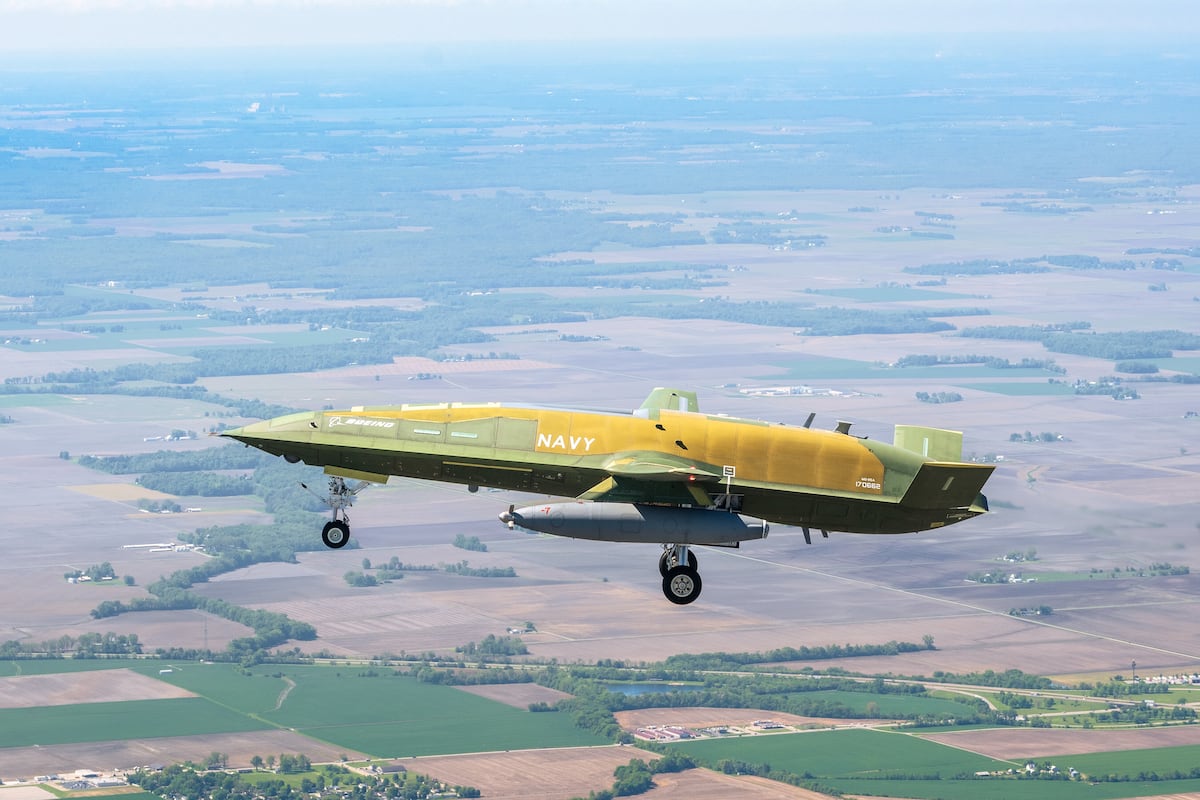
Caption: MQ‑25A Stingray conducts a developmental test flight over southern Illinois as part of early flight testing | Credits: Boeing photo by Eric Shindelbower
Geopolitical and operational implications for U.S. naval power
The operational introduction of a carrier‑based unmanned tanker carries outsized strategic significance despite the program’s relatively limited fleet size in early buys. At the tactical level, organic unmanned fuel provision expands the sortie generation and reach of a carrier strike group by allowing fighters to dedicate sorties to striking or air defense rather than on‑carrier refueling. This increases flexible options for force projection, particularly in the vast Indo‑Pacific theater where distance and dispersed basing complicate sustainment. Strategically, the Stingray contributes to the U.S. aim of preserving manned platforms for high‑value missions, thereby extending air wing longevity and operational tempo against peer or near‑peer opponents.
For potential adversaries, the adoption of unmanned carrier tankers complicates targeting and attrition calculations: adversary air defenses must now account for additional sustainment nodes that enable longer‑range strike axes, increasing the logistical footprint that must be suppressed to blunt U.S. carrier operations. Conversely, the platform introduces new vulnerabilities — chiefly command‑and‑control resilience, electromagnetic and cyber hardening, and susceptibility to adversary electronic warfare or kinetic action — that adversaries will seek to exploit. Integration challenges on the deck and in carrier operations, along with doctrine, training and sustainment pipelines, will determine how rapidly the theoretical advantages translate into decisive tactical and strategic gains.
Finally, the MQ‑25 program underscores broader geopolitical dynamics: a push toward unmanned systems to offset rising costs and personnel constraints; an industrial relationship between prime contractors and the Navy to field next‑generation capabilities; and a calibrated signaling effect to allies and competitors that the U.S. is investing in force structure changes to maintain maritime air superiority and operational reach. How quickly and effectively the Navy scales, defends and employs the Stingray will influence regional deterrence calculations and the evolution of carrier‑centric power projection in contested environments.