
NATO is evolving its eastern deterrence posture from static defenses and symbolic tripwires toward an integrated, sensor-driven “autonomous zone” that leverages unmanned systems, cross-border data links and long-range fires to detect, attrit and punish an incipient Russian incursion before massed forces and civilians are exposed.
Operational Summary: The Eastern Flank’s Autonomous Layer
NATO’s Eastern Flank Deterrence Initiative (EFDI) aims to create a forward operational layer in which unmanned aerial and ground systems, distributed sensors and precision fires operate as the first line of detection and response. Rather than relying solely on forward-stationed human formations as tripwires, the concept emphasizes a networked “kill zone” forward of allied positions that can deny freedom of movement to an attacker through rapid detection, attribution and engagement.
This approach combines real-time data sharing across national boundaries with automated or semi-automated effectors. The alliance is testing connectivity, command interoperability and permissive rules for autonomous responses through exercises and Task Force X experimentation. The immediate goal is practical: prove the concept in live drills, identify gaps in permissions and technical integration, and accelerate procurement and doctrine to make this operational today rather than a distant prospect.
Key operational assumptions informing the design are: (1) unmanned systems can absorb initial attrition and operate in hazardous forward zones humans should avoid; (2) a distributed sensor backbone can create effective domain awareness to ranges that shift the decision calculus for an aggressor; and (3) coupling detection to long-range precision fires provides deterrent and denial effects without requiring large conventional force concentrations on the border.
Historical Lineage: From Tripwires to Networked Denial
NATO’s move toward an autonomous defense zone represents a logical evolution rooted in decades of alliance doctrine. During the Cold War, forward defense and later “flexible response” placed human forces at the frontier to deter or delay Soviet aggression. After the Cold War, smaller expeditionary footprints and reliance on mobilization created vulnerabilities that Russia has exploited since 2014 and most recently in the conflict in Ukraine.
Lessons from Ukraine — notably pervasive drone surveillance, long-range loitering munitions and distributed targeting that can reach tens of kilometers from frontlines — have accelerated changes in allied thinking. Where earlier deterrence emphasized visible force posture and political signaling, the new model blends physical obstacles (anti-tank ditches, fortifications) with invisible, data-driven layers that can detect and engage at speed. That shift mirrors historic NATO transitions: from static fortress defense to combined arms mobility, and now to a hybrid of autonomous sensing and long-range strike.
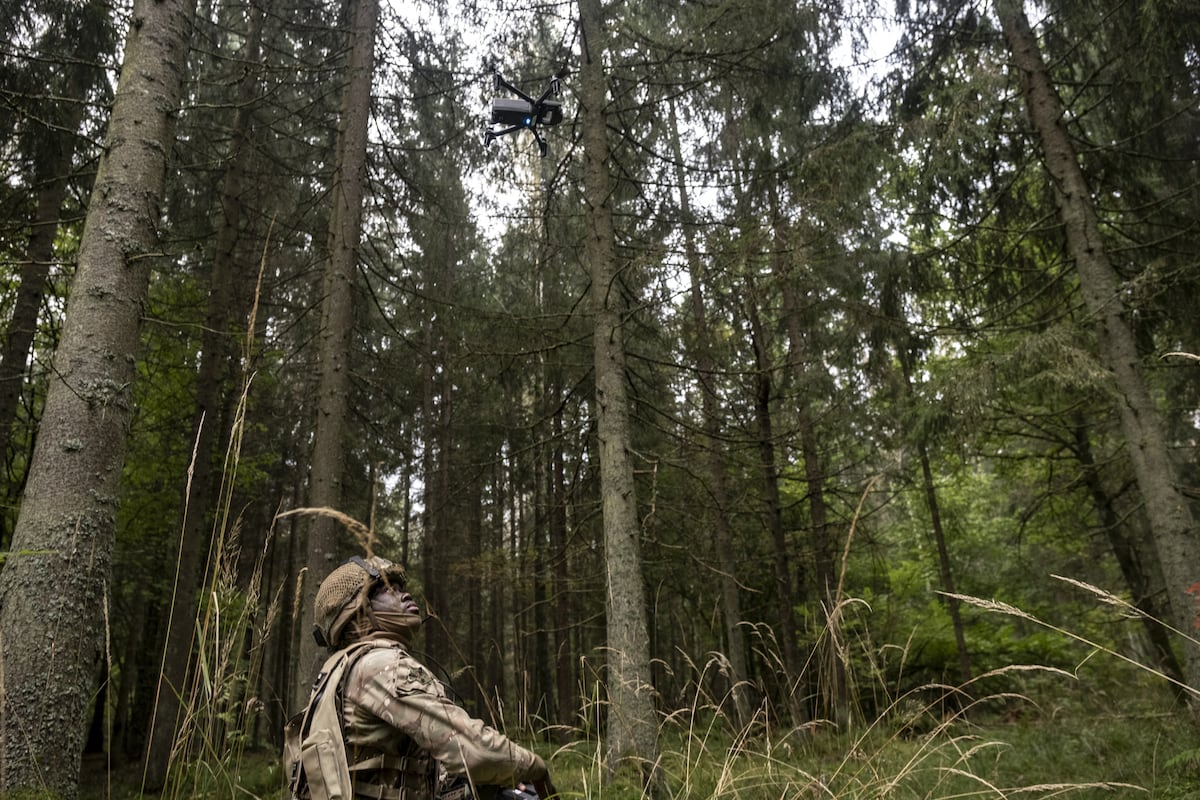
Caption: NATO personnel testing unmanned reconnaissance capabilities during exercises in Latvia | Credits: Damian Lemanski/Bloomberg via Getty Images
Geopolitical Impact: Deterrence, Escalation Risks and Alliance Dynamics
The operationalization of an autonomous zone on NATO’s eastern flank will have immediate and medium‑term geopolitical consequences. Strategically, it strengthens deterrence by denying an adversary the ambiguity that formerly accompanied initial probing attacks. If sensors and automated effectors can reliably detect and punish incursions within hours or minutes, the political calculus for limited aggression — the “nibbling” strategy — becomes far riskier for Moscow.
However, the approach also carries escalation and political risks. Cross-border sensor networks that “trigger” effectors raise legal and sovereignty questions, especially when engagements may occur near or across international boundaries. Differences in national rules of engagement and hesitation about delegating lethal authority to autonomous systems could produce seams an adversary might exploit. NATO will need clear command-and-control protocols and political pre‑authorization frameworks to prevent inadvertent crisis escalation.
Operational dependence on autonomous systems and a shared data backbone creates strategic vulnerabilities of its own. Adversaries will prioritize cyber and electronic-warfare campaigns, deception, and countermeasures to blind or spoof sensors and disrupt the data links that tie detection to effect. Resilience — redundancy of sensors, hardened communications and diversified industrial supply chains — will be as important as the systems themselves.
Politically, the initiative tests alliance cohesion. Rapid fielding requires common standards for interoperability, shared investment in connecting systems, and alignment on controversial issues such as the role of human oversight in kinetic engagements. The countries on the eastern flank, motivated by proximity and recent drone incursions, are eager to move faster; others will demand safeguards and legal clarity. Success depends on reconciling these perspectives into common doctrine and procurement paths that deliver credible capability without fracturing consensus.
Lastly, the shift toward autonomous forward defense will influence Moscow’s doctrinal choices. Faced with a robust sensor-shoot chain, Russian planners may alter force posture — investing more in electronic attack, deep strike, or sub-threshold operations aimed at political destabilization. NATO’s challenge is to make its autonomous defenses both operationally effective and politically controllable so they strengthen deterrence without lowering the threshold for miscalculation.