
Pakistan’s induction of the first of eight Chinese-built Hangor-class diesel-electric attack submarines marks a clear acceleration of Islamabad’s undersea warfare capability and deepens a strategic defense relationship with Beijing that is reshaping naval calculations across the Arabian Sea and the wider Indian Ocean.
Situation Overview: Commissioning, Capabilities, and Program Timeline
The April 30 commissioning in Sanya of the first Hangor-class export submarine represents the initial delivery in a multi-billion-dollar program signed in 2015. The boat is an export variant of China’s Type 039A (Yuan) design, with an approximate surfaced/submerged displacement near 2,800 tons and an Air-Independent Propulsion (AIP) system that materially extends submerged endurance compared with conventional diesel-electric boats. It is fitted with modern sonar suites, heavyweight torpedoes and anti-ship cruise missiles able to threaten surface combatants, submarines and selected land targets. Four hulls in the eight-submarine contract are being produced in China with the remaining four slated for local construction in Pakistan under a technology-transfer arrangement; the Chinese-built tranche is due for induction by 2028. Pakistani leadership framed the event as a milestone in naval modernization, underscoring the navy’s intent to strengthen deterrence and protect vital sea lines of communication across the Arabian Sea.
Historical Background: The Pakistan–China Defense Partnership and Submarine Evolution
The Hangor acquisition is the latest manifestation of a long-standing and intensifying Pakistan–China security partnership. Over recent years China has been the dominant source of Pakistani arms, supplying the bulk of Islamabad’s major platforms across air and maritime domains and participating in joint development programs such as the JF-17 combat aircraft. Pakistan’s existing submarine inventory—about eight hulls including three smaller types—has been incrementally aged out as strategic requirements have evolved. Sanya’s role as a major People’s Liberation Army submarine base and the site chosen for the commissioning ceremony underscores how the program dovetails with Chinese naval infrastructure and logistics that can, in political and practical terms, project influence into the Arabian Sea. The 2015 procurement framework that produced the Hangor boats reflects both Beijing’s emergence as a mature submarine exporter and Islamabad’s strategic preference for capability acquisition linked to local industry participation through technology transfer.
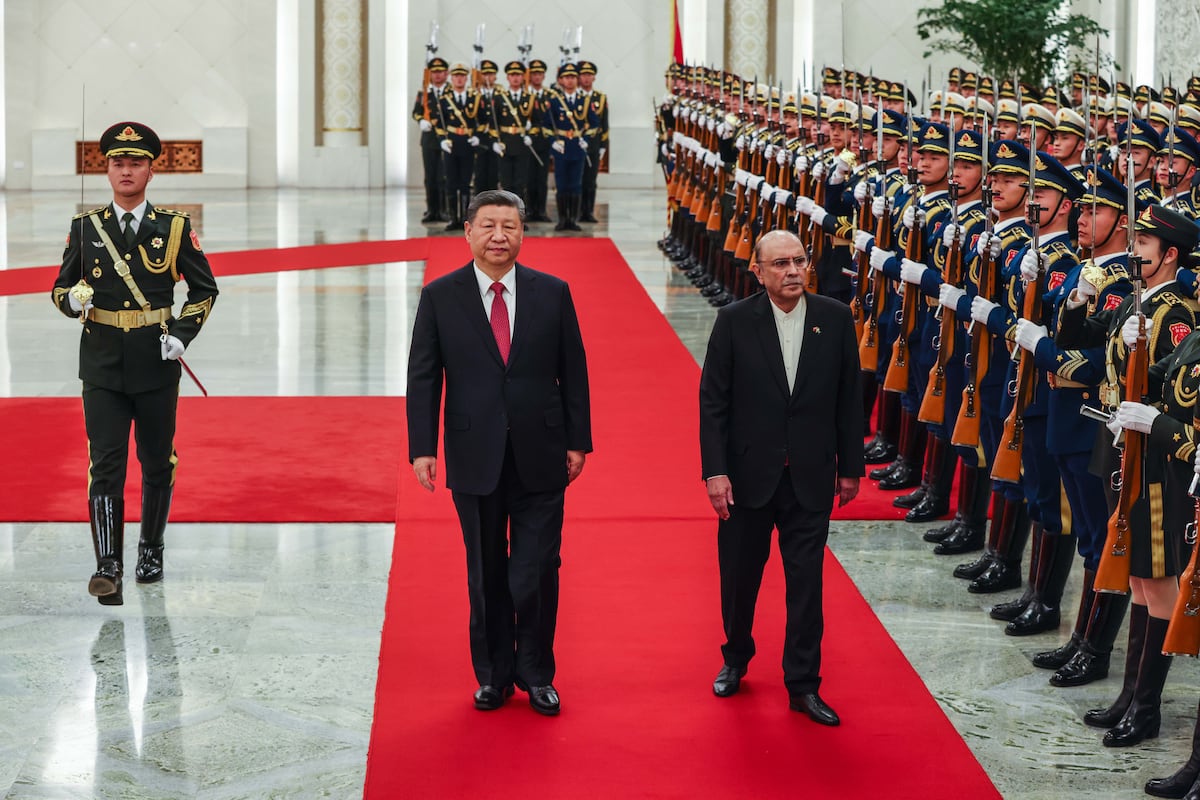
Caption: High-level diplomatic engagement between Pakistan and China underscores the strategic depth of the defense relationship that produced the Hangor submarine program | Credits: Wu Hao - Pool/Getty Images
Strategic Implications: Regional Balance, Deterrence, and Maritime Competition
The introduction of AIP-equipped Hangor boats changes tactical and strategic calculations in South Asian maritime competition in several ways. Operationally, longer submerged endurance increases the survivability and area-denial potential of Pakistan’s submarine force, complicating adversary anti-submarine warfare (ASW) planning and increasing the resources required to secure commercial routes or conduct naval operations in the Arabian Sea. Strategically, the program tightens China’s foothold in a region that is central to its maritime supply lines and to broader competition for influence in the Indian Ocean; the partnership facilitates Chinese access to operational knowledge, logistics links and potentially enhanced common operating practices in regional waters.
At the same time, the move is likely to accelerate countervailing measures. New Delhi’s parallel efforts to modernize its conventional submarine force — including expected procurement of AIP-capable boats from third-party suppliers — reflect an adaptive response aimed at preserving deterrence and undersea dominance. The technology-transfer element of Pakistan’s program also has medium-term implications for regional arms dynamics: indigenous construction capability increases Pakistan’s autonomy over sustainment and deployments, and could reduce its dependence on external maintenance cycles while raising the bar for regional ASW efforts.
For outside actors, including the United States, Europe and other Indian Ocean partners, Pakistan’s upgraded undersea capability will be factored into maritime security planning, coalition ASW cooperation and the protection of sea lines of communication. The net effect is greater complexity: improved Pakistani submarine capability strengthens Islamabad’s conventional deterrence vis-à-vis India and enhances Beijing’s strategic depth, while prompting investments in surveillance, ASW assets and diplomatic efforts to manage escalation risk across a crowded and strategically vital maritime domain.