
The Pentagon’s recent $500 million award to Perennial Autonomy marks a decisive step toward industrializing “attritable” counter-drone systems — a procurement move that accelerates fielding of low-cost interceptors and reshapes both tactical air defense and strategic deterrence in multiple theaters.
Situation Overview: Rapid Scale-Up of U.S. Counter‑UAS Capabilities
The Department of Defense, through Joint Interagency Task Force 401, has placed a large-scale indefinite-delivery contract with Perennial Autonomy to acquire AI-enabled counter-unmanned aerial systems (C-UAS). The package centers on small, low-cost interceptors and strike drones already in operational use — notably Merops air-to-air interceptors, Bumblebee short-range quadcopters, and Hornet mid‑range kamikaze systems — and is structured to be executed within a three‑year window or until funds are exhausted.
This action formalizes a move from experimental buys to volume production, reflecting a shift in procurement emphasis toward attritable systems that can be expended in high-intensity, high-rate engagements. The award follows prior smaller contracts and field tests, and accompanies the broader “Drone Dominance” initiative that funds the domestic industrial base to produce cheap, scalable aerial systems for force protection and offensive use.
Historical Context: From Ukraine’s Shahed Threat to a New Doctrine of Attritable Defense
Lessons from recent conflicts — particularly Russia’s use of one‑way loitering munitions in Ukraine and extensive UAV employment in the Middle East — catalyzed U.S. doctrine and procurement changes. Perennial’s lineage traces back to a private sector research effort initially known as Project Eagle, launched by high‑profile technologists, and matured into operational systems used by Ukrainian forces to defeat Shahed-style threats. The adaptation of those systems into U.S. inventories represents a cross‑pollination of battlefield innovation and defense acquisition.
Historically, air defense emphasized high-cost, reusable interceptors and complex layered systems (radars, missiles, electronic warfare). The current pivot recognizes a different cost calculus: replacing expensive single-shot defenses with large quantities of inexpensive interceptors that impose a favorable exchange rate against adversary drones. Reported unit-price differentials — attritable interceptors materially cheaper than many attack drones — underpin a war-of‑attrition logic now embedded in procurement and fielding decisions.
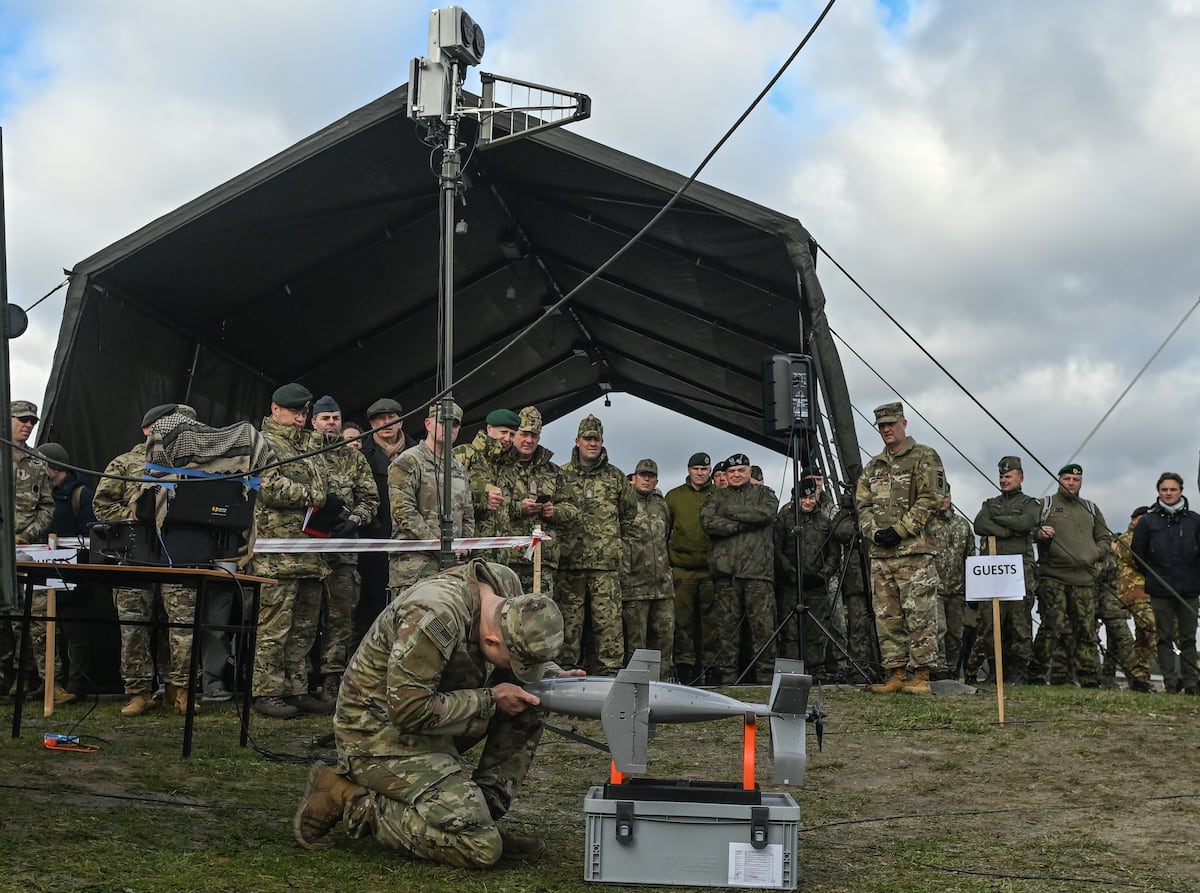
Caption: Demonstration of a Merops interceptor during allied exercises illustrating rapid-deployment counter-UAS concepts | Credits: Artur Widak/NurPhoto via Getty Images
Geopolitical Consequences: Regional Security, Industrial Posture, and Strategic Signaling
Operational implications are immediate and multi-layered. For forward bases and deployed forces, massed attritable interceptors create a pragmatic defensive posture against persistent, low-cost aerial attacks — lowering vulnerability of logistics hubs, airfields and dispersed units. This changes force protection calculus in high-threat environments such as the Levant and the broader Middle East, where Iranian-proxy and state-linked UAV campaigns have threatened U.S. assets and partners.
At the alliance and industrial level, the award catalyzes domestic production scaling and European manufacturing partnerships, which strengthens transatlantic defense supply chains and reduces single‑source risk. For NATO and partner states, the U.S. procurement signals an open avenue for interoperability and accelerated capability transfer for base defense and short-range air defense modernization.
Strategically, the move communicates several messages: deterrence through denial (making aerial harassment costly and less effective), a commitment to technological overmatch in autonomous systems, and readiness to absorb high-intensity, curtain‑fire UAV campaigning. However, it also risks driving an arms race in low-cost aerial systems. Adversaries will be incentivized to proliferate more abundant or cheaper unmanned attack platforms, invest in saturation tactics, or develop counter-countermeasures such as EW, decoys, or swarm employment at scale.
There are political and escalation risks as well. Rapid fielding of interceptors and strike drones into contested zones could blur defensive and offensive lines of engagement, especially where attribution is contested. States observing U.S. doctrine changes — notably Russia and China — may adapt their own doctrines and export strategies, accelerating global diffusion of both offensive and defensive small-UAS technologies.
Finally, the contract underscores budgetary and doctrinal trends: investing in large numbers of affordable systems complements higher-end deterrent capabilities and reconciles constrained procurement timelines with urgent theater requirements. Policymakers should balance speed with oversight: ensure sustainment, supply-chain security, rules-of-engagement clarity, and export controls to prevent unintended diffusion while leveraging allied industrial base capacity to project stabilized fielding across theaters.