The Pentagon’s new framework agreements to procure large quantities of containerized missiles mark a deliberate shift toward cheap, rapidly deployable strike capacity — a procurement pivot with immediate operational intent and long‑term strategic consequences for force posture, deterrence calculus, and the global arms environment.
Pentagon action: snapshot of the new containerized munitions initiative
The Department of Defense has established framework agreements with four companies — Anduril, CoAspire, Leidos and Zone 5 — to launch the Low‑Cost Containerized Munitions (LCCM) program, enabling potential procurement of more than 10,000 low‑cost, containerized missiles across a three‑year production window beginning in 2027. An assessment phase will begin in June 2026 with purchases of test rounds from all four vendors, and terms have been laid for future firm‑fixed‑price production contracts. Separately, an agreement with Castelion outlines a conditional two‑year contract for at least 500 Blackbeard hypersonic missiles per year once testing and validation are complete, and the Pentagon is seeking authorization to acquire upward of 12,000 Blackbeard rounds over five years. Senior acquisition and R&D officials framed these moves as both an industrial‑base diversification away from traditional primes and a deliberate demand signal to innovative entrants to deliver affordable mass at speed.
Historical evolution of containerized weapons and procurement trends
Containerized launchers build on decades of military logistics and improvisation: the reuse of commercial shipping containers for military purpose dates to Cold War-era mobility innovations, while the last two decades have seen concepts such as truck‑mounted and sea‑based modular launchers mature into doctrinal elements for distributed lethality. The current LCCM effort represents an accelerated institutionalization of that evolution by moving from prototype demonstrations to formalized procurement pathways and multi‑firm competition. Historically, such shifts — from bespoke, prime‑driven systems to standardized, modular munition packs — reflect efforts to reduce per‑unit cost, increase production surge capacity, and simplify sustainment. The addition of hypersonic designs like Blackbeard into parallel acquisition tracks signals a hybridization: pairing massed low‑cost strike with a smaller number of high‑value, speed‑dominant weapons, echoing earlier force‑structure changes where quantity and quality were deliberately balanced to meet changing operational demands.
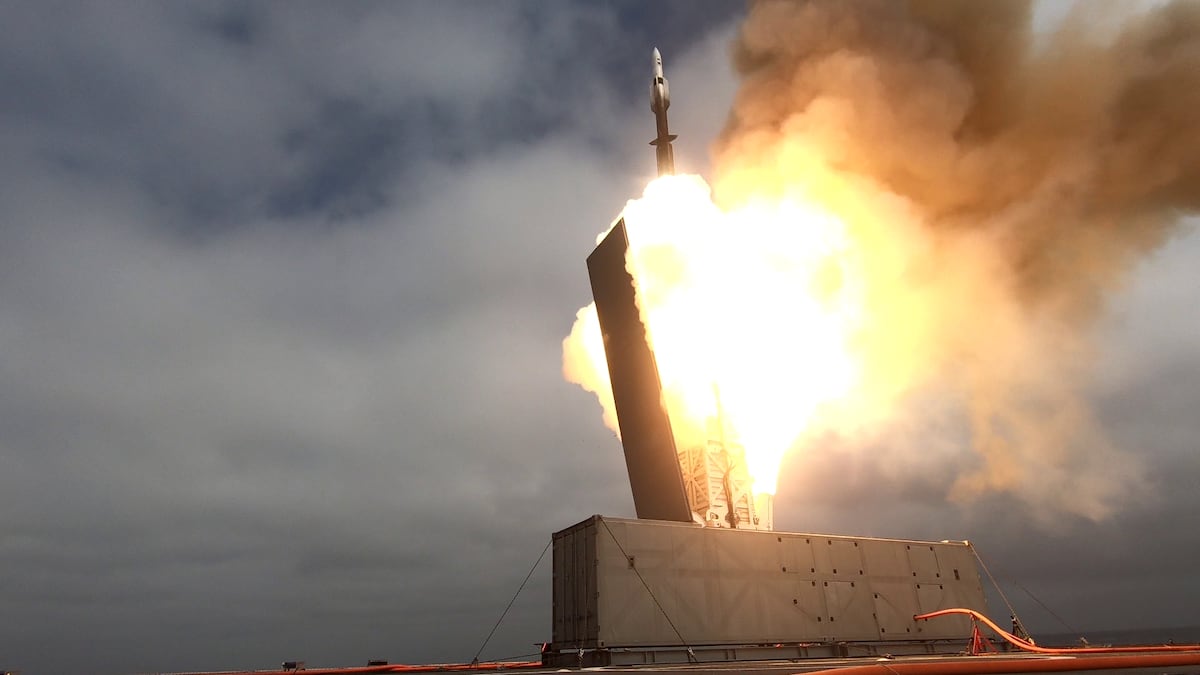
Caption: Demonstration of a containerized vertical launch firing system in maritime service, illustrating the mobility and concealment advantages of LCCM concepts | Credits: Lt. Zachary Anderson/U.S. Navy
Geopolitical impact: deterrence, escalation, industrial competition and arms stability
The LCCM and parallel Blackbeard plans will reshape several geopolitical dynamics. Operationally, cheap, containerized missiles increase the U.S. ability to mass fires from distributed and commercially ambiguous platforms — complicating adversary targeting, enhancing resilience, and enabling rapid surge capacity in crises. Strategically, massed low‑cost strike inventories lower the threshold for high‑volume engagements, which can compress escalation ladders and raise crisis instability if adversaries misread intent. The simultaneous push for hypersonics reflects a two‑track strategy: overwhelm with numbers while preserving a capability for decisive, high‑speed strikes. Diplomatically, these programs will be closely watched by near peer competitors (China, Russia) who may accelerate counter‑measures: advanced missile defenses, electronic and cyber countermeasures, offensive counterforce posture, and their own mass‑production campaigns — increasing regional arms competition.
From an industrial standpoint, the Pentagon’s move to solicit offerings from nontraditional primes diversifies the supplier base and could shorten acquisition timelines, but it also introduces supply‑chain, quality assurance and sustainment risks. Rapid scaling raises export control, proliferation and legal questions: containerized systems are inherently easier to conceal and transport, which complicates arms transfer regimes and alliance coordination on basing and employment. Finally, in the context of current Mideast operations and congressional munitions funding requests, the procurement push signals that U.S. planners expect sustained high demand for missiles — a factor that will influence allied stockpiling decisions, global ammunition markets, and the tempo of future conflicts.