
The U.S. Air Force Special Operations Command is field-testing a highly pragmatic solution: a modular, low-cost turboprop — the OA-1K Skyraider II — that can be rapidly disassembled, airlifted and reassembled to provide on-demand armed overwatch for dispersed special operations forces; the effort highlights tension between affordable, expeditionary capabilities and the demands of high-end conflict with peer adversaries.
Rapid-Deployment Capability and Program Snapshot
AFSOC is evaluating whether the Skyraider II, a militarized derivative of the Air Tractor AT-802, can be turned into a truly deployable asset by breaking it down to fit inside strategic airlifters such as C-5s and C-17s and reassembling it in theater within hours. The platform emphasizes simplicity: a single-engine, propeller-driven airframe designed to operate from austere dirt strips, deliver persistent sensor coverage and provide immediate, localized strike or overwatch for small teams. AFSOC currently fields 18 examples with a program-of-record target of 75 aircraft reduced by funding decisions to an expected 53.
The Skyraider II’s advocates frame it as a consolidation play: one inexpensive airframe that can perform elements of close air support, strike and ISR traditionally delivered by a collection of more complex, costlier platforms. That rationale aligns with Special Operations Command concepts that seek to reduce the size and complexity of the so-called mission “stack” while preserving persistent, tactical-level air support.
Historical Lineage and Program Context
The Skyraider II deliberately evokes the Vietnam-era A-1 Skyraider as both a doctrinal and symbolic heir: slow, rugged, and built to loiter and support ground forces. Its lineage to agricultural aircraft reflects a long-standing military practice of adapting simple, robust civil designs for combat roles where survivability in permissive environments and low operating cost matter more than speed or stealth. The program’s recent trajectory — prototyping, limited fielding at Will Rogers ANG, and planned basing at Cannon AFB and Davis-Monthan AFB — has unfolded against Pentagon-wide reassessments of force structure and missions following GAO scrutiny of the original 75-aircraft rationale.
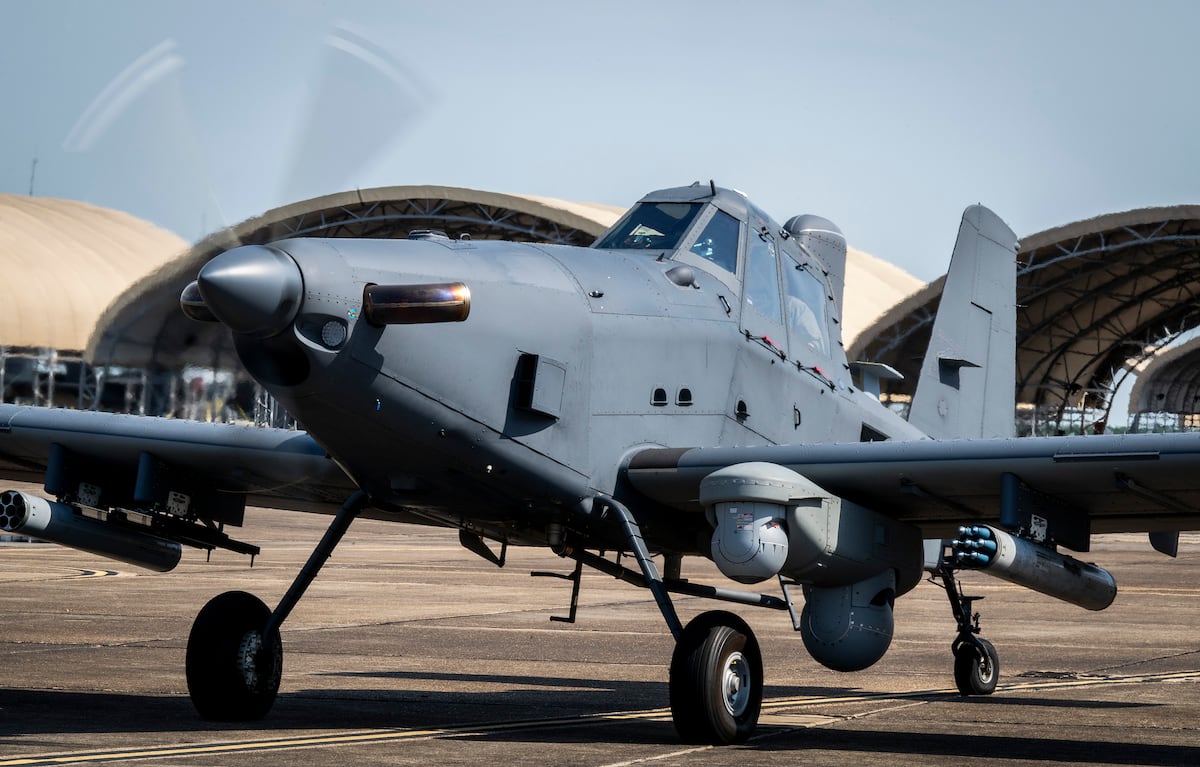
Caption: OA-1K Skyraider II preparing for operations from an austere strip, demonstrating rapid-deploy intent | Credits: Samuel King Jr./U.S. Air Force
Geopolitical and Operational Implications
At the operational level, the Skyraider II enhances Special Operations’ agility and persistence in low- to mid-intensity theaters: small units gain organic, on-call aerial ISR and precision fires without waiting for high-end platforms. That improves responsiveness in counterinsurgency, counterterrorism and irregular-warfare contexts, and it contributes to distributed operations where forward basing and logistics are limited.
Strategically, the program is a hedge: it sustains capabilities well-suited for competition short of high-end conflict while conserving resources for modernized, survivable systems optimized for contested domains. However, the aircraft’s characteristics — slow speed, lack of ejection seat and limited survivability against integrated air defenses — make it a marginal asset in a high-intensity fight with a near-peer such as China. Funding reductions and the Pentagon’s pivot toward peer competition increase political scrutiny of low-cost platforms whose utility is theater-dependent.
There are alliance and signaling implications as well. Modular, transportable aircraft can reassure partners by enabling rapid reinforcement and partnership training in permissive environments, but they also risk proliferation of a capability that adversaries could counter cheaply with kinetic or electronic means. To maximize strategic value, the program must be integrated into broader concepts of distributed lethality, resilient logistics and layered air defenses, and be matched with improved sensors, standoff weapons and allied interoperability where possible.
Policy trade-offs are clear: preserve and scale an affordable, expeditionary capability that fills current operational gaps, or reallocate scarce procurement dollars toward survivable, networked platforms for a prospective high-end war. The pragmatic path for decision-makers is to keep a modest fleet of modular aircraft while investing in upgrades that enhance contested-environment survivability, export controls, and doctrine that explicitly ties the Skyraider II to permissive and irregular-warfare missions rather than frontline peer-contest roles.