
Russia’s unannounced three-day nuclear exercise — mobilizing tens of thousands of personnel, hundreds of launchers and dozens of strategic platforms, and explicitly integrating Belarusian launch sites — represents a calibrated signal of deterrence, coercive diplomacy and operational opportunism that reshapes immediate European security calculations and raises acute escalation and arms-control risks.
Situation Snapshot: Scope, Components, and Immediate Drivers
The drills, declared on May 19 and running for three days, involved nearly 65,000 troops, more than 200 missile launchers, roughly 140 aircraft, 73 surface vessels and 13 submarines, including eight strategic nuclear submarines. Units from Russia’s Strategic Missile Forces, Long‑Range Aviation, Northern and Pacific Fleets, and ground formations from the Leningrad and Central military districts were engaged, with live ballistic and cruise-missile firings planned within Russian territory. Crucially, Minsk conducted a parallel exercise focused on delivering and preparing nuclear munitions “from unprepared positions” on Belarusian soil, and Russia’s Oreshnik intermediate-range ballistic missile — based in Belarus since 2025 and capable of either conventional or nuclear warheads — featured in the calculus.
The timing and posture are deliberate. The exercise was not the routine October “Grom” drill but an early, surprise mobilization coming a week after Moscow’s successful Sarmat ICBM test and as President Putin traveled to Beijing — a coordination that blends domestic signaling with external diplomacy. Russian commentary framed the maneuvers as defensive; Western analysts and Ukrainian sources interpret them as information pressure aimed at NATO deliberations, a potential diversion to draw Ukrainian reserves northward ahead of a summer offensive, and a mechanism to obscure operational shortfalls.
Historical Frame: Nuclear Signaling, Forward Basing, and Evolving Doctrine
Russia’s pattern of nuclear exercises and signaling has intensified since 2022, reflecting an adaptive doctrine that emphasizes flexible escalation, forward basing and the integration of non-strategic systems into broader deterrent postures. The annual strategic drill known colloquially as “Grom” shifted to autumn since 2022; surprise nuclear or nuclear‑adjacent exercises surfaced in 2024 and now again in 2026, indicating a willingness to vary timing for political effect. The Sarmat program illustrates both prestige priorities and technical fragility: a high-profile private and state effort that suffered notable failures in 2024 before achieving a May 12, 2026 test success.
Belarus’ growing military entanglement with Russia is a decisive historical inflection point. Agreements since 2024–2025 enabled forward deployment of systems such as the Oreshnik IRBM and closer operational coordination, effectively extending Moscow’s strategic depth westward and compressing NATO warning and decision timelines. This forward posture builds on longer-term trends dating to post‑2014 securitization of Russia’s near abroad and represents a deliberate use of allied territory to complicate regional defense planning.
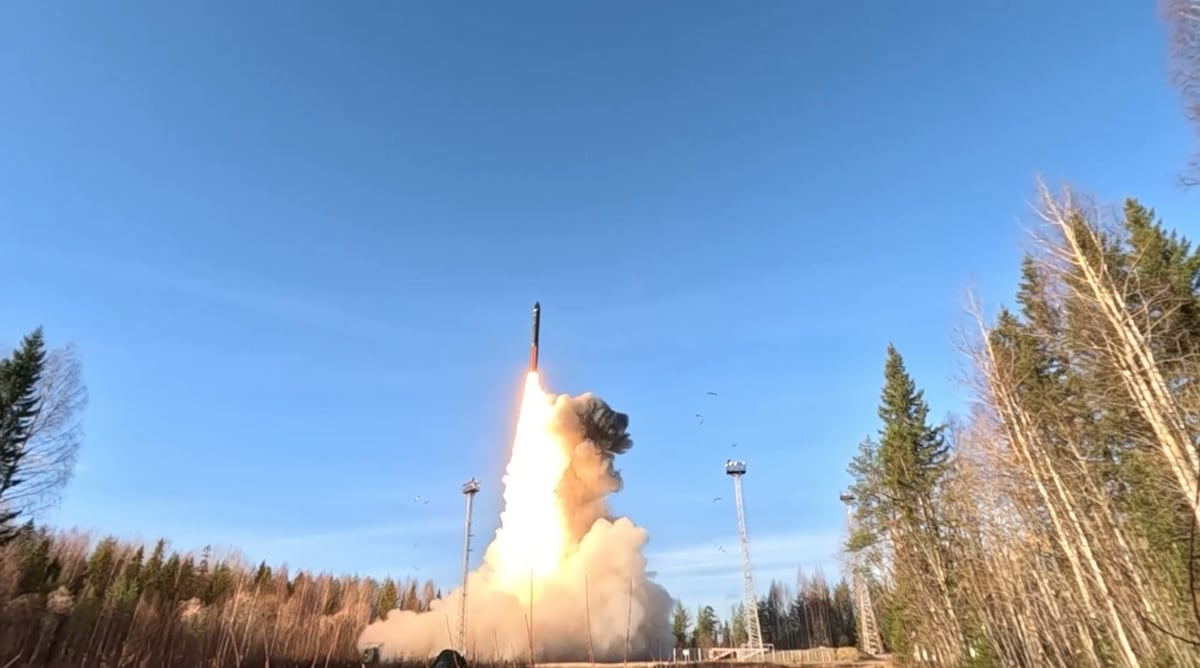
Caption: Strategic forces participate in large-scale exercises demonstrating Russia’s land, sea and air nuclear capabilities | Credits: Russian Defense Ministry/Anadolu via Getty Images
Geostrategic Consequences: Risks, Regional Effects, and Policy Imperatives
The exercise produces layered and immediate geopolitical effects. First, it elevates crisis instability: forward-deployed or forward‑planned nuclear-capable systems in Belarus shorten decision and warning times, increase the risk of miscalculation in a fast-moving confrontation, and complicate NATO’s command-and-control calculations. Second, it exerts political pressure on alliance deliberations — using a show of force to influence debates over nuclear sharing, long-range strikes to Ukraine, and reinforcement of eastern flank defenses.
Operationally, the drills serve dual purposes. They are a demonstrable readiness rehearsal for strategic forces while simultaneously creating a credible northern threat axis that could compel Kyiv to reassign forces away from southern and eastern fronts — a maneuver that could facilitate Russian conventional operations. At the same time, the Kremlin’s synchronization of military exercise and high-level diplomacy (the Putin‑Xi meeting) signals a desire to normalize displays of strategic capability in support of geopolitical partnerships and to deter outside intervention.
For Western and regional policymakers the implications are clear: bolster deterrence without escalation by accelerating intelligence sharing, air‑and‑missile‑defense deployments to vulnerable sectors, and NATO’s integrated readiness; strengthen crisis communications to prevent inadvertent escalation given compressed timelines introduced by Belarusian basing; and pursue diplomatic and economic levers to deter further entrenchment of nuclear-capable systems outside Russia’s borders. In the arms‑control domain, Moscow’s actions undermine prospects for meaningful dialogue — reinforcing the need to protect nuclear safety, reaffirm negative‑intent mechanisms, and explore confidence‑building measures specifically aimed at forward-deployed forces.
Absent a credible, calibrated Western response that combines deterrence, defensive reinforcement and targeted diplomacy, Russia’s pattern of surprise strategic signaling and Belarus integration is likely to persist — raising the baseline risk across Europe and complicating efforts to manage escalation in an already volatile security environment.