
As the Indo-Pacific becomes the principal theater of great-power competition, air and missile defense units—once niche elements of U.S. Army operations—have moved to the forefront of regional deterrence, alliance operations and force design, demanding new doctrine, multinational integration and rapid technological modernization to contend with sophisticated missile, cruise-missile and drone threats.
Current operational snapshot: Indo‑Pacific air defenders in demand
The U.S. 94th Army Air and Missile Defense Command has transitioned from a low-visibility specialty to a highly sought capability across the theater. Commanders now prioritize layered air defense at scale to protect dispersed bases, maritime approaches and joint formations against increasingly capable ballistic, cruise and unmanned threats. Technological advances—most notably fielding of the Integrated Air and Missile Defense Battle Command System (IBCS)—are changing force employment by enabling an “any‑sensor, any‑shooter” architecture that reduces dependence on legacy radars and ties diverse interceptors and sensors into a unified battlespace picture. Operationally, this shift manifests in larger, more complex exercises (for example the expansion of Balikatan into a multinational mission rehearsal) and in heightened demand for trained air‑defense crews, sustainment nodes, and C2 interoperability across services and partner nations.
Origins and trajectory: how air defense rose to strategic prominence
Air and missile defense in the U.S. Army has evolved through successive operational lessons and political shifts. After the 94th AAMDC was reactivated in 2005, incremental modernization and the reappraisal of missile threats in Northeast and East Asia steadily elevated the mission’s profile. Over the past decade the People’s Republic of China’s rapid force expansion and North Korea’s persistent missile testing recalibrated threat assessments, prompting investments in layered interceptors, networked command systems and theater-level training. The emergence of low-cost, massed aerial threats—loitering munitions and drone swarms—further enlarged the mission set, forcing doctrinal adjustments and new multi‑domain integration. These developments are reinforced by an expanding pattern of allied participation in major exercises, converting bilateral drills into multinational rehearsals that reflect both operational necessity and shared political will.
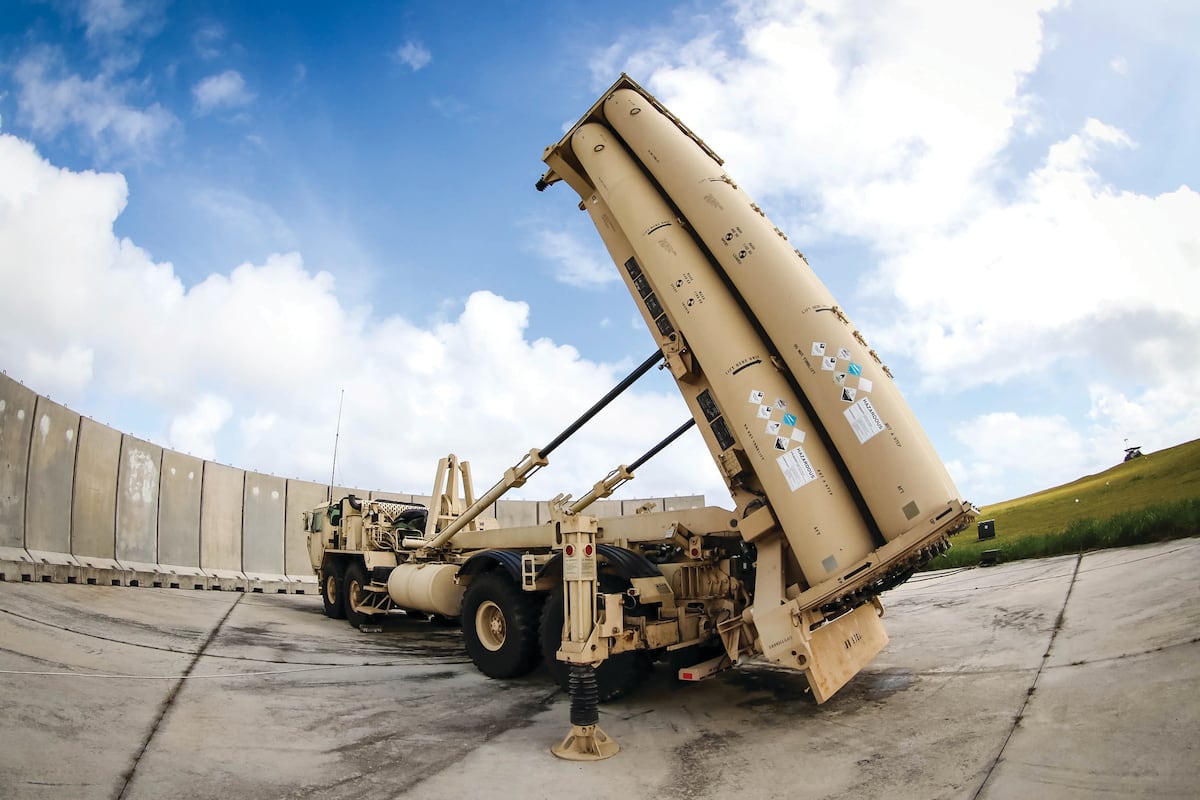
Caption: THAAD emplacement exemplifies deployed, layered defenses protecting U.S. and partner assets in the Indo‑Pacific | Credits: Capt. Adan Cazarez/U.S. Army
Geopolitical consequences: deterrence posture, alliance dynamics and escalation risks
The elevation of air defenders reshapes regional geopolitics in three principal ways. First, it strengthens deterrence by complicating adversary attack plans and reducing the probability of successful strikes on high‑value targets; networked defenses and multinational rehearsals raise the threshold for coercive action but do not eliminate risk. Second, it deepens alliance integration: increased participation by Australia, Japan, New Zealand, France and Canada in joint air‑defense operations demonstrates growing political alignment and practical burden‑sharing, while also creating new interoperability and basing considerations that require diplomatic management. Third, the concentration of advanced A2/AD countermeasures introduces escalation dynamics—adversaries may pursue asymmetric options (saturation strikes, cyber and space attacks against sensors, or legal and political counters) to undermine defensive advantages. Policy and force-planning implications are clear: sustainment of a dispersed, layered defense requires persistent investment in sensors, logistics and allied C2 links; doctrine must reconcile forward deterrence with graduated escalation control; and diplomatic channels should be leveraged to clarify redlines and cooperative incident management to avoid miscalculation.