
A coordinated maritime strike during Balikatan 2026 brought U.S., Philippine, Japanese and Canadian platforms together to sink two decommissioned Philippine Navy vessels, showcasing multi-domain integration, forward deterrence signaling and a measurable increase in interoperability among Pacific partners at a time of heightened strategic competition in the Indo‑Pacific.
Operational snapshot: MARSTRIKE performance and tactical outcomes
The live‑fire Joint Task Force Maritime Strike (MARSTRIKE) phase concentrated sensors, strike systems and command nodes across land, sea and air to deliver synchronized long‑range effects against maritime targets. Participating assets included Japan Ground Self‑Defense Force Type‑88 surface‑to‑ship missiles, U.S. Army High Mobility Artillery Rocket Systems (HIMARS), Philippine Air Force FA‑50PHs and A‑29 Super Tucanos, U.S. Marine Corps expeditionary interdiction and air‑defense systems, unmanned aerial systems, and the Royal Canadian Navy frigate HMCS Charlottetown. The simultaneous employment of shore‑based missiles, rocket artillery and strike aircraft to neutralize decommissioned ships validated tactical linkages between sensors and shooters and exercised command‑and‑control flows under a multinational construct.
From a force development perspective, the exercise tested procedures for target acquisition, cross‑national weapons deconfliction, timing of fires and assessment of effects under realistic conditions. The destruction of the BRP Quezon and BRP Rajah Sulayman demonstrated the operationalization of coordinated maritime strike concepts: distributed sensor inputs feeding multiple weapon types to achieve a common tactical objective. For the Philippines, employing domestic airframes in conjunction with allied strike assets provided practical experience in joint targeting and battle rhythm synchronization.
Historical trajectory: Balikatan’s evolution and regional security drivers
Balikatan has long represented the principal bilateral readiness mechanism between the United States and the Philippines, evolving over time from humanitarian‑and‑training centric activities into a broader framework that encompasses maritime defense, amphibious operations and combined fires. In the contemporary phase, the exercise reflects a wider trend of deepening military cooperation among U.S. treaty and partner states across the Indo‑Pacific as states confront contested maritime claims, expanded surveillance and gray‑zone coercion.
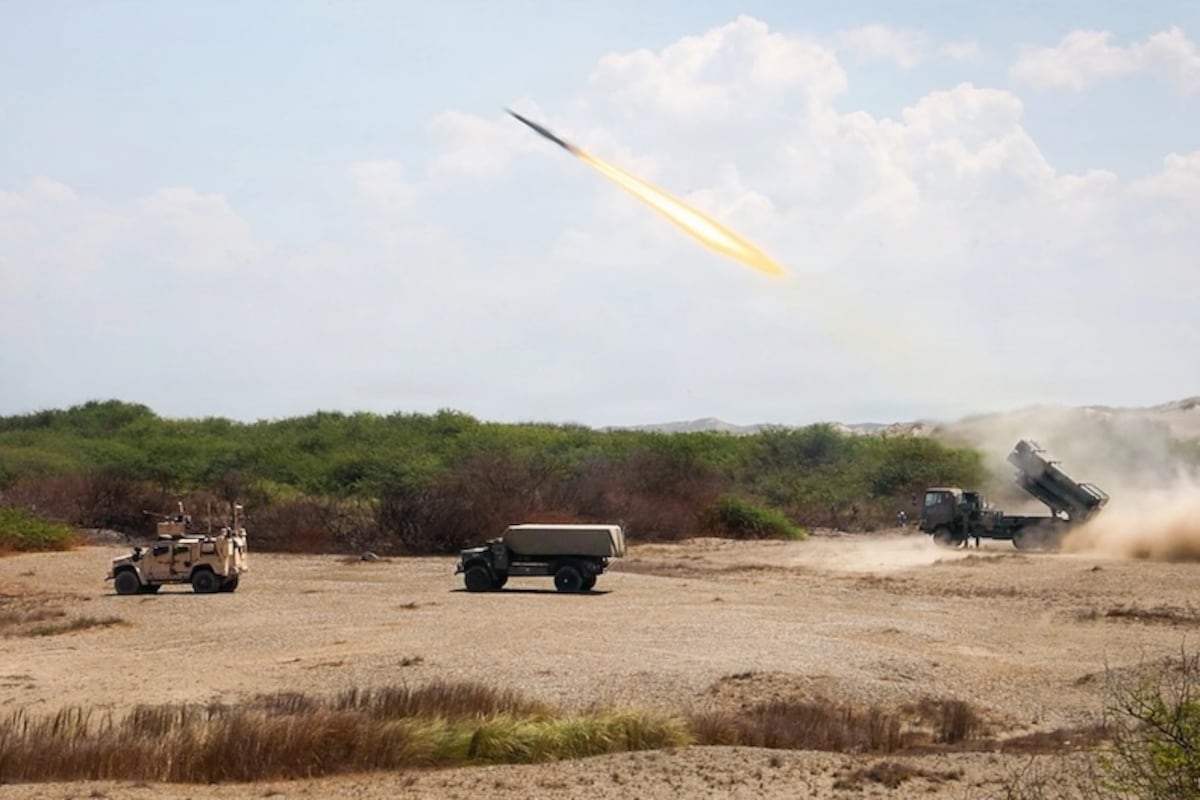
Caption: Multinational strike assets participate in live‑fire maritime exercises off Northern Luzon, illustrating integrated sensors‑to‑shooters operations | Credits: Jonathan Beauchamp/U.S. Marine Corps
Geostrategic consequences: signaling, interoperability gains and regional implications
The MARSTRIKE event serves several overlapping geopolitical functions. First, it communicates deterrence: a publicly observable, high‑intensity combined strike exercise signals to regional actors the capacity and will of the U.S. and partners to operate jointly in contested maritime spaces. Second, it advances interoperability in practical terms—data‑sharing, joint targeting, logistics and rules of engagement—lowering the friction for coalition responses in a crisis and increasing collective operational tempo.
Japan’s direct employment of a Type‑88 surface‑to‑ship system alongside U.S. rocket artillery and Philippine strike aircraft underscores Tokyo’s expanding operational role in regional security interoperability, while Canada’s frigate participation broadens the exercise’s diplomatic footprint and underscores allied cohesion beyond immediate bilateral ties. For the Philippines, the exercise advances its defense modernization and doctrinal integration with key partners, strengthening deterrent posture without formal basing changes.
Risks and limitations remain. High‑visibility strike events can be perceived as escalatory by third parties and thus require careful strategic communications to avoid misinterpretation. Operational lessons—such as sustainment of integrated architectures, secure communications, and tempo management—must be institutionalized to translate episodic success into persistent capability. Ultimately, Balikatan 2026’s MARSTRIKE phase reflects a deliberate effort by like‑minded states to normalize advanced, combined maritime strike proficiencies as part of a layered deterrence strategy in the Indo‑Pacific.