
Europe stands at an inflection point where a concentrated investment of roughly €50 billion per year could, within a decade, close critical military-technology gaps and enable a materially more autonomous European defense posture — provided political leaders treat the effort as a strategic priority and reshape procurement, industrial policy and coalition-building accordingly.
Current proposal and strategic assessment
A consortium of German defence investors and strategists has laid out a costed roadmap identifying ten priority capability gaps and a finance envelope that averages €50 billion annually to 2036. Their central claim: targeted spending of about €150–200 billion by 2030 and near €500 billion across a full decade would deliver the nucleus of European operational independence. Key short‑term priorities include sovereign command‑and‑control (C2) and battle‑management systems (estimated at roughly €10–20+ billion), mass‑produced autonomous systems and loitering munitions (circa €30 billion), and ground‑based long‑range precision strike (€20–30 billion). Air‑defence shortfalls, space‑based reconnaissance/communications and resilient PNT (positioning, navigation and timing) are also highlighted, with a proposed large‑scale push to field a European equivalent of low‑Earth‑orbit resilient comms. The analysis frames feasibility in pragmatic terms: many of these capabilities could reach operational readiness in three to five years, while deeper technological projects (e.g., sixth‑generation combat aircraft) would span a decade or more and cost multiples of the near‑term items.
From post‑Cold War dependence to a wake‑up call
Europe’s current strategic posture is the product of three decades of defense specialization, NATO dependence and fragmented national procurement. After the Cold War, most European states reduced force structure and deferred many enabling technologies to the United States, embedding transatlantic dependencies across reconnaissance, secure communications, air‑battle management and strategic logistics. Repeated attempts at European integration — from PESCO to the European Defence Fund — narrowed gaps but left significant seams in scale, supply chains and sovereign platforms. The war in Ukraine and the accelerated adoption of drone‑centric tactics have crystallized those vulnerabilities: inexpensive, mass‑produced autonomous systems and persistent ISR have become force multipliers, while gaps in brigade‑level air defence, deep strike and space resilience impose strategic risk. The German‑led paper explicitly treats the effort as an urgency comparable to a national “Manhattan Project,” arguing that history’s long timelines are a political choice rather than a technical inevitability.
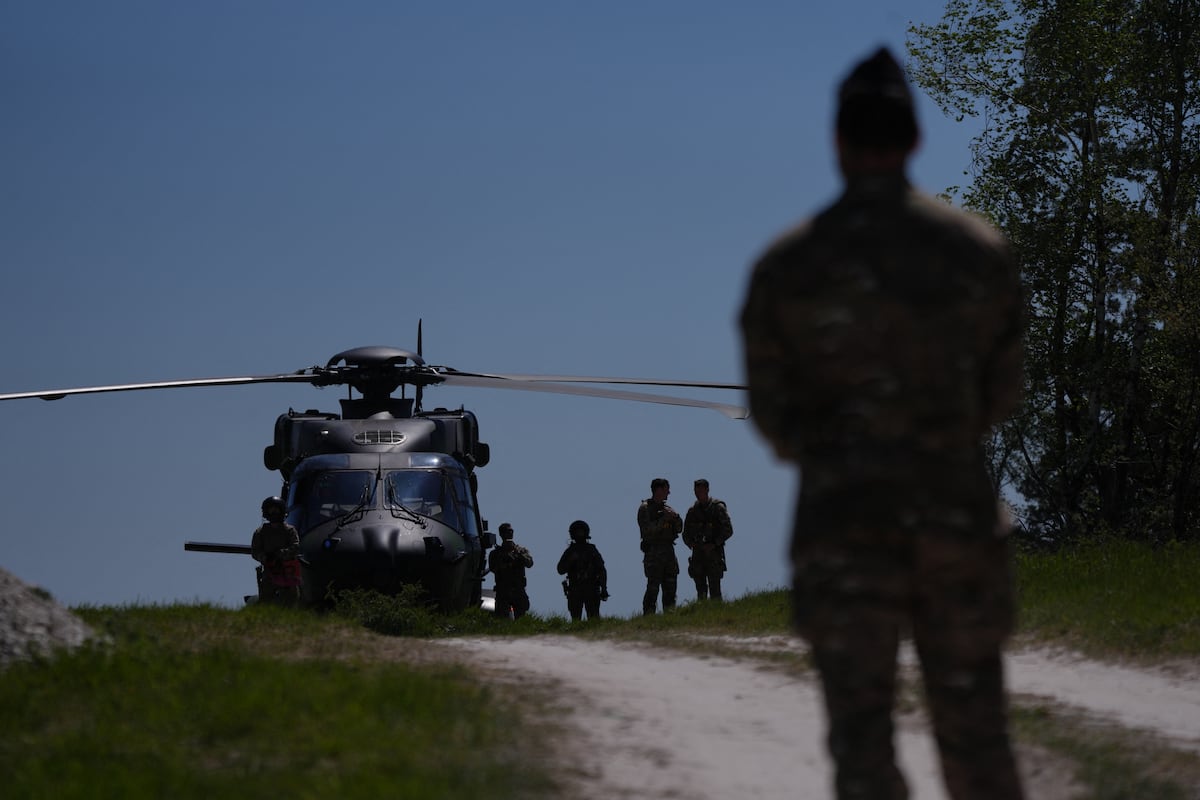
Caption: Troops participate in a large-scale Franco-European exercise highlighting evolving force structures and interoperability challenges | Credits: Aurelien Morissard / POOL / AFP via Getty Images
Strategic consequences and policy imperatives
Were Europe to pursue the roadmap, the geopolitical effects would be broad and layered. Short term, faster fielding of C2, drones and ground‑based deep strike would strengthen deterrence vis‑à‑vis Russia by reducing campaign‑level vulnerabilities and raising the threshold for coercive action. Mid‑term, an operational European PNT/comms constellation and robust space launch capability would reduce strategic dependence on U.S. orbital services and create leverage in contested scenarios. However, autonomy is not zero‑sum: a credible European industrial and technological backbone could rebalance transatlantic relations toward burden‑sharing rather than rupture — provided interoperability and combined deterrence remain policy anchors.
Significant risks accompany the opportunity. Political fragmentation, national industrial protectionism, divergent export controls and slow procurement cultures could inflate costs and delay delivery. Large projects (notably next‑generation combat air) risk absorbing budgets and industrial capacity, potentially crowding out quicker force‑multiplying investments. There is also an economic tradeoff: the proposed outlays amount to roughly 0.25% of combined European GDP and about 10% of current defense expenditure — achievable, but requiring reallocation, sustained fiscal discipline and clear political lines of responsibility.
Operationally useful recommendations follow directly from the analysis: prioritize modular C2 and battle‑management to integrate sensors and fires; scale mass production of affordable autonomous air and loitering systems alongside an industrial mobilization plan; protect dual‑use supply chains for semiconductors, propulsion and space components; and adopt procurement mechanisms that favor rapid prototyping, outcome‑based contracts and easier market access for new entrants. Implementing these through ‘lead‑coalitions’ of willing states—rather than creating heavyweight new EU institutions—would lower the political barrier and accelerate delivery. Finally, policymakers must manage strategic signalling: pursue autonomy as a partner to NATO and the United States, not as a geopolitical decoupling, thereby preserving collective defence while increasing Europe’s capacity to act independently when necessary.