
The U.S. Air Force’s MQ-9 Reaper inventory has fallen to roughly 135 aircraft following combat losses during Operation Epic Fury, forcing a rapid reassessment of persistent ISR capacity, procurement priorities and force posture in contested littoral environments.
Current status and operational trade-offs
Operationally, the MQ-9 shortfall reduces the service’s margin for meeting persistent intelligence, surveillance and reconnaissance (ISR) demands even as leaders assert the force can still sustain its stated "56 combat lines" worldwide. The current fleet of ~135 aircraft sits about 54 aircraft below the long-cited 189-aircraft benchmark, a gap driven by attrition in Iran-related engagements. Senior Air Force officials have signaled two near-term responses: buy back available MQ-9A airframes this fiscal year to restore numbers, and accelerate development of a cheaper, more attritable successor that can be deployed in higher-threat environments without risking expensive sensor suites.
The operational trade-offs are clear. The MQ-9 excels at long-endurance, sensor-heavy missions across contested-permissive theaters; losing them forces commanders either to accept shorter or less-capable ISR coverage, to surge other assets (manned aircraft, satellites, or allied platforms), or to accept greater risk by sending Reapers into contested airspace. The procurement pivot toward modular, mass-producible ISR platforms acknowledges this calculus: a lower per-unit price and scalable production allow commanders to adopt an "affordable mass" model that accepts higher attrition rates in exchange for sustained swarm-like presence.
Evolution of the Reaper and the push for attritable systems
The MQ-9 emerged as the U.S. Air Force’s principal remotely piloted ISR and strike asset during two decades of counterinsurgency and permissive airspace operations. Its sensor suite and endurance made it indispensable in CENTCOM and other theaters, but those same attributes—high-cost, integrated sensors and a design optimized for uncontested skies—became vulnerabilities as adversaries improved capabilities and contested lower-altitude domains.
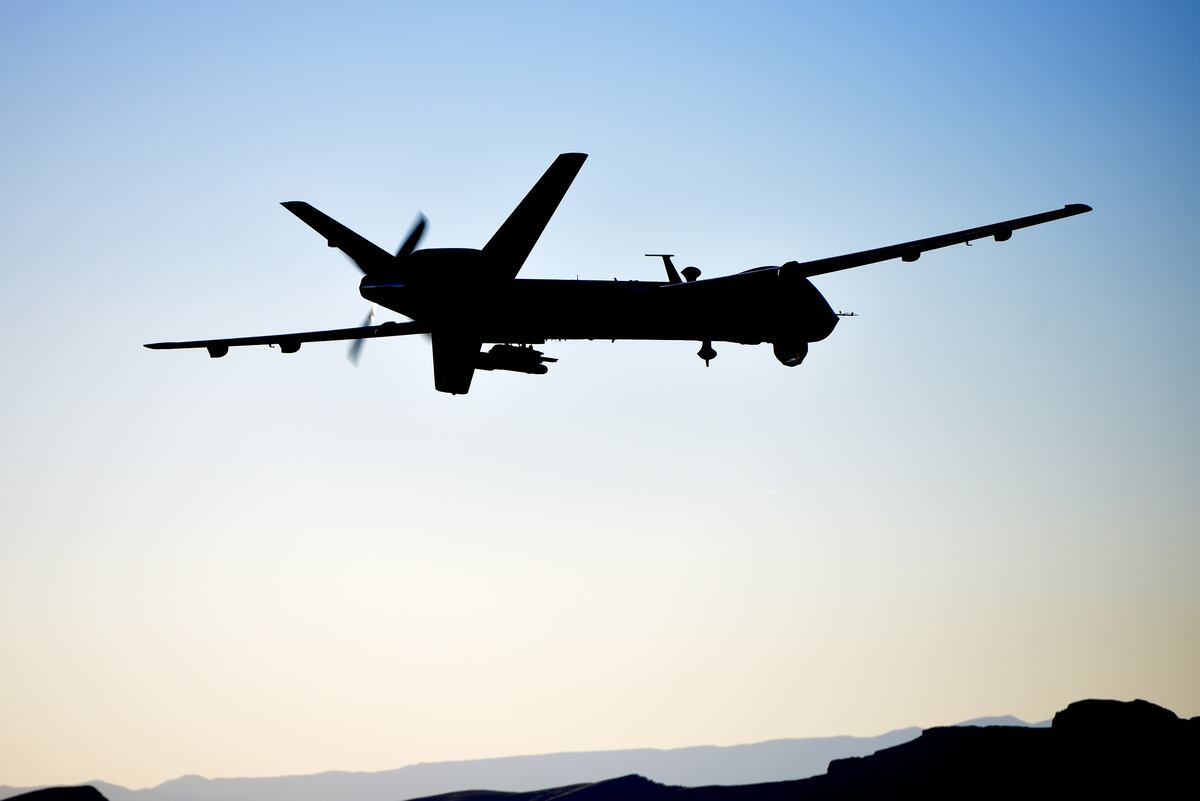
Caption: An MQ-9 Reaper during a training sortie demonstrating the platform’s endurance and sensor role | Credits: Airman 1st Class William Rio Rosado/U.S. Air Force
Attempts to replace or augment the MQ-9 have a long history. Earlier initiatives—such as the MQ-X effort shelved in 2012 and a market survey in 2020—failed to produce a transition program. The losses underscored by Operation Epic Fury catalyzed renewed action: a May 11 requirements document and an April 14 solicitation for "Attritable ISR Aircraft" set thresholds and objectives that favor range, rapid production scaling, and modular payloads rather than the MQ-9’s heavy integrated sensors. Key technical goals include a threshold 200 km operational range (objective 1,500 km) and threshold loiter times of four hours (objective 20 hours), with an industrial requirement that production "must be able to scale within months." Industry interest is robust—more than 50 responses to early requests for information—reflecting a broader defense-industrial shift toward open architecture, autonomy and manufacturability.
Strategic consequences and policy implications
The decline in MQ-9 numbers has immediate and downstream geopolitical implications. Regionally, reduced persistent ISR coverage in the Middle East elevates uncertainty for CENTCOM commanders, complicates targeting and force protection, and increases the risk of miscalculation during crises with Iran. Politically, high-visibility platform losses affect deterrence perceptions: adversaries may infer both vulnerability of high-value U.S. remotely piloted assets and a willingness to accept attrition costs in future engagements.
At the systemic level, the Air Force’s pivot to attritable, mass-producible ISR platforms signals a doctrinal shift away from a small number of exquisite systems toward distributed, lower-cost fleets better suited to contested environments. This has several implications: it pressures the defense industrial base to scale production quickly and diversify supply chains; it incentivizes adversaries and non-state actors to invest in relatively low-cost countermeasures and electronic warfare; and it raises export-control and alliance-management questions as partners consider procurement and interoperability with new, modular systems.
Moreover, congressional oversight and budgetary friction are likely: calls to "buy back" MQ-9As intersect with a longer-term competition for resources to fund next-generation systems, sensor development and survivability measures. In the near term, risk mitigation options include leasing or foreign purchases of ISR-capable platforms, greater reliance on allied ISR contributions, dispersal and hardening of launch-and-recovery infrastructure, and intensified investments in space-based and signals intelligence to compensate for gaps in persistent low-altitude coverage.
Finally, the loss-driven acceleration of attritable designs will be watched closely by peer competitors. China and Russia can draw lessons about U.S. adaptation under attrition pressure, potentially recalibrating their own force design and escalation thresholds. For U.S. planners, the strategic imperative is to balance restoration of near-term capacity with rapid prototyping and fielding of scalable, resilient ISR architectures that reduce single-platform dependence while managing escalation risks during crises.