
The abrupt cancellation of a scheduled deployment of the 2nd Armored Brigade Combat Team, 1st Cavalry Division — more than 4,000 soldiers and associated equipment bound for Poland — represents an unexpected and consequential shift in U.S. force posture in Europe that combines immediate operational friction with broader political and deterrence implications for NATO, Poland, and Russia.
Deployment Cancellation: Situation Overview
The U.S. Army confirmed that it has called off the nine‑month rotation of the Fort Hood–based armored brigade to Poland, a move that took affected personnel by surprise and left parts of the brigade already forward-deployed or with equipment in transit. Official explanations are scant: Army and Defense Department offices declined detailed comment, and senior Army leaders did not reference the change during an otherwise routine budget posture hearing. Congressional figures have pointed to a widening Army funding gap — estimates range from roughly $2 billion cited by the Senate Armed Services Committee ranking member to industry reporting suggesting $4–6 billion — which, combined with competing operational demands at home, offers a plausible near‑term driver for the decision.
Operationally, the cancellation disrupts rotational schedules, complicates logistics chains and unit readiness cycles, and creates immediate personnel and equipment management challenges. The advance echelon already present in Poland and the equipment en route will require rapid administrative and operational decisions about disposition, maintenance and host‑nation coordination. The uncertainty of public messaging from the Pentagon increases the risk of misinterpretation by allies and adversaries alike.
Roots in Recent History and Force Posture Changes
U.S. rotational deployments to Eastern Europe expanded substantially after Russia’s 2014 annexation of Crimea and accelerated again following the 2022 full‑scale invasion of Ukraine. From a NATO perspective, the surge in rotations, exercises and prepositioned materiel was intended to restore credible deterrence on the alliance’s eastern flank and reassure frontline states such as Poland and the Baltic countries. By 2024–2025 rotational levels exceeded pre‑2022 baselines, with more than 10,000 U.S. troops routinely present in Poland on a rotational basis.
At the same time, the U.S. military has been balancing multiple operational strains: extended overseas deployments, National Guard activations for domestic missions, border security support, and sustainment costs tied to high operational tempo. Recent Pentagon decisions — including an announced reduction of roughly 5,000 troops in Germany — reflect a broader reassessment of theater footprints and resource prioritization. The canceled deployment sits at the intersection of those competing pressures: political directives, finite budgets, and shifting strategic priorities since the outbreak of war in Ukraine.
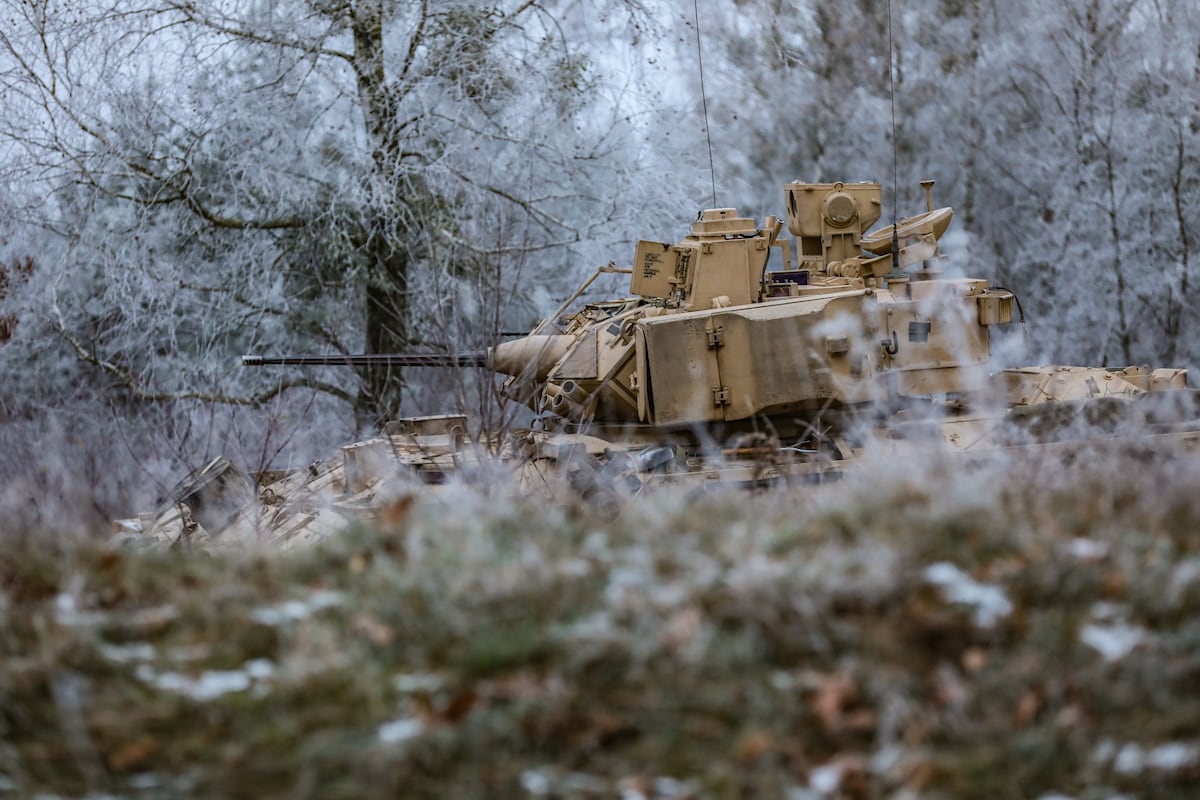
Caption: A Bradley fighting vehicle from the 1st Cavalry Division during allied maneuvers in Poland, illustrating the scale of armored rotations on NATO’s eastern flank. | Credits: Staff Sgt. Matthew A. Foster/Army
Strategic and Regional Consequences
The cancellation has layered geopolitical effects with both short‑ and long‑term dimensions. In the near term, allies in Warsaw and across the eastern flank will perceive a gap in U.S. forward reassurance at a sensitive moment, which could prompt political friction, calls for compensatory measures, or expedited bilateral arrangements with other NATO partners. Poland may seek to bolster its own defenses through accelerated procurement, deeper bilateral cooperation with other NATO members, or a more prominent role for allied forces from the U.K., Canada or Baltic states.
For NATO cohesion, the decision underscores vulnerability to U.S. domestic constraints and operational overstretch; repeated or poorly explained adjustments to rotational commitments can erode allied confidence in Washington’s reliability and complicate burden‑sharing negotiations. Adversaries — particularly Moscow — may interpret the move as an opening to probe deterrence thresholds in ambiguous ways short of open conflict, testing alliance resolve through cyber, hybrid, or calibrated military pressure.
Longer term, the episode could reinforce trends already visible since 2022: a reversion to smaller U.S. footprints in Europe, coupled with pressure for increased European defense investment and operational independence. Alternatively, transparency and rapid diplomatic engagement by Washington could mitigate damage by reaffirming commitments, clarifying resource constraints, and offering compensatory measures such as intensified exercises, enduring basing agreements, or increased equipment prepositioning. How the Pentagon and NATO frame and manage this cancellation will determine whether it becomes a tactical setback or a manageable rebalancing within a still‑robust transatlantic security architecture.