
In a high-profile demonstration of evolving U.S. long-range strike capabilities, American and Philippine forces successfully launched a Tomahawk cruise missile from the Army’s new Typhon mobile launcher during the Balikatan exercises, striking a target roughly 600 kilometers inland; the event signals a deliberate shift toward distributed, land-based precision fires in the Indo-Pacific and carries important strategic, operational, and diplomatic implications for regional stability.
Incident Overview and Tactical Details
On May 5, U.S. Army Pacific’s 1st Multi-Domain Task Force, working with the Philippine Army Artillery Regiment, executed a live-fire Tomahawk launch from a Typhon ground launcher, with the missile impacting a designated area at Fort Magsaysay in Nueva Ecija after departing from the Tacloban region. The joint firing supported night maneuver training by U.S. ground forces and was integrated into the broader Balikatan exercise sequence that included maritime strike elements. Local notices and navigational warnings were issued in advance, and planners said the use of the Tomahawk was scenario-dependent, executed when commanders determined it would provide realistic support to ground maneuvers.
Operationally, the launch demonstrated the integration of a sea-launched, long-range cruise weapon onto a mobile ground platform, validating both the Typhon launcher’s transportability and the Tomahawk’s utility in a land-based, close-support role for maneuver forces. The event also highlighted procedural coordination between U.S. and Philippine forces, including target designation, safety management, and the sequencing of joint fires across air, land, and sea domains.
Evolution of Ground-Based Long-Range Strike in the Region
The test sits at the intersection of several historical threads: the Tomahawk’s decades-long role as a ship- and submarine-launched precision strike munition; the U.S. Army’s recent pivot toward long-range precision fires and the creation of Multi-Domain Task Forces to integrate sensors and shooters across domains; and growing allied efforts to disperse strike capability ashore. Transitioning Tomahawk-like capability to mobile ground launchers is part of a broader doctrinal evolution aimed at complicating adversary targeting and increasing survivability of high-value strike systems.
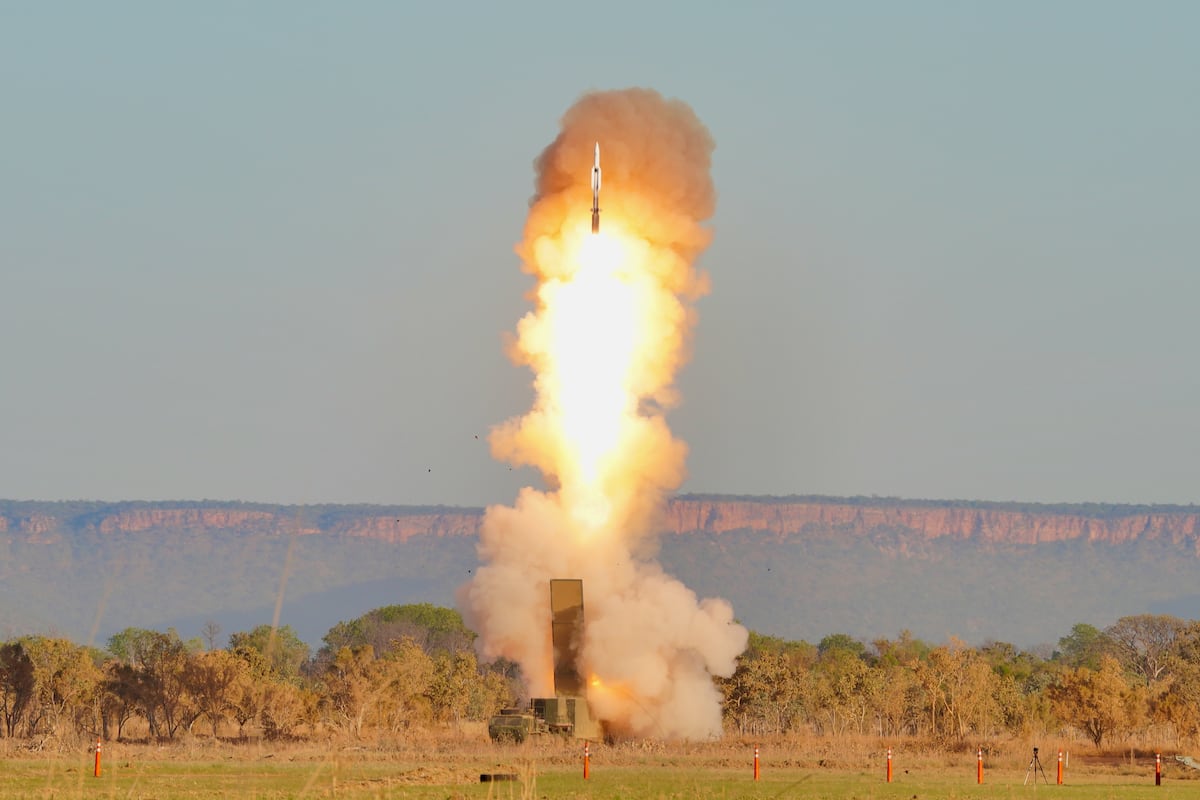
Caption: U.S. Army personnel operating Typhon during an earlier live-fire exercise demonstrating mobile, ground-based launch capability | Credits: U.S. Army/Sgt. Perla Alfaro
Regional Strategic Consequences and Diplomatic Implications
The demonstration serves multiple strategic messaging functions: it reassures regional partners—most immediately the Philippines—that the U.S. can deploy long-range, precision strike capability in support of collective defense; it signals to potential adversaries the increasing operational flexibility of U.S. and allied fires; and it advances interoperability and acquisition planning among partners considering similar capabilities. Participation by other allies in Balikatan and the concurrent maritime strike activities underscore a growing coalition approach to integrated strike and maritime denial.
At the same time, the deployment and firing of a mobile, land-based Tomahawk system raises escalation-management concerns. Beijing has previously expressed sensitivity to forwarded long-range strike assets in the region; such demonstrations can harden threat perceptions and encourage countermeasures, from accelerated Chinese deployments and exercises to intensified diplomatic protest. For regional states, accepting tests or hosting such systems involves trade-offs between deterrence benefits and political friction with China.
Practically, the incident advances Philippine operational knowledge and helps inform future procurement choices, while offering the U.S. a valuable data point on integrating ground-based cruise fires into joint campaigns. Moving forward, allies will need to balance transparency (for safety and crisis stability) with operational security, and policymakers should expect increased attention to rules of engagement, targeting authorities, and signaling practices to mitigate miscalculation while preserving deterrent effect.