
The U.S. Navy's decision to extend the service life of the amphibious assault ship USS Wasp by five years — pushing its retirement to 2034 — is a deliberate, near-term measure to preserve amphibious capacity while longer-term force-structure choices and shipbuilding timelines remain constrained; this move highlights trade-offs between sustainment, readiness, and strategic posture at a moment of rising demand for forward-deployed expeditionary assets.
Current Decision and Operational Snapshot
The Chief of Naval Operations approved a five-year service-life extension for USS Wasp following a service-wide study of the Wasp-class family. The decision signals an intent to use targeted life-extension measures to mitigate capability shortfalls rather than accept immediate retirements. Naval leadership is simultaneously evaluating whether similar extensions are feasible for other LHDs, and Naval Sea Systems Command is finalizing a companion review for amphibious dock landing ships (LSDs).
Operationally, the extension preserves one of the Navy and Marine Corps’ high-end amphibious platforms at a time when the fleet is stressed: amphibious readiness rates have declined sharply in recent years, several Wasp-class ships experienced engineering failures in 2024, and deployment schedules have been disrupted. Keeping Wasp in service supports current commitments — including expeditionary presence in the Middle East — while providing breathing room for maintenance cycles, potential mid-life upgrades, and planning for new-construction replacements.
Wasp-Class Legacy and Fleet Readiness Trends
The Wasp class was designed as a large-deck amphibious assault ship capable of sea control, forcible-entry support, aviation operations, and sustaining a Marine expeditionary unit. Historically the backbone of U.S. amphibious power projection since the late 20th century, these ships now confront age-related wear, deferred maintenance, and evolving mission demands such as integration of short-takeoff/vertical-landing (STOVL) aviation and distributed maritime operations.
Congressional direction and oversight have shaped recent policy: the fiscal 2023 NDAA established a 31-ship amphibious requirement, including 10 assault ships, while budget proposals and shipbuilding plans (including requests for an America-class replacement and an additional San Antonio-class transport dock) aim to replenish capability over a multi-year horizon. Independent oversight has flagged risk: a 2024 GAO assessment found roughly half the amphibious fleet in poor condition, and readiness metrics reported in 2025 showed amphibious availability well below stated requirements. The Wasp extension is therefore both a stopgap and a reflection of a longer-term shift toward life-extension as a programmatic lever.
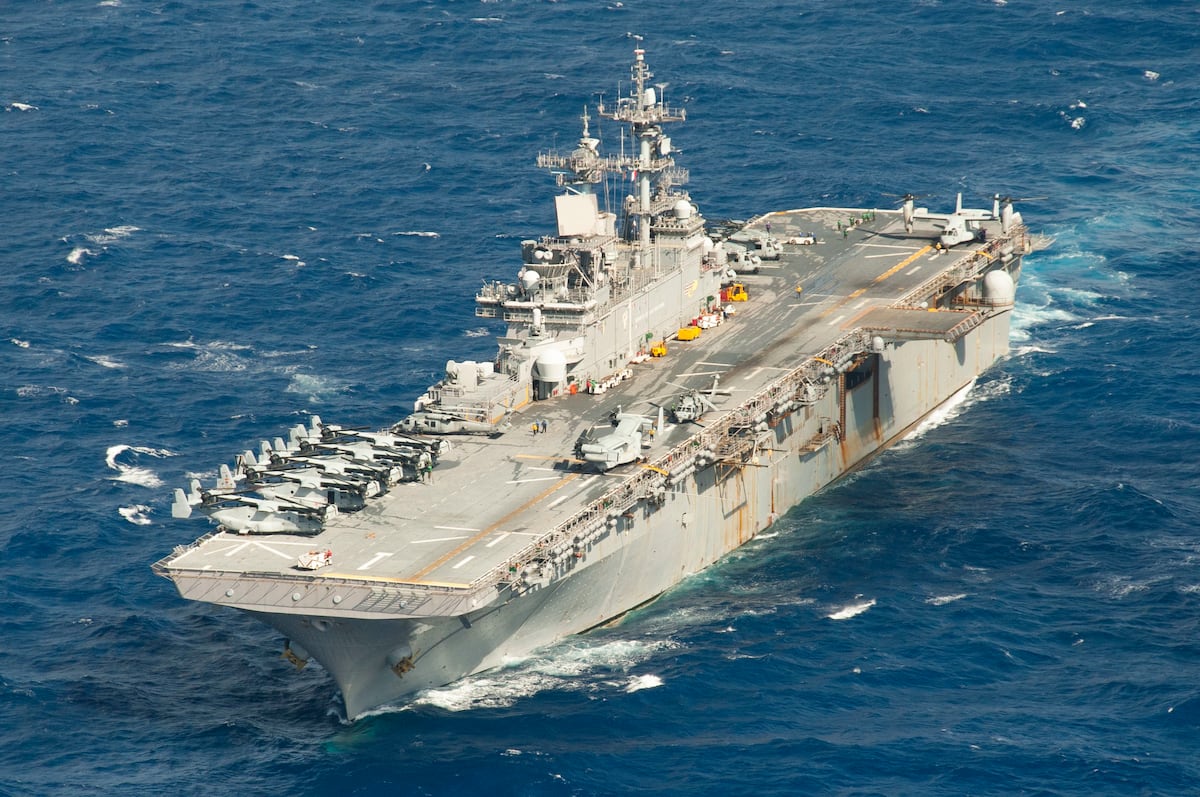
Caption: USS Wasp transits during a bilateral exercise, illustrating the ship’s role in expeditionary operations | Credits: MCS3 Taylor King/U.S. Navy
Strategic Implications for U.S. Amphibious Power Projection
Extending Wasp’s service life yields immediate operational benefits — retained sortie-generation capacity for aviation, preserved well-deck lift for equipment and landing craft, and continuity for embarked Marine expeditionary units. Strategically, it buys time against a backdrop of growing mission demand: Indo-Pacific competition, persistent instability in the Middle East, and allied expectations for amphibious-capable forces all stress the requirement for ready expeditionary platforms.
However, life extensions are not a substitute for long-term recapitalization. Prolonging service introduces financial and technical trade-offs: mid-life refits must address structural fatigue, propulsion and auxiliary system reliability, and avionics/aviation-deck upgrades to support modern aircraft; these retrofits carry cost and schedule risk and can divert shipyard capacity from new construction. Politically, the approach reduces near-term pressure on Capitol Hill for large new procurement but will require steady funding lines for sustainment and phased modernizations to avoid recurring readiness dips.
Regionally, maintaining amphibious capacity through extensions helps preserve U.S. options for crisis response, deterrence signaling, humanitarian assistance and sea-basing operations, and it reassures partners who rely on U.S. expeditionary presence. Yet, if extensions become the default without commensurate investment in the shipbuilding industrial base and a clear replacement timeline, the United States risks a hollowed fleet with aging platforms that are more brittle in contested environments. The optimal path blends selective life extensions for mission continuity with accelerated procurement and industrial capacity development to restore a modern, resilient amphibious force posture over the coming decade.