
The United States is simultaneously contracting its conventional footprint in Europe and investing in finely tuned, technology-forward training capabilities — a posture that reflects a shift from massed presence toward agile deterrence by capability, with immediate implications for alliance signaling, readiness for drone- and electronic‑warfare environments, and the future shape of NATO’s collective defense.
Shift in force posture and the new training unit
The U.S. Army’s creation of a specialized opposing‑force company in Hohenfels — designed to replicate contemporary drone and electronic‑warfare threats — exemplifies a tactical response to battlefield realities while occurring against the backdrop of a planned withdrawal of approximately 5,000 troops from Germany. Operating as an OPFOR, the unit blends traditional infantry tactics with first‑person‑view drones and electronic‑attack techniques to stress-test allied formations in high‑threat scenarios. That approach boosts training fidelity and helps units adjust logistics, reconnaissance, and air‑defense practices to the realities of low‑cost, networked weapons systems.
Yet the unit’s long‑term utility depends on force posture decisions at the strategic level. A smaller U.S. footprint limits available manpower and colocated enablers for sustained training cycles and may complicate sustainment of specialized companies abroad. The establishment of the company therefore represents a tension between capability modernization and the political decision to consolidate forces — a tradeoff that will shape the readiness calculus for Europe’s high‑end contingencies.
Roots of the transition: historical drivers and operational lessons
Since the end of the Cold War, the U.S. presence in Europe has shifted from large, forward‑stationed formations to a combination of rotational forces, prepositioned equipment, and multinational exercises. Recent policy shifts accelerate that trend: political disagreements over Middle East policy and the Iran conflict have catalyzed plans to draw down thousands of troops from Germany. Simultaneously, the war in Ukraine has acted as a live laboratory, demonstrating how small, inexpensive unmanned systems and electronic warfare can reshape operational tempo, threaten logistics chains, and compress decision cycles.
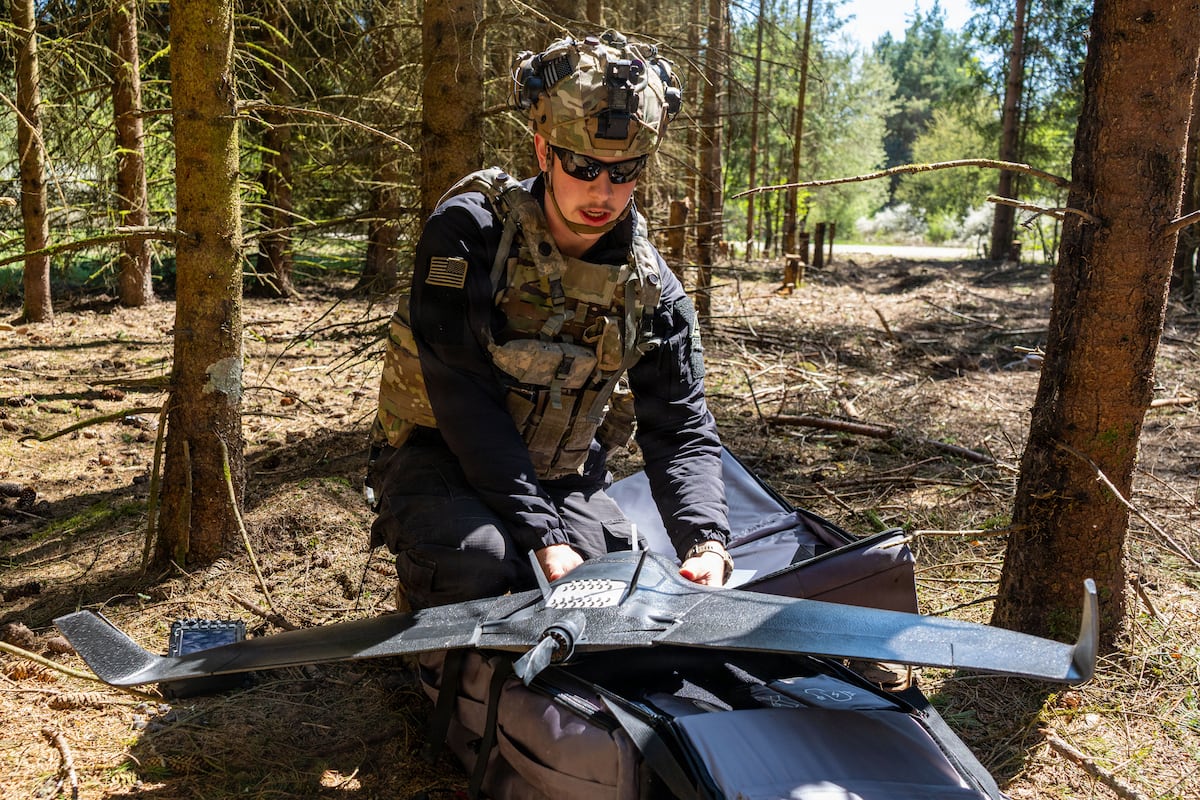
Caption: Soldiers set up a tactical FPV reconnaissance drone during combined exercises at the Joint Multinational Readiness Center in Hohenfels, Germany | Credits: Sgt. Collin Mackall/U.S. Army
Geopolitical implications for deterrence, alliance dynamics, and capability development
Operationally, training units that replicate Russia‑style and hybrid threats improve allied resiliency by accelerating doctrinal and technical adaptation. They help close the gap between concept and practice for counter‑drone tactics, electronic‑attack mitigation, and distributed logistics. Strategically, however, a reduced U.S. troop presence risks eroding the tangible signals of commitment that have underpinned European deterrence since 1991. Adversaries may interpret a smaller footprint as an opportunity to probe seams in NATO posture, even as the Alliance compensates through exercises and capability sharing.
Politically, the drawdown amplifies pressure on European states to accelerate defense industrial cooperation and burden‑sharing, potentially advancing a longer‑term trajectory toward greater EU and NATO autonomy in certain capability areas. It also exposes a policy dilemma for Washington: how to balance domestic political drivers and regional diplomatic frictions with the need to deter destabilizing behavior and sustain high‑end readiness. The most likely near‑term outcome is a hybrid model: fewer permanently stationed forces but increased investment in modular, specialized units and persistent training nodes that can project expertise in drone and electronic warfare across the continent.
For policymakers, the imperative is clear: preserve training intensity and interoperability while investing in distributed basing, resilient logistics, and partner capacity. Without those compensatory measures, capability‑focused innovations will be less effective as a strategic substitute for presence, and NATO’s deterrence posture could suffer unevenly across regions and missions.