
The debate over whether to reduce U.S. troop levels in Germany has moved from Washington rhetoric to front-line scrutiny: senior U.S. officers at the Hohenfels training area have underscored the tangible operational and deterrent advantages of a sustained presence while the White House signals a review of deployments, leaving NATO planners and regional partners to weigh the strategic trade-offs between forward basing, readiness, and alliance credibility.
Current Situation: U.S. Forces in Germany Under Review
A public review initiated by U.S. political leadership has raised the prospect of a partial drawdown of forces based in Germany, where roughly 35,000 active-duty U.S. personnel constitute the largest American military footprint in Europe. Military leaders visiting Hohenfels emphasized that those forces perform multiple, mutually reinforcing roles: they provide a visible deterrent to potential adversaries, enable large-scale combat training with NATO allies, and act as a staging ground for lessons learned from nearby conflicts such as the war in Ukraine. Operational units rotating through Europe—recently concluding nine-month deployments in Poland and the Baltics—use facilities like Hohenfels to rehearse complex combined-arms operations, air-defense and counter-drone tactics, and integration with partner systems and processes. At the working level, commanders framed the presence not as static occupation but as a capability multiplier that sustains interoperability, rapid reinforcement options, and continuous adaptation to new threat sets.
Historical Role and Training Value of the German Presence
U.S. forces based in Germany trace their purpose to the immediate post-World War II settlement and were institutionalized during the Cold War as the linchpin of NATO's forward presence. Over decades this presence evolved from static garrisons into a network of training, logistics, and intelligence hubs—of which Hohenfels is notable as the U.S. Army’s principal combat training center outside American territory. Spanning roughly 163 square kilometers of varied terrain, Hohenfels enables large-scale maneuver, force-on-force exercises, and advanced live-fire training that are difficult to replicate elsewhere in Europe. The facility’s permanent opposition force and multinational participants provide a continuous environment for experimenting with tactics, integrating allies’ equipment, and incorporating combat lessons from recent conflicts, particularly the rapid evolution of drone employment and electronic warfare witnessed in Ukraine.
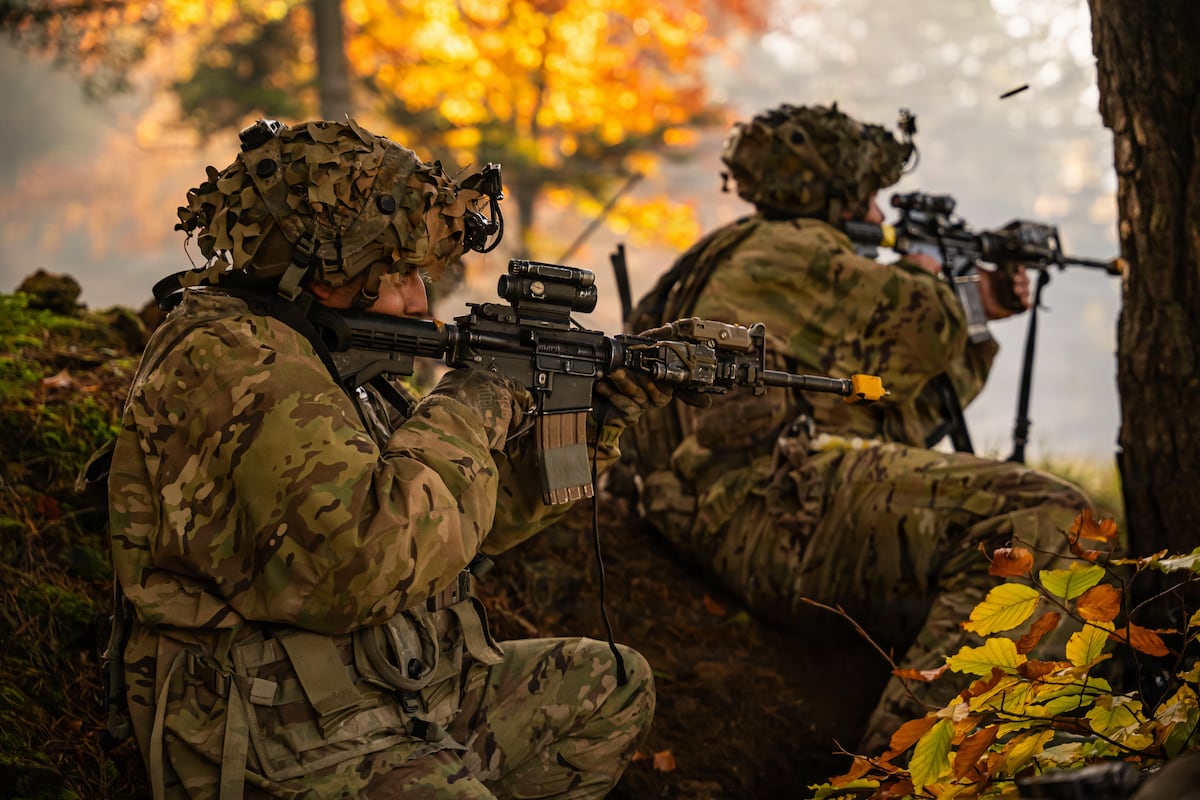
Caption: U.S. soldiers conducting combined-arms training at the Hohenfels Training Area, October 2025 | Credits: Sgt. Christian Aquino/US Army
Regional and Alliance-Level Implications
A significant reduction of U.S. forces in Germany would ripple across NATO’s deterrence posture, European security calculations, and operational readiness. Forward-deployed American units contribute to signaling: their presence assures allies, complicates an adversary’s strategic calculus, and shortens reinforcement timelines. Removing or shrinking that presence risks diminishing visible commitment and could encourage probing by revisionist states, particularly given recent Russian behavior in the neighborhood and the precedent effects such moves would have on allied decision-making.
Operationally, a withdrawal would degrade unique training access—large training areas and permanent opposition forces are finite resources—and force a shift to either more expensive contingency deployments or a heavier reliance on partner-hosted exercises that may not match Hohenfels’ scale or frequency. Training dividends from near-term operational lessons (notably counter-drone and electronic-warfare tactics derived from Ukraine) could be harder to institutionalize without a dedicated, persistent platform for experimentation. Politically, unpredictability in U.S. force posture complicates burden-sharing negotiations: allies may be pushed to increase capabilities and readiness rapidly, but divergent national capacities and political will create an uneven transition and may leave shortfalls in critical areas such as long-range strike, air defense, and logistics staging—concerns already voiced by some European defense ministers.
Strategically, the optics of a drawdown would interact with domestic U.S. politics and alliance cohesion: while rotational models and expeditionary forces can mitigate some risks, they cannot fully replicate the deterrent and diplomatic value of a visible, permanent footprint. To preserve NATO credibility and operational effectiveness, policy choices should balance cost and political objectives against the asymmetric value of forward-based training, deterrence, and interoperability. Transparent consultation with allies, phased adjustments rather than abrupt withdrawals, and investment in distributed basing, host-nation facilities, and interoperable capabilities would be prudent measures to limit strategic fallout while addressing domestic policy priorities.