
Project Flytrap and related Army experiments have pushed U.S. ground forces to treat drone swarms not as an abstract threat but as an operational fact of modern combat: units must integrate acoustic and visual detection, electronic warfare, rapid manufacturing fixes and new standards into everyday tactics to survive and prevail against massed unmanned attacks.
Operational Summary: Training for Drone-Swarm Warfare
Over recent exercises in Europe, U.S. forces and partners concentrated on the mechanics of fighting in skies saturated by low-cost, mass-produced unmanned aerial systems. The campaign-scale training involved roughly a thousand personnel operating against and with swarms, experimenting with tens of drones simultaneously while layering jamming, counter-UAS systems and legacy aviation assets. Troops rehearsed adaptive small-unit procedures — from changing patrol patterns and lookout disciplines to learning acoustic signatures — and tested rapid logistics solutions such as on-site additive manufacturing for replacement parts. For the first time the Army incorporated unified testing standards under a cross-agency task force to harmonize data collection and acquisition decisions across multiple prototype systems, indicating a shift from ad hoc experimentation toward institutionalized procurement and doctrine development.
Historical Context: The Proliferation of Massed Unmanned Forces
The current doctrinal pivot traces to a decade-long diffusion of unmanned capabilities: advances in commercially available sensors, batteries and manufacturing techniques drove down costs and raised availability, enabling militaries and irregular actors alike to field swarm tactics at operational scales. Conflicts across Eastern Europe and the Middle East exposed how relatively inexpensive loitering munitions and coordinated swarms can impose disproportionate effects on airframes, fixed sites and maneuver formations. Those battlefield precedents accelerated bureaucratic responses — from new interagency standards to consolidated acquisition bodies — as militaries sought to close a widening gap between the pace of adversary innovation and traditional procurement timelines. The emphasis on human sensory training (teaching soldiers to listen for drones) recalls earlier transitions in small-unit doctrine when new ambient threats required simple, low-cost human adaptations alongside high-technology fixes.
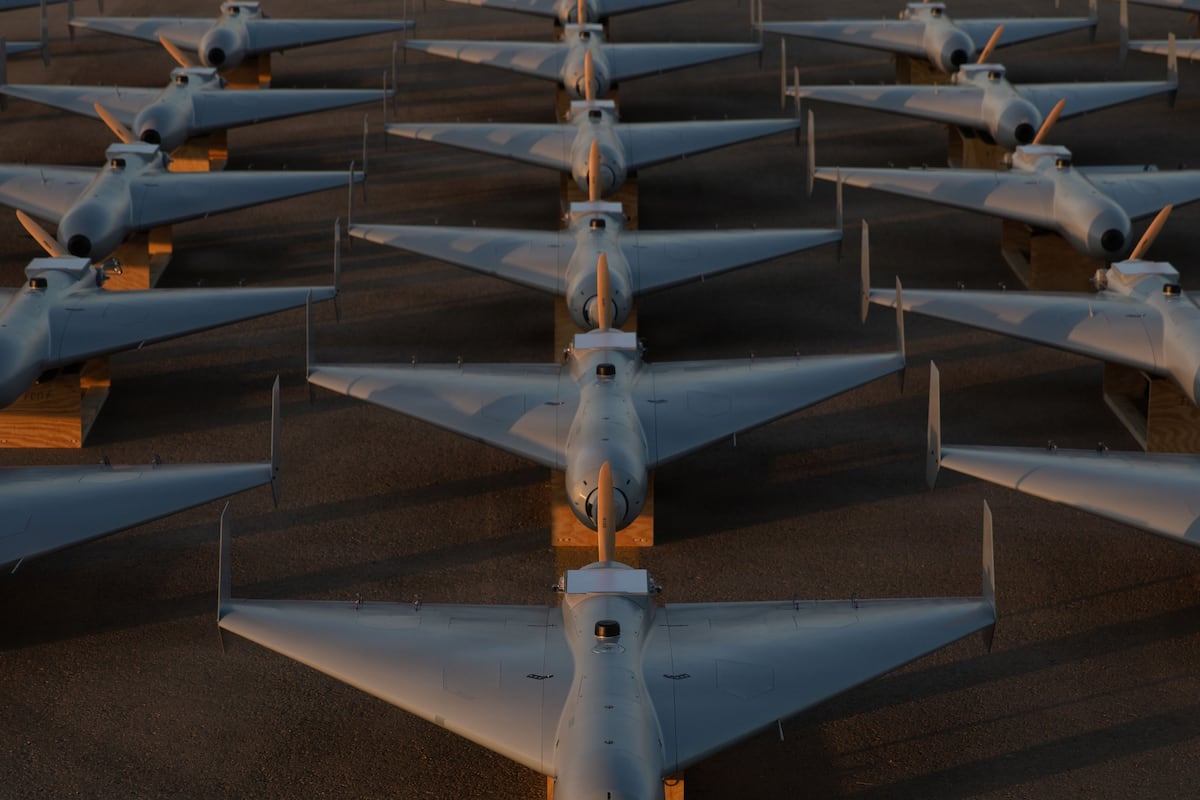
Caption: Low-cost Unmanned Combat Attack System (LUCAS) platforms staged for testing and tactics development | Credits: DOD
Geopolitical Consequences: Defense, Doctrine, and Global Stability
The operational and historical shifts carry immediate geopolitical consequences. First, allied interoperability will be tested: coalition forces must adopt common standards for detection, data-sharing and rules of engagement to operate cohesively against distributed aerial threats. Second, strategic balances may tilt as lower barriers to entry allow regional powers and proxies to project disruptive power at low cost, complicating deterrence and escalation calculus. Third, the demand for rapid acquisition, modular electronic warfare suites and resilient logistics will press defense budgets and reform initiatives; procurement authorities that can field iterative solutions quickly will gain influence. Finally, diffusion of swarm tactics makes nonproliferation and export-control policy more salient — unilateral advances in swarm employment risk accelerating reciprocal adoption by adversaries and nonstate actors. In sum, mastering counter-swarm techniques is not only a tactical necessity for protecting platforms like attack helicopters and patrol units but also a strategic imperative shaping alliance posture, industrial policy and the international rules that govern emergent unmanned warfare.